The Taj Mahal
History's most famous love letter was written in marble and took more than twenty years to finish.
By Greg Goodwin · Published October 17, 2026 · Updated October 24, 2026
Cheat Sheet
- Location: the right bank of the Yamuna River, Agra district, Uttar Pradesh, India.
- Garden: the surrounding Mughal garden covers nearly 17 hectares.
- Chief architect: Ustad Ahmad Lahori (also spelled Lahawri), according to UNESCO and Britannica.
- Facades: each of the four identical sides has a central arch 108 ft (33 m) high.
- Workforce: more than 20,000 workers over a little more than two decades.
- Pollution zone: the Taj Trapezium Zone protects 10,400 sq km around the monument.
The 60-Second Version
The Taj Mahal is a white marble mausoleum in Agra, India, built by the Mughal emperor Shah Jahan in memory of his wife Mumtaz Mahal, who died in 1631. Construction began around 1632. By UNESCO's account the tomb itself was finished in 1648, and the mosque, guest house, gateway and courtyards were completed by 1653. More than 20,000 workers took part, and craftsmen and materials came from across the Mughal Empire and well beyond it. The result is a strictly symmetrical complex of tomb, garden, mosque and gateway beside the Yamuna River, crowned by a bulbous double dome and framed by four slender minarets. It is widely regarded as the finest achievement of Indo-Islamic architecture, and it has been a UNESCO World Heritage site since 1983. Air pollution that damaged the facade has long been a concern, and steps to reduce it have been taken since the late 1990s.
The Long Version
A Tomb for an Empress
Shah Jahan ordered the monument in memory of his favorite wife, Mumtaz Mahal, who died in 1631. Britannica describes the Taj Mahal as the tomb of both Mumtaz Mahal and the emperor himself. Inside the main chamber, an octagonal room enclosed by a perforated marble screen, the visible tombs are cenotaphs; the real graves lie in the crypt below, a practice followed in imperial Mughal tombs. According to UNESCO, Mumtaz Mahal's cenotaph sits at the exact center of the chamber, while Shah Jahan's was added beside hers more than thirty years later.
The People and Materials
The plans have been attributed to several architects of the period, but the chief architect is said to have been Ustad Ahmad Lahori, an Indian of Persian descent. The calligrapher Amanat Khan al-Shirazi is among the master artisans named. Stonemasons, painters, sculptors and inlayers were gathered from across the Mughal Empire as well as Persia and Central Asia, and more than 20,000 workers were involved. White marble forms the mausoleum, but lapis lazuli, jade, turquoise, jasper and sandstone were also used, much of it brought from places such as China, Sri Lanka and Afghanistan by hundreds of elephants.
Reading the Layout
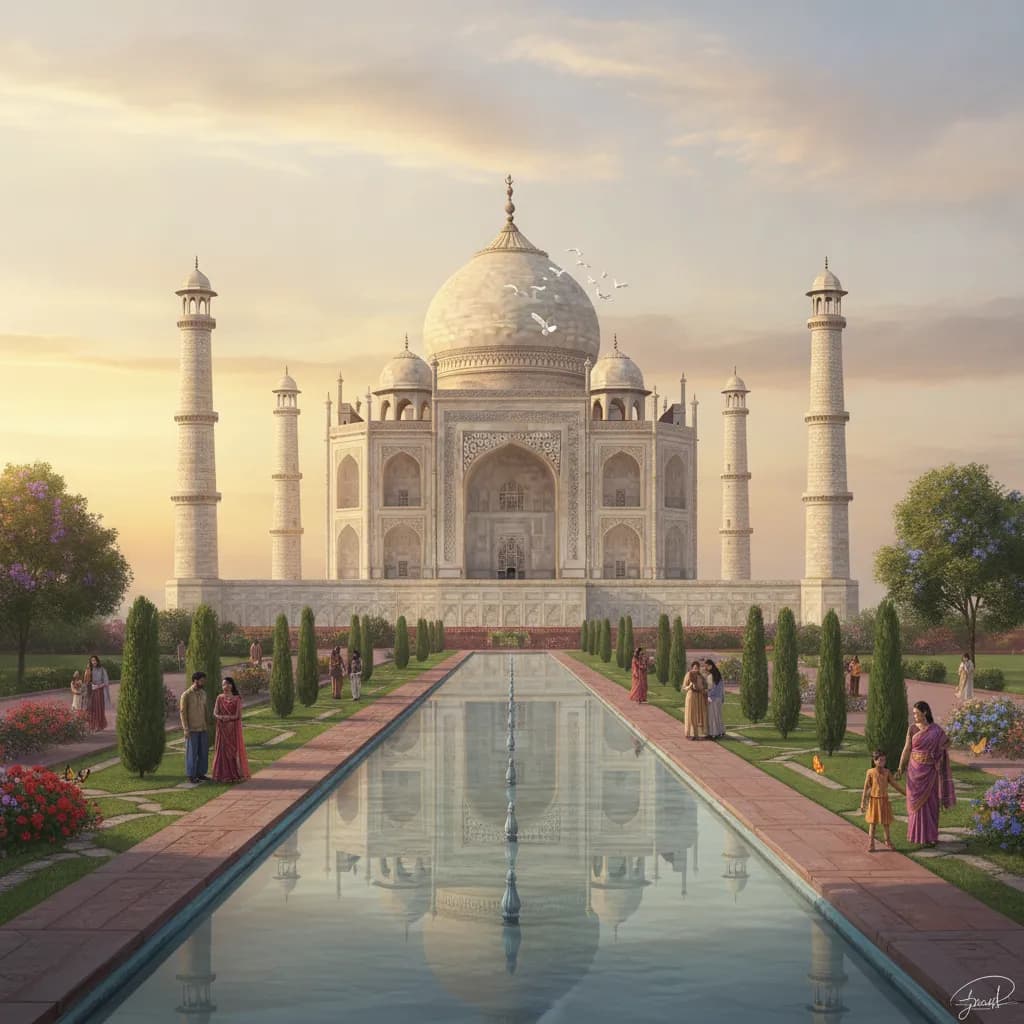
The complex is built around symmetry along a central axis. A garden of nearly 17 hectares is divided into four quarters by walkways, in the Persian walled-garden tradition. Unusually, the tomb sits at the garden's far end instead of its center, which UNESCO says adds depth and perspective to the view. The mausoleum rises on a high marble platform, with a free-standing minaret at each corner. Each of its four facades has a central arch 108 feet (33 m) high, and the red sandstone mosque on one side is matched by an identical building, the jawab, on the other.
Dates and Disagreements
Sources give slightly different timelines. UNESCO's World Heritage listing says the monument was built between 1631 and 1648, while its fuller statement says construction started in 1632 and finished in 1648, with the mosque, guest house, main gateway, outer courtyard and cloisters completed in 1653. Britannica says the complex, begun about 1632, took 22 years. These figures fit together once you separate the tomb itself from the whole complex, but you will still see 1631, 1632, 1648 and 1653 quoted, so treat any single year with some caution.
Protecting a Monument
UNESCO inscribed the Taj Mahal in 1983. The Archaeological Survey of India manages it. Britannica notes that steps have been taken since the late 1990s to reduce air pollution that damaged the facade. In December 1996 the Supreme Court of India ordered industries in the Taj Trapezium Zone to stop using coal and coke or move away. The zone covers 10,400 sq km and includes 40 protected monuments, three of them World Heritage Sites: the Taj Mahal, Agra Fort and Fatehpur Sikri. UNESCO says repairs and conservation since the British period have not compromised the monument's authenticity.
Why People Care
The Taj Mahal has become shorthand for devotion and for architectural perfection, and UNESCO calls it a universally admired masterpiece of world heritage. It is also a living lesson in conservation: keeping a fragile white marble landmark intact next to a busy modern city takes constant, deliberate effort.
Glossary
- Mausoleum
- A large building built as a tomb.
- Cenotaph
- A symbolic tomb; at the Taj Mahal the visible ones are upper-chamber markers, with the real graves in the crypt below.
- Minaret
- A slender tower; four stand at the corners of the Taj Mahal's platform.
- Jawab
- Arabic for "answer," the name for the red sandstone building that mirrors the mosque for symmetry.
- Taj Trapezium Zone
- A protected area around Agra where industrial pollution is restricted to safeguard the monument.
Go Deeper
More to Explore
- Angkor Wat
A 12th-century temple so grand that it ended up on a national flag, and so well made it outlasted the empire that built it.
- The Colosseum
Under the Colosseum's arena floor, a hidden underground network let gladiators and animals appear out of nowhere mid-show.
- Stonehenge
Stonehenge's smaller bluestones were hauled an estimated 150-plus miles from Wales, and no one has settled exactly why.
- The Pyramids of Giza
The Great Pyramid was the world's tallest man-made structure for about 3,800 years, until a medieval English cathedral topped it.
- Petra
Petra is an ancient city carved straight into rose-colored sandstone cliffs, and its famous Treasury was probably a royal tomb.