The Colosseum
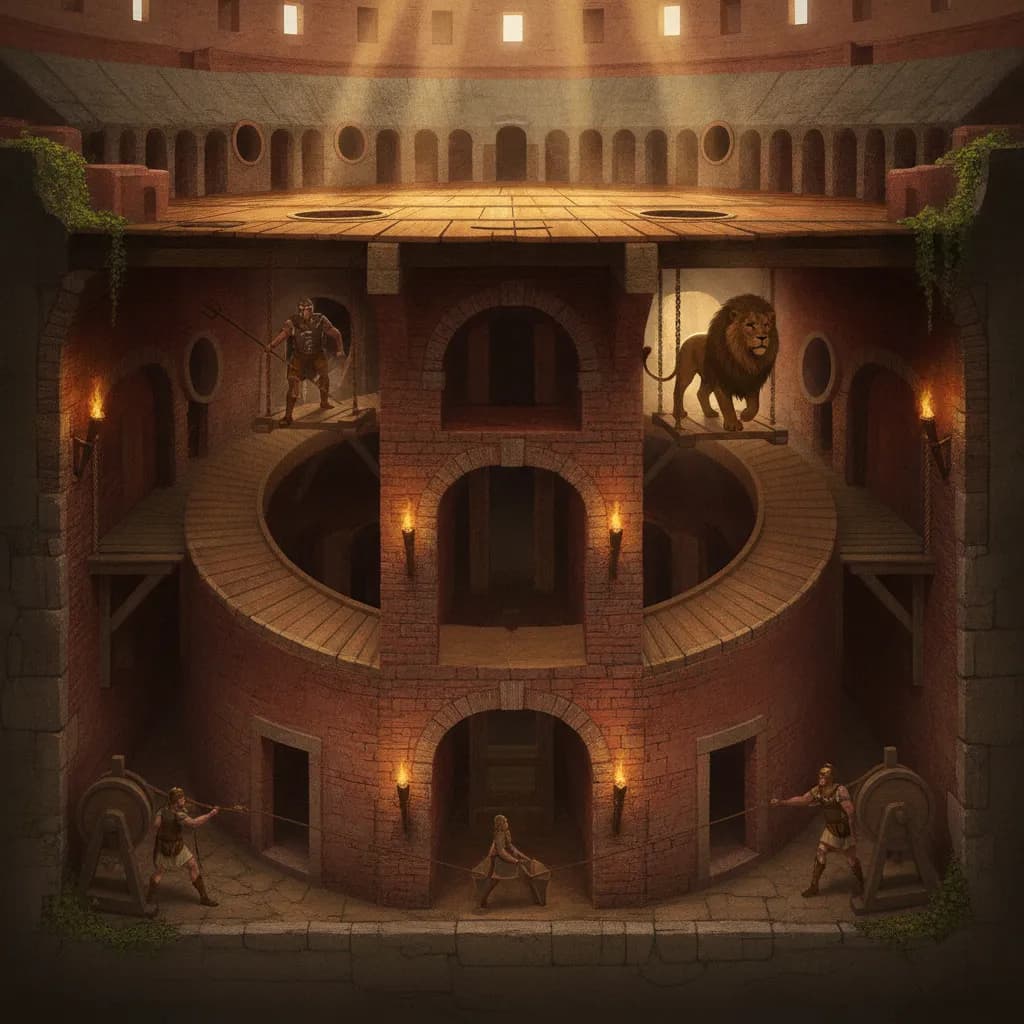
Under the Colosseum's arena floor, a hidden underground network let gladiators and animals appear out of nowhere mid-show.
By Greg Goodwin · Published October 3, 2026 · Updated October 24, 2026
Cheat Sheet
- Completed in 80 CE under Emperor Titus, after construction began under his father, Emperor Vespasian, around 72 CE.
- Could reportedly hold an estimated 50,000-80,000 spectators, making it one of the largest amphitheaters ever built in the ancient world.
- Hosted gladiatorial combats, staged animal hunts, and reportedly even mock naval battles, achieved by flooding the arena floor in its early years.
- An elaborate underground network called the hypogeum housed animals, gladiators, and stage machinery, allowing dramatic surprise entrances during events.
- The Colosseum fell into disuse and disrepair over centuries, suffering damage from earthquakes and serving at various points as housing, workshops, and even a quarry for building materials.
- Major restoration efforts beginning in the 19th and 20th centuries, and continuing today, have stabilized the structure as one of the world's most visited archaeological sites.
The 60-Second Version
The Colosseum was completed in 80 CE under Emperor Titus, after construction began roughly eight years earlier under his father, Emperor Vespasian, as part of a broader public-works building program intended partly to restore public goodwill after a turbulent period in Roman politics. The finished amphitheater could reportedly hold somewhere between 50,000 and 80,000 spectators, making it one of the largest venues of its kind ever constructed in the ancient world, a scale that still impresses engineers studying it today. Its program of public entertainment included gladiatorial combats, staged animal hunts, and, according to historical accounts, even mock naval battles achieved by flooding the arena floor during the venue's earliest years. Much of the spectacle's logistics depended on an elaborate underground network called the hypogeum, which housed animals, gladiators, and stage machinery out of sight, allowing dramatic surprise entrances to appear seemingly out of nowhere in the middle of an event. Over the centuries following the fall of the Roman Empire, the Colosseum fell into genuine disuse and disrepair, suffering damage from earthquakes and serving at various points as housing, workshops, and even a source of stone material quarried for other building projects around Rome. Major restoration efforts beginning in the 19th and 20th centuries, and continuing into the present day, have since stabilized the structure, turning it into one of the most visited archaeological sites anywhere in the world.
The Long Version
A Building Project With a Political Purpose
The Colosseum was completed in 80 CE under Emperor Titus, after construction began roughly eight years earlier under his father, Emperor Vespasian, as part of a broader public-works building program intended partly to restore public goodwill after a turbulent period in Roman politics, making the amphitheater as much a political statement as an entertainment venue.
A Scale That Still Impresses
The finished amphitheater could reportedly hold somewhere between 50,000 and 80,000 spectators, making it one of the largest venues of its kind ever constructed in the ancient world, a capacity achieved through sophisticated engineering that still genuinely impresses architects and historians studying the structure today.
Spectacle on an Enormous Scale
Its program of public entertainment included gladiatorial combats, staged animal hunts, and, according to historical accounts, even mock naval battles achieved by flooding the arena floor during the venue's earliest years, a staggering range of spectacle for a single building to accommodate.
A Hidden World Beneath the Arena Floor
Much of the spectacle's logistics depended on an elaborate underground network called the hypogeum, which housed animals, gladiators, and stage machinery out of sight, allowing dramatic surprise entrances to appear seemingly out of nowhere in the middle of an event, a level of staged theatrical complexity that wouldn't look out of place in a modern production.
From Ruin to Restored Icon
Over the centuries following the fall of the Roman Empire, the Colosseum fell into genuine disuse and disrepair, suffering damage from earthquakes and serving at various points as housing, workshops, and even a source of stone material quarried for other building projects around Rome. Major restoration efforts beginning in the 19th and 20th centuries, and continuing into the present day, have since stabilized the structure, turning it into one of the most visited archaeological sites anywhere in the world.
Why People Care
The Colosseum's combination of staggering ancient engineering and genuinely dark, violent history makes it one of the most compelling landmarks on Earth, and understanding both its original function and its long decline and restoration deepens what's otherwise just an impressive photo opportunity.
Glossary
- Hypogeum
- The Colosseum's elaborate underground network of tunnels and chambers, used to house animals, gladiators, and stage machinery.
- Emperor Vespasian
- The Roman emperor who began construction of the Colosseum around 72 CE, as part of a broader public-works building program.
- Emperor Titus
- Vespasian's son and successor, under whom the Colosseum was formally completed and opened in 80 CE.
- Naumachia
- A staged mock naval battle, reportedly performed in the Colosseum's arena during its early years by flooding the floor.
- Gladiatorial combat
- Staged fights between trained combatants, one of the Colosseum's most famous forms of public entertainment.
Go Deeper
- Archaeological Park of the Colosseum — Official Site
- The Colosseum, by Keith Hopkins and Mary Beard
More to Explore
- Angkor Wat
A 12th-century temple so grand that it ended up on a national flag, and so well made it outlasted the empire that built it.
- The Taj Mahal
History's most famous love letter was written in marble and took more than twenty years to finish.
- Stonehenge
Stonehenge's smaller bluestones were hauled an estimated 150-plus miles from Wales, and no one has settled exactly why.
- The Pyramids of Giza
The Great Pyramid was the world's tallest man-made structure for about 3,800 years, until a medieval English cathedral topped it.
- Petra
Petra is an ancient city carved straight into rose-colored sandstone cliffs, and its famous Treasury was probably a royal tomb.