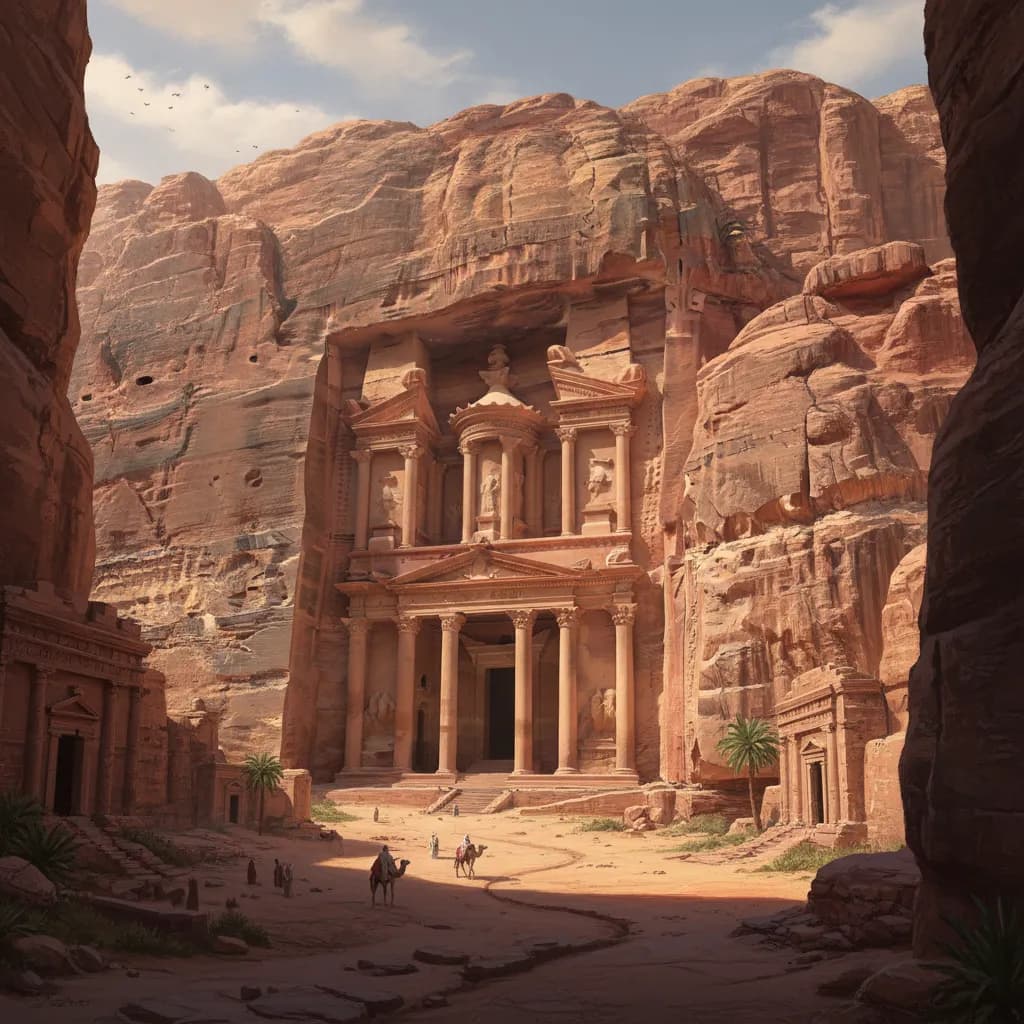
Petra
An entire ancient city, most famously its iconic Treasury facade, carved directly into solid rose-colored rock rather than built up from separately assembled stone.
Cheat Sheet
- Petra is an ancient city carved directly into rose-colored sandstone cliffs in present-day Jordan, famous for its elaborate rock-cut architecture.
- Petra was the capital of the Nabataeans, an ancient Arab trading civilization that grew wealthy controlling regional trade routes for valuable goods including incense and spices.
- The Treasury, Petra's most famous and iconic structure, is an elaborately carved facade whose true original function is believed to have been a royal tomb rather than a literal treasury.
- As-Siq, a narrow, naturally formed sandstone gorge, serves as Petra's dramatic main entrance, requiring visitors to walk through a winding rock passage before the Treasury comes into view.
- Petra's sophisticated water management system, including channels and cisterns carved into the rock, allowed the ancient city to thrive despite its arid desert surroundings.
- After centuries of decline and abandonment, Petra remained largely unknown to the Western world until it was documented by a European explorer in 1812, and today it draws visitors from around the world as one of Jordan's most significant tourist attractions.
The 60-Second Version
Petra is an ancient city carved directly into rose-colored sandstone cliffs in present-day Jordan, famous for its elaborate rock-cut architecture. Petra was the capital of the Nabataeans, an ancient Arab trading civilization that grew wealthy controlling regional trade routes for valuable goods including incense and spices. The Treasury, Petra's most famous and iconic structure, is an elaborately carved facade whose true original function is believed to have been a royal tomb rather than a literal treasury. As-Siq, a narrow, naturally formed sandstone gorge, serves as Petra's dramatic main entrance, requiring visitors to walk through a winding rock passage before the Treasury comes into view. Petra's sophisticated water management system, including channels and cisterns carved into the rock, allowed the ancient city to thrive despite its arid desert surroundings. After centuries of decline and abandonment, Petra remained largely unknown to the Western world until it was documented by a European explorer in 1812, and today it draws visitors from around the world as one of Jordan's most significant tourist attractions.
The Long Version
A Trading Capital Carved From Stone
Petra served as the capital of the Nabataeans, an ancient Arab trading civilization that grew substantially wealthy by controlling key regional trade routes carrying valuable goods including incense and spices between Arabia and the broader Mediterranean world, wealth that directly funded the elaborate rock-cut architecture the city remains famous for today.
The Treasury's Misleading Name
The Treasury, Petra's most iconic and widely photographed structure, is an elaborately carved sandstone facade whose grand, ornate design led early Western explorers to assume it once held royal treasure, giving the structure its enduring name, though archaeological evidence suggests its original function was actually as a royal tomb rather than a literal treasury.
Walking Through the Siq
Visitors traditionally approach Petra's main sites through As-Siq, a narrow, naturally formed sandstone gorge that winds for over a kilometer between towering rock walls, creating a genuinely dramatic approach that builds anticipation before the Treasury's facade suddenly comes into view at the gorge's end, an experience widely considered one of the most memorable in world travel.
Engineering Water Access in the Desert
Beyond its famous carved architecture, Petra's ancient inhabitants developed a sophisticated water management system, including channels, cisterns, and dams carved directly into the rock, allowing the city to reliably capture and store water despite its surrounding arid desert environment, an engineering achievement that was essential to sustaining Petra's population and prosperity for centuries.
Ad slot (placeholder — set NEXT_PUBLIC_ADSENSE_SLOT_ID once an ad unit is created)
Glossary
- Nabataeans
- An ancient Arab trading civilization that built Petra and grew wealthy controlling regional trade routes.
- The Treasury (Al-Khazneh)
- Petra's most famous carved facade, believed to have originally served as a royal tomb.
- As-Siq
- The narrow, naturally formed sandstone gorge serving as Petra's dramatic main entrance.
- Rock-cut architecture
- Architecture carved directly into solid rock, rather than built from separately assembled materials, as seen throughout Petra.
- UNESCO World Heritage Site
- The formal international recognition status Petra holds, reflecting its outstanding cultural and historical significance.