Angkor Wat
A 12th-century temple so grand that it ended up on a national flag, and so well made it outlasted the empire that built it.
By Greg Goodwin · Published October 24, 2026
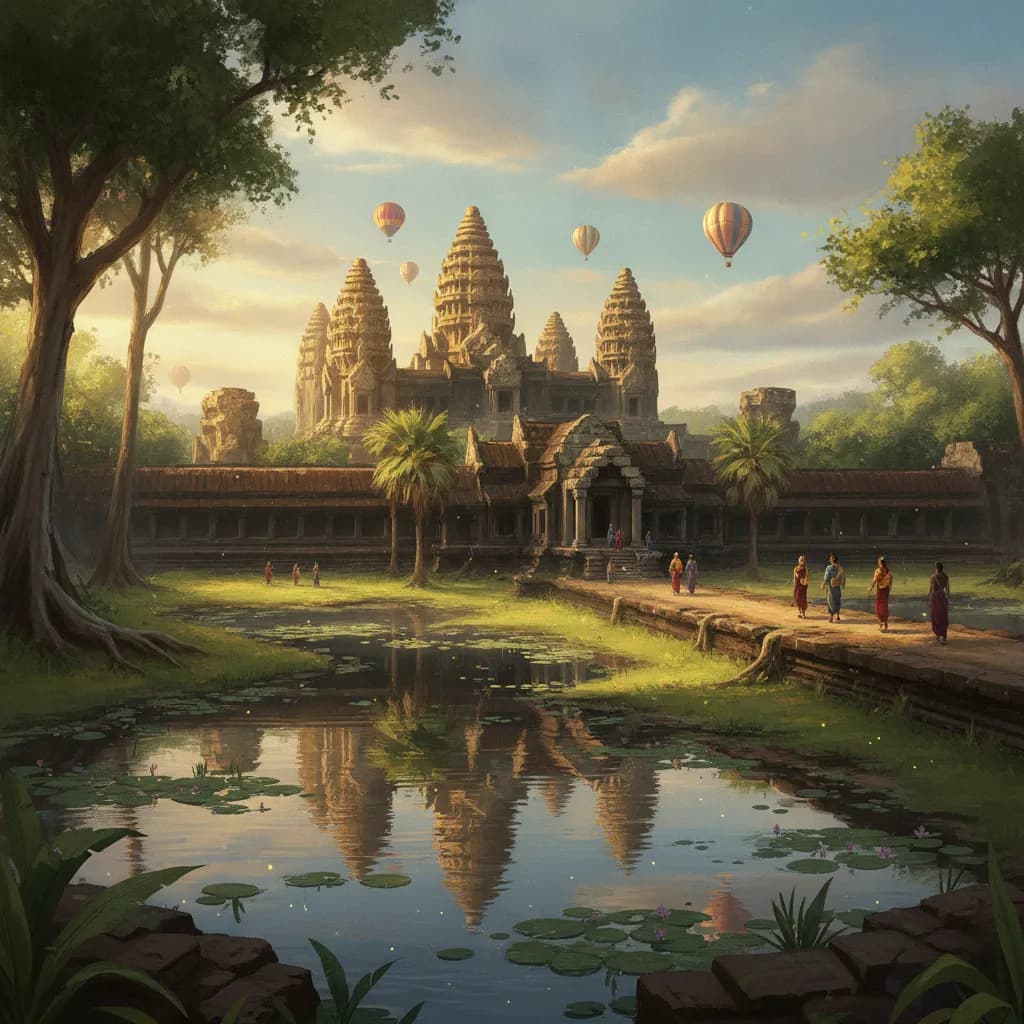
Cheat Sheet
- Builder: King Suryavarman II of the Khmer empire, who reigned 1113 to about 1150.
- Era: built in the 12th century, with construction believed to have spanned about three decades.
- Size: roughly 400 acres (160 hectares); Britannica calls it the world's largest religious structure.
- Access: a 617-foot (188-meter) bridge crosses the moat to the temple.
- UNESCO: the Angkor complex was inscribed as a World Heritage site in 1992 and removed from the Danger list in 2004.
- Symbol: Angkor Wat appears on the flag of Cambodia.
The 60-Second Version
Angkor Wat is a vast temple complex near Siem Reap, Cambodia, built in the 12th century by the Khmer king Suryavarman II. It began as a Hindu temple dedicated to Vishnu and later became a Buddhist site, and it has remained a place of worship ever since. Its design represents the cosmos: five central towers symbolize the peaks of Mount Meru, the home of the gods in Hindu belief, and a wide moat stands for the oceans at the edge of the world. Visitors cross a long causeway, pass through layered galleries, and see miles of intricate carvings of gods, battles, and scenes from the Ramayana and Mahabharata. Britannica describes it as the world's largest religious structure. It is part of the Angkor World Heritage site, listed in 1992, and it is one of Southeast Asia's most visited landmarks.
The Long Version
Who Built It and Why
Angkor Wat was built in the 12th century by King Suryavarman II, who reigned from 1113 to about 1150 over the Khmer empire. Britannica says he built it as a vast funerary temple in which his remains were to be deposited, and construction is believed to have spanned some three decades. It lay within Angkor, the royal center from which a dynasty of Khmer kings ruled one of the largest and most prosperous kingdoms in Southeast Asian history. From the end of the 9th century until early in the 13th, many construction projects were undertaken at Angkor, and this temple was the most notable.
Design and Layout
The temple is organized as a symbolic mountain. All of its original religious motifs derive from Hinduism, and it was dedicated to the god Vishnu. Five central towers represent the peaks of Mount Meru, and the enormous moat suggests the oceans surrounding the world. Visitors reach the temple over a bridge about 617 feet (188 meters) long, and the interior is entered through three galleries separated by paved walkways. Britannica gives the covered area as some 400 acres (160 hectares), while other sources cite 162.6 hectares. Moat width figures also vary by source, with NASA giving 174 meters and others near 190.
Carvings and Stories
The walls are covered with bas-relief sculptures of very high quality. They depict Hindu gods and ancient Khmer scenes as well as episodes from the Mahabharata and the Ramayana, the two great Indian epics. Reading these carved galleries is like walking through a stone picture book, which is why guides often spend the most time there. Figures, armies, and celestial dancers are rendered in a style that has become a defining image of Khmer art. Because the carvings are so extensive, estimates of their total length differ widely, and visitors are best advised to rely on the site's official guidance rather than a single number.
From Hindu Temple to Buddhist Shrine
After the Cham people of modern Vietnam sacked Angkor in 1177, King Jayavarman VII, who reigned from 1181 to about 1220, decided the Hindu gods had failed him. He built a new capital nearby, Angkor Thom, and dedicated it to Buddhism. Angkor Wat then became a Buddhist shrine, and many of its Hindu carvings and statues were replaced with Buddhist art. In the early 15th century Angkor was abandoned as a capital, but Theravada Buddhist monks continued to maintain the temple, and it remained a pilgrimage site. A Chinese envoy, Zhou Daguan, spent about a year at Angkor in 1296 and 1297, and his account is an important source on Angkor life.
Rediscovery, Restoration, and Visiting
Angkor Wat was never truly lost to the Cambodians, but European explorers brought it wide attention, including Henri Mouhot after the French colonial regime was established in 1863. Restoration programs in the 20th century were suspended during the political unrest of the 1970s, and when work resumed in the mid-1980s, extensive repairs were needed, with some sections dismantled and rebuilt. In 1992 the Angkor complex was designated a UNESCO World Heritage site and immediately placed on the list of World Heritage in Danger. It was removed from that list in 2004. Today it is one of the most important pilgrimage shrines and tourist attractions in Southeast Asia.
Why People Care
Angkor Wat shows what a medieval empire could build with stone, ritual, and storytelling, and it still serves as a living religious site and a national symbol of Cambodia. Knowing its history makes a visit, or just a photo, far more meaningful.
Glossary
- Khmer
- The main ethnic group of Cambodia and the name of the empire that built Angkor.
- Mount Meru
- The mythical mountain home of the gods in Hindu cosmology, which the central towers represent.
- Bas-relief
- Sculpture carved so the figures stand out only slightly from the flat wall behind them.
- Gallery
- A covered, colonnaded corridor, here forming the layered enclosures of the temple.
- Angkor Thom
- The walled capital built by Jayavarman VII, near Angkor Wat.
Go Deeper
More to Explore
- The Taj Mahal
History's most famous love letter was written in marble and took more than twenty years to finish.
- The Colosseum
Under the Colosseum's arena floor, a hidden underground network let gladiators and animals appear out of nowhere mid-show.
- Stonehenge
Stonehenge's smaller bluestones were hauled an estimated 150-plus miles from Wales, and no one has settled exactly why.
- The Pyramids of Giza
The Great Pyramid was the world's tallest man-made structure for about 3,800 years, until a medieval English cathedral topped it.
- Petra
Petra is an ancient city carved straight into rose-colored sandstone cliffs, and its famous Treasury was probably a royal tomb.