India
More people vote in a single Indian general election than live in nearly every other country on Earth combined.
Cheat Sheet
- Population of roughly 1.44 billion, having surpassed China in 2023 to become the world's most populous country.
- 22 officially recognized languages at the national level, with Hindi and English serving as the primary languages of national government business.
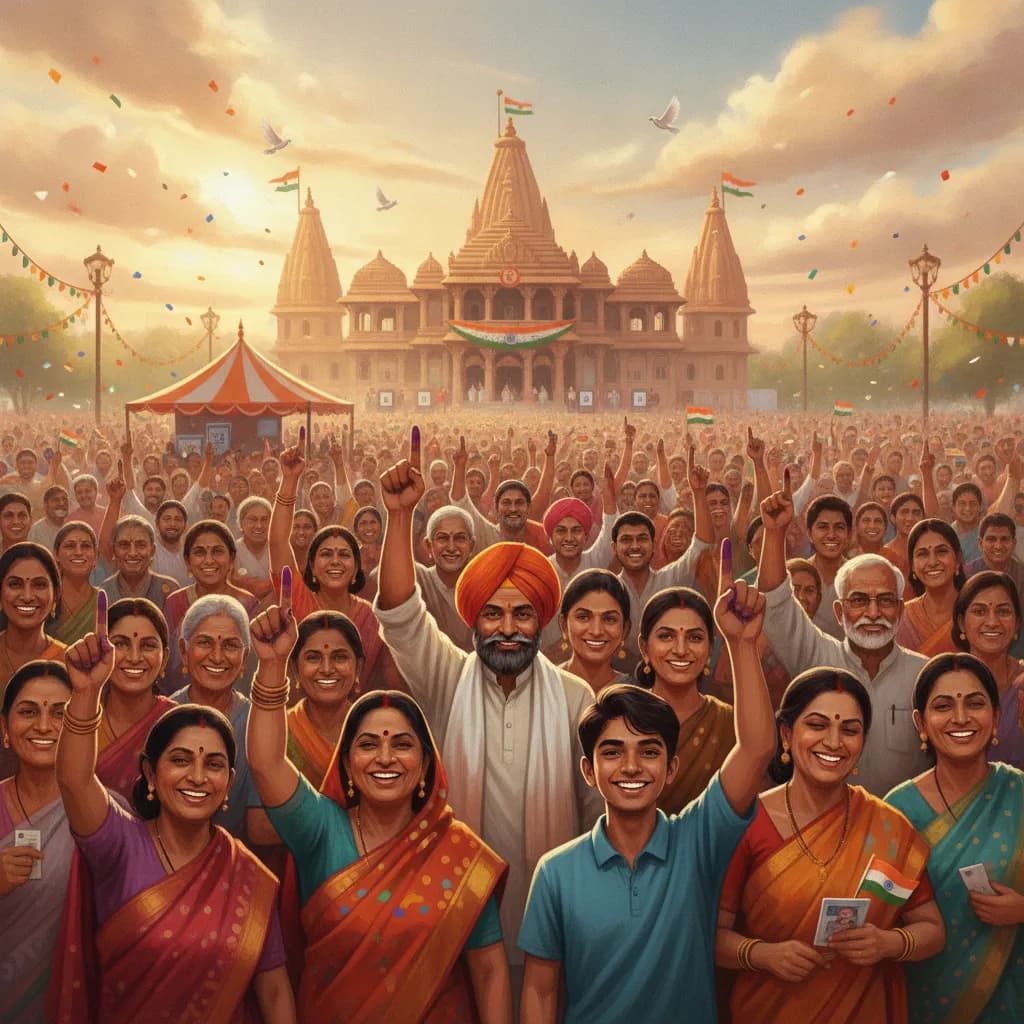
- World's largest democracy by population, holding elections with hundreds of millions of eligible voters.
- Gained independence from British colonial rule in 1947, followed shortly by the partition that created Pakistan.
- Home to major world religions' origins, including Hinduism, Buddhism, Jainism, and Sikhism.
- One of the world's fastest-growing major economies in recent years, with a large and globally significant technology and services sector.
The 60-Second Version
India occupies a genuinely singular place in the modern world, combining the largest population of any nation with a democratic system that regularly conducts elections on a scale nowhere else attempts. Centuries of trade, conquest, and cultural exchange left India as the birthplace of several of the world's major religions, and its independence from British colonial rule in 1947 arrived alongside one of the twentieth century's most consequential and traumatic partitions, splitting the subcontinent and creating Pakistan in the same stroke. In the decades since, India has built a deliberately decentralized and linguistically diverse system of government to hold together a country with dozens of officially recognized languages and enormous regional variation in culture, cuisine, and custom. More recently, India's economy has emerged as one of the fastest-growing among major nations, anchored by a globally significant technology and services sector that's reshaped both its domestic middle class and its international economic standing.
The Long Version
A Nation of Extraordinary Scale
India's population, now estimated at roughly 1.44 billion people, surpassed China's in 2023 to make it the most populous country on Earth, a scale that shapes nearly every aspect of its governance, economy, and daily life in ways smaller nations simply don't have to reckon with.
Independence and Partition
India gained independence from nearly two centuries of British colonial rule in 1947, a moment of enormous historical significance that arrived paired with the partition of the subcontinent into India and the newly created Pakistan, a division that triggered mass displacement and violence whose effects on regional politics are still felt today.
Holding Together Extraordinary Diversity
Governing a country with 22 officially recognized languages and deep regional variation required building a political system flexible enough to accommodate that diversity, and India has since become widely described as the world's largest democracy, conducting elections involving hundreds of millions of eligible voters.
A Rising Economic and Cultural Force
In recent decades, India has emerged as one of the world's fastest-growing major economies, driven substantially by a large and globally influential technology and services sector, while its cultural exports, from Bollywood films to its deep religious and philosophical traditions, continue to carry outsized global influence relative to even its enormous size.
Ad slot (placeholder — set NEXT_PUBLIC_ADSENSE_SLOT_ID once an ad unit is created)
Why People Care
As the world's most populous nation and one of its fastest-growing major economies, India's political choices, economic trajectory, and cultural influence increasingly shape global affairs, making a basic understanding of the country valuable well beyond its own borders.
Glossary
- Partition of India
- The 1947 division of British India into India and Pakistan, accompanied by mass displacement and violence.
- Lok Sabha
- The lower house of India's Parliament, whose members are directly elected by voters.
- Bollywood
- The informal name for India's Hindi-language film industry, based in Mumbai, one of the largest film industries in the world by output.
- Caste system
- A traditional Indian social hierarchy, historically rigid, that continues to shape social and political life despite legal prohibitions on discrimination.
- Non-alignment
- A foreign policy stance, historically championed by India, of not formally aligning with major world power blocs.
Go Deeper
More to Explore
- Morocco
A country where you can watch the sun set over the Atlantic in the morning and stand among Sahara sand dunes by nightfall.
- Japan
A country that runs some of the most punctual trains on Earth, down to the second, while also maintaining religious traditions that stretch back over a thousand years.
- Italy
A country that wasn't actually a single unified nation until 1861 — meaning "Italian" regional identity and dialects still run considerably deeper than many outsiders assume.
- Egypt
A country whose vast desert makes up most of its actual land area — while nearly its entire population squeezes into a narrow green ribbon along a single river.
- Biomes
A rainforest in Brazil and a rainforest in Southeast Asia can share almost no species in common, yet ecologists still classify them as the same biome.