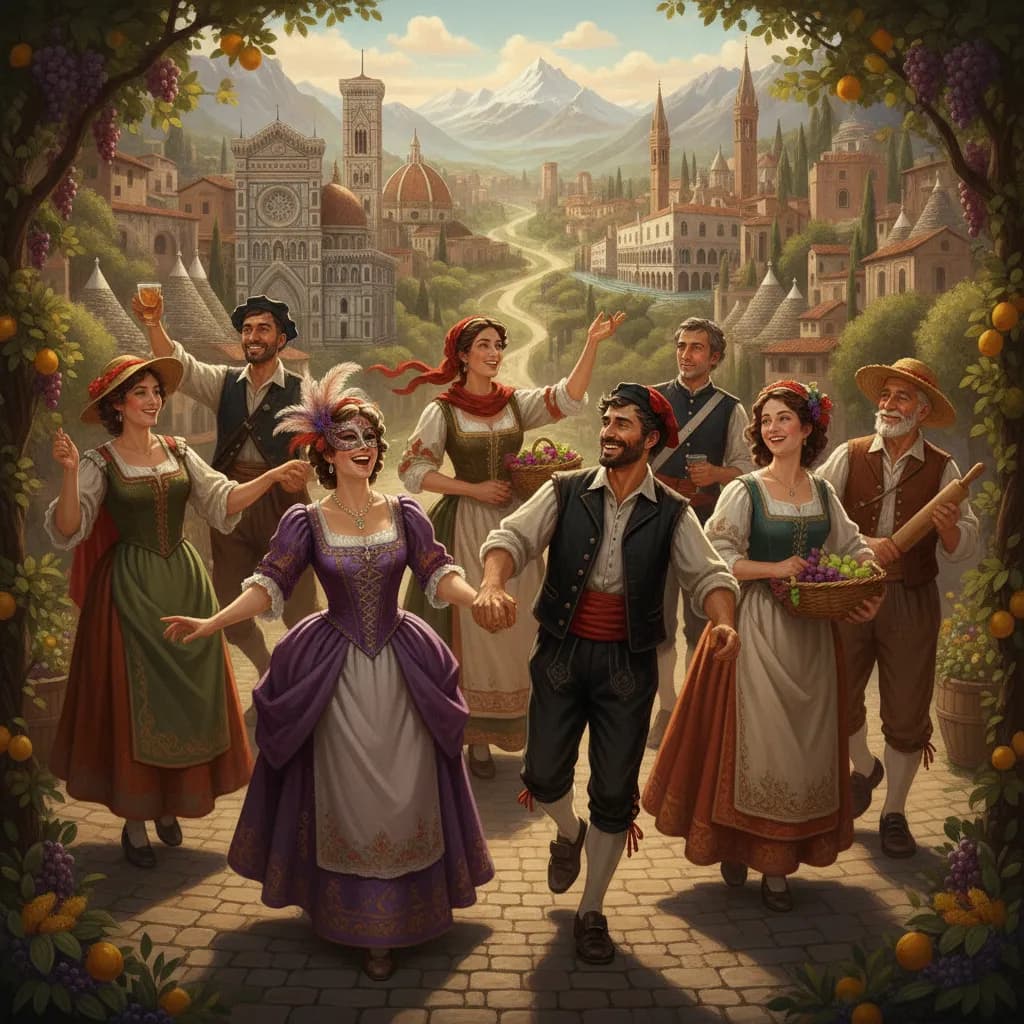
Italy
A country that wasn't actually a single unified nation until 1861 — meaning "Italian" regional identity and dialects still run considerably deeper than many outsiders assume.
Cheat Sheet
- Italy is a Southern European country shaped like a boot extending into the Mediterranean Sea, with a history stretching from ancient Rome through the Renaissance to the modern era.
- Italy has more UNESCO World Heritage Sites than any other country, reflecting its extraordinary concentration of historical, artistic, and architectural significance.
- The Renaissance, a period of extraordinary artistic and intellectual flourishing beginning in the 14th century, originated in Italian city-states like Florence before spreading across Europe.
- Italy wasn't unified into a single nation until 1861, considerably later than many other major European countries, and retains strong distinct regional identities and dialects to this day.
- Italian cuisine varies significantly by region, and dishes considered quintessentially "Italian" abroad, like specific pasta preparations, often actually originated in or are strongly associated with just one particular region.
- The Vatican City, an independent city-state and the seat of the Roman Catholic Church, is entirely surrounded by the city of Rome.
The 60-Second Version
Italy is a Southern European country shaped like a boot extending into the Mediterranean Sea, with a history stretching from ancient Rome through the Renaissance to the modern era. Italy has more UNESCO World Heritage Sites than any other country, reflecting its extraordinary concentration of historical, artistic, and architectural significance. The Renaissance, a period of extraordinary artistic and intellectual flourishing beginning in the 14th century, originated in Italian city-states like Florence before spreading across Europe. Italy wasn't unified into a single nation until 1861, considerably later than many other major European countries, and retains strong distinct regional identities and dialects to this day. Italian cuisine varies significantly by region, and dishes considered quintessentially "Italian" abroad, like specific pasta preparations, often actually originated in or are strongly associated with just one particular region. The Vatican City, an independent city-state and the seat of the Roman Catholic Church, is entirely surrounded by the city of Rome.
The Long Version
From Ancient Rome to the Renaissance
Italy's history spans an extraordinary range, from the ancient Roman Empire's foundational influence on Western law, architecture, and language, through the Renaissance, a period of extraordinary artistic and intellectual flourishing that began in Italian city-states like Florence in the 14th century before spreading across the rest of Europe, permanently reshaping European art, science, and thought.
An Unmatched Concentration of Heritage Sites
Italy holds more UNESCO World Heritage Sites than any other country in the world, a reflection of its extraordinarily dense concentration of historically, artistically, and architecturally significant locations accumulated across thousands of years of continuous civilization and cultural achievement.
A Nation Unified Surprisingly Recently
Unlike some other major European nations with longer histories of centralized statehood, Italy wasn't unified into a single country until 1861, having previously existed as a collection of separate kingdoms, city-states, and territories for centuries. This relatively recent unification helps explain why strong distinct regional identities, traditions, and dialects remain such a significant part of Italian culture today.
Regional Cuisine and an Independent State Within Rome
Italian cuisine varies considerably by region, and dishes widely considered quintessentially "Italian" internationally often actually originated in, or remain most strongly associated with, one specific region rather than the country as a whole. Separately, the Vatican City, the world's smallest independent state and the seat of the Roman Catholic Church, sits entirely enclosed within the city of Rome, a distinctive geopolitical arrangement found nowhere else in the world.
Ad slot (placeholder — set NEXT_PUBLIC_ADSENSE_SLOT_ID once an ad unit is created)
Glossary
- Renaissance
- A period of extraordinary artistic and intellectual flourishing beginning in 14th-century Italy before spreading across Europe.
- UNESCO World Heritage Site
- A landmark or area formally recognized by UNESCO for outstanding cultural or historical significance; Italy has more than any other country.
- Italian unification
- The 1861 process by which separate Italian states and territories were unified into a single nation.
- Vatican City
- An independent city-state entirely surrounded by Rome, serving as the seat of the Roman Catholic Church.
- City-state
- An independent, self-governing city, such as Renaissance-era Florence or Venice, common in pre-unification Italy.