The James Webb Space Telescope
If something breaks on the James Webb Space Telescope, there's no repair mission coming — it orbits nearly a million miles away, four times farther than the Moon.
Cheat Sheet
- Launched December 25, 2021, after decades of development and repeated schedule delays dating back to the early 2000s.
- Positioned at the Sun-Earth L2 Lagrange point, roughly 1 million miles from Earth — far too distant for any astronaut repair mission, unlike Hubble.
- Observes primarily in infrared light, allowing it to see through cosmic dust and detect extremely distant, ancient galaxies that visible-light telescopes miss.
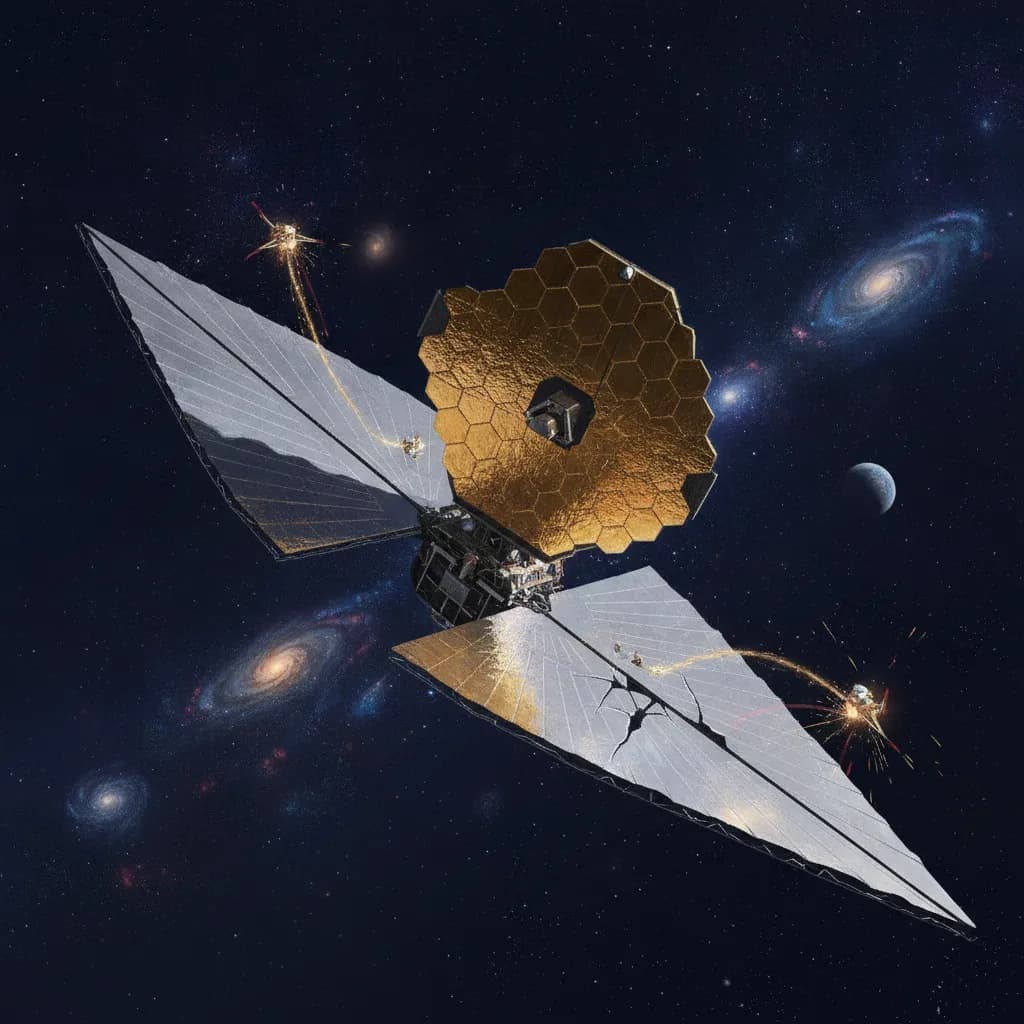
- Its primary mirror spans 21.3 feet across, built from 18 hexagonal gold-coated beryllium segments that unfolded after launch.
- Designed as a successor to (not a replacement for) the Hubble Space Telescope, observing complementary wavelengths of light.
- Final total mission cost is estimated at roughly $10 billion, making it one of the most expensive scientific instruments ever built.
The 60-Second Version
The James Webb Space Telescope finally launched on December 25, 2021, following decades of development marked by repeated delays and cost overruns dating back to the early 2000s. Unlike its famous predecessor, Webb doesn't orbit relatively close to Earth at all, instead sitting at a gravitationally stable point roughly a million miles away, a position that offers excellent observing conditions but also means no astronaut servicing mission could ever reach it if something went wrong. Its scientific specialty lies in infrared light rather than the visible-light wavelengths most earlier telescopes focused on, letting it peer through obscuring cosmic dust clouds and detect extremely distant, ancient galaxies whose light has stretched into infrared wavelengths over billions of years of travel. That capability comes from an enormous primary mirror built from 18 gold-coated hexagonal segments that had to launch folded up and then precisely unfold once safely in space, an engineering feat with essentially zero margin for error given the total lack of repair options. Rather than replacing its predecessor, Webb was designed specifically as a complementary successor, observing wavelengths of light that earlier telescopes weren't built to capture, at a total mission cost estimated around $10 billion.
The Long Version
A Launch Decades in the Making
The James Webb Space Telescope finally launched on December 25, 2021, capping off a development process that began in the early 2000s and endured repeated schedule delays and significant cost overruns along the way, making its eventual successful launch and deployment a genuine milestone after years of uncertainty about whether the mission would ever fly.
Too Far Away to Fix
Unlike its famous predecessor, which orbits relatively close to Earth and has been serviced by astronauts multiple times, Webb sits at a gravitationally stable point roughly a million miles from Earth, a position offering excellent observing conditions but also meaning that no repair mission could realistically reach it if a critical component ever failed.
Seeing Through Dust to the Edge of Time
Webb's core scientific specialty is infrared light rather than the visible wavelengths most earlier telescopes prioritized, a capability that lets it peer through obscuring clouds of cosmic dust and detect extremely distant, ancient galaxies whose original light has stretched into infrared wavelengths over billions of years of travel across the expanding universe.
An Enormous Mirror With No Room for Error
That observing power comes from an enormous primary mirror spanning over 21 feet across, built from 18 gold-coated hexagonal segments that had to launch in a tightly folded configuration and then precisely unfold once safely in space, an engineering feat that carried essentially zero margin for error given the complete absence of any repair option. Rather than replacing its predecessor outright, Webb was deliberately designed as a complementary successor, observing wavelengths its predecessor couldn't, at a total estimated mission cost of roughly $10 billion.
Ad slot (placeholder — set NEXT_PUBLIC_ADSENSE_SLOT_ID once an ad unit is created)
Why People Care
The James Webb Space Telescope has already reshaped astronomers' understanding of the early universe, and understanding both its remarkable engineering and the genuine risk built into its remote, unreachable location explains why its successful deployment was treated as such a pivotal moment in modern space exploration.
Glossary
- Lagrange point
- A location in space where the gravitational forces of two large bodies balance in a way that lets a spacecraft maintain a stable position.
- Infrared astronomy
- The study of infrared light from celestial objects, which can penetrate cosmic dust that blocks visible light.
- Primary mirror
- The main light-collecting mirror of a telescope; the James Webb Space Telescope's spans 21.3 feet across 18 segments.
- Hubble Space Telescope
- A space telescope launched in 1990 that primarily observes visible and ultraviolet light, complementary to Webb's infrared focus.
- Deployable telescope
- A telescope designed to launch in a folded configuration and unfold once in space, as Webb's mirror and sunshield did.
Go Deeper
More to Explore
- Satellites and Orbits
Every satellite currently orbiting Earth is technically falling toward the planet at every single moment — they just happen to be moving forward fast enough to keep missing it.
- The Moon Landing
The computer that guided Apollo 11 safely onto the Moon had a small fraction of the processing power of a basic modern calculator.
- The Big Bang
Not actually an explosion in space — it was the expansion of space itself, everywhere at once, starting roughly 13.8 billion years ago.
- Mars Exploration
A planet that once likely had rivers and lakes, and that a fleet of robotic rovers has spent decades methodically trying to prove it.
- Exoplanets
A category of planet that scientists can't actually see directly in most cases — instead, they detect them by watching for a star's light flickering, ever so slightly, as something passes in front of it.