How Stars Live and Die
Stars are born in cold clouds, burn on gravity-powered fusion, and go out with either a whimper or the biggest bang in the galaxy.
By Greg Goodwin · Published October 24, 2026
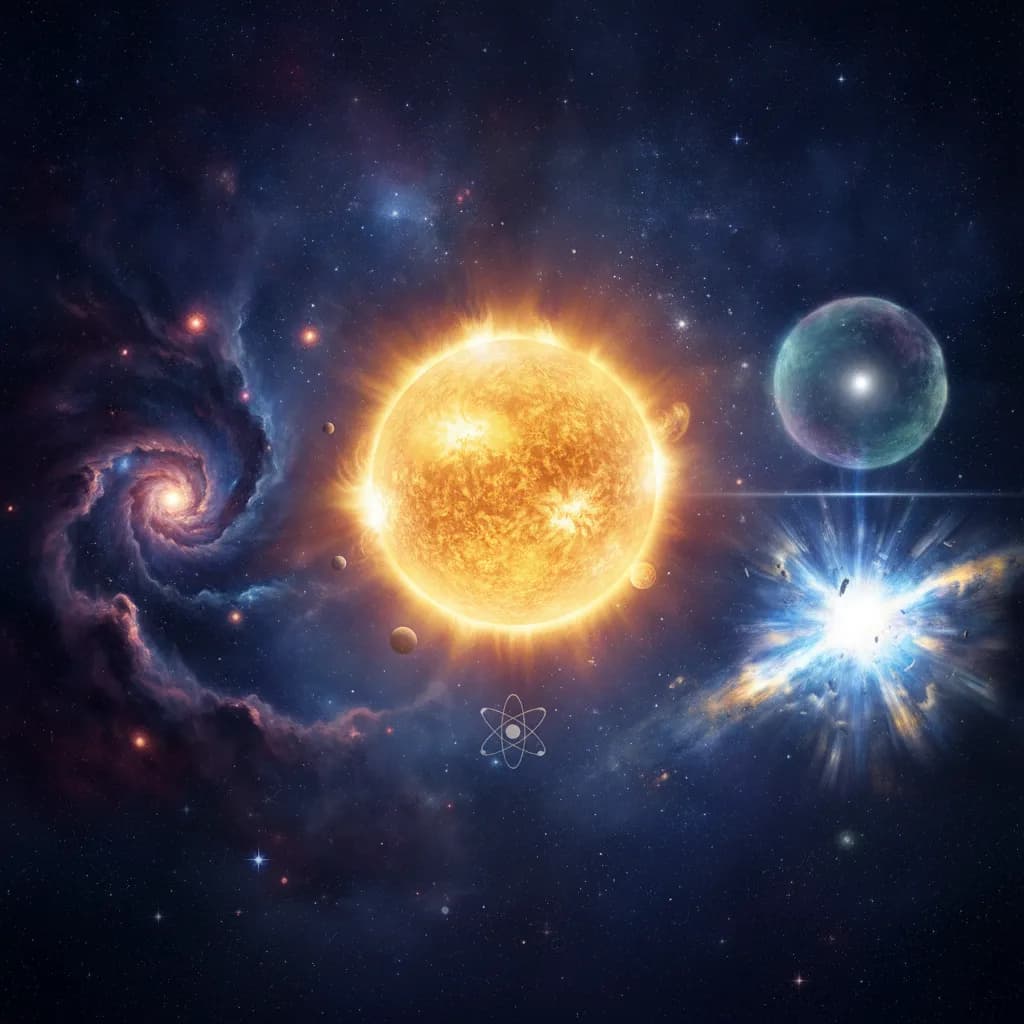
Cheat Sheet
- Molecular clouds that birth stars range from about 1,000 to 10 million times the Sun's mass, per NASA.
- The Sun's core is about 15 million degrees Celsius.
- Objects below about 0.08 solar masses cannot sustain hydrogen fusion and are called brown dwarfs.
- Red dwarfs can burn for trillions of years, far longer than the universe's roughly 13.8 billion years.
- The Chandrasekhar limit, about 1.4 solar masses, is the maximum mass of a white dwarf.
- Fusing iron absorbs energy rather than releasing it, which is why an iron core marks the end of a massive star's fuel.
The 60-Second Version
Stars are enormous balls of hot gas held together by their own gravity and powered by nuclear fusion in their cores. They are born in huge clouds of gas and dust called molecular clouds, where clumps collapse into protostars. Once a core is hot and dense enough to fuse hydrogen into helium, the star settles into the main sequence, the longest stage of its life. Our Sun, about 4.6 billion years old, has roughly 5 billion more years of hydrogen fusion ahead. How a star ends depends on its mass. Sun-like stars swell into red giants, shed their outer layers as a planetary nebula, and leave behind a white dwarf. Stars that begin with roughly eight or more times the Sun's mass fuse heavier and heavier elements until an iron core collapses, triggering a supernova and leaving a neutron star or black hole. Nearly all elements heavier than helium were made in stars.
The Long Version
Birth in the Clouds
According to NASA, stars form inside molecular clouds, vast clouds of gas and dust that range from about 1,000 to 10 million times the Sun's mass. Within a cloud, denser clumps start to collapse under their own gravity, heating as they shrink. The core of each clump becomes a protostar, which keeps pulling in material while a surrounding disk may later form planets. If a collapsing object ends up below about 0.08 solar masses, its core never gets hot enough to fuse ordinary hydrogen, and it becomes a brown dwarf instead of a true star.
The Long Middle: Main Sequence
When the core gets hot and dense enough for hydrogen to fuse into helium, the star reaches the main sequence, which NASA describes as the longest phase of a star's life. During this phase, energy from fusion pushes outward while gravity pulls inward, and the two balance. The Sun's core is about 15 million degrees Celsius. Mass sets the pace: massive stars burn through fuel in millions of years, while small red dwarfs can last for trillions of years, much longer than the universe's roughly 13.8 billion years so far. The Sun is about 4.6 billion years old, with roughly 5 billion years of hydrogen burning left.
How Sun-Like Stars End
When hydrogen in the core runs low, the core contracts and heats up while the outer layers swell, turning a Sun-like star into a red giant. Eventually it sheds its outer layers as a planetary nebula, a glowing shell with nothing to do with planets despite the name. The exposed core remains as a white dwarf, a dense, Earth-sized ember that slowly cools. White dwarfs cannot exceed about 1.4 solar masses, the Chandrasekhar limit. Earth's habitability will end well before the Sun becomes a red giant, since the Sun gradually brightens over time.
How Massive Stars End
Stars beginning with about eight or more times the Sun's mass follow a more dramatic path. They fuse successively heavier elements in nested shells until the core is iron. Fusing iron absorbs energy instead of releasing it, so the core runs out of support and collapses within moments, triggering a supernova. What remains is either a neutron star, an object perhaps 20 kilometers wide made of ultra-dense matter, or a black hole. Sources, including different NASA pages, give somewhat different mass cutoffs between these outcomes, with remnants of roughly 1.4 to 3 solar masses typically described as neutron stars, so the thresholds should be read as approximate.
Stardust and the Cycle
Supernovae and planetary nebulae scatter freshly made elements into space, where they mix into clouds that eventually form new stars. The hydrogen and most of the helium date from the Big Bang, but nearly everything heavier, including the carbon in your cells and the oxygen you breathe, was forged inside stars or in their deaths. Astronomers have also tied some heavy elements, such as gold, to the collisions of neutron stars. The Sun itself contains heavy elements, a sign that it formed from material enriched by earlier generations of stars.
Why People Care
The life cycle of stars explains where the atoms in your body came from and how long the Sun will keep Earth livable. It also gives context for every night-sky headline, from supernovae to black holes.
Glossary
- Main sequence
- The long, stable phase when a star fuses hydrogen into helium in its core.
- Protostar
- A young star still gathering mass and heating up, before steady hydrogen fusion begins.
- Planetary nebula
- A glowing shell of gas shed by a dying Sun-like star, named for its planet-like look in early telescopes, not for planets.
- Supernova
- The explosion that ends the life of a massive star, or of certain white dwarfs.
- Neutron star
- The ultra-dense leftover core of a collapsed massive star, only about 20 kilometers wide.
Go Deeper
More to Explore
- The James Webb Space Telescope
Webb sits roughly a million miles from Earth, so if something breaks, no repair mission is coming to the rescue.
- Satellites and Orbits
Every satellite is falling toward Earth right now; it just moves sideways fast enough to keep missing.
- The Moon Landing
The computer that guided Apollo 11 safely onto the Moon had a small fraction of the processing power of a basic modern calculator.
- The Big Bang
Not actually an explosion in space — it was the expansion of space itself, everywhere at once, starting roughly 13.8 billion years ago.
- Mars Exploration
A planet that once likely had rivers and lakes, and that a fleet of robotic rovers has spent decades methodically trying to prove it.