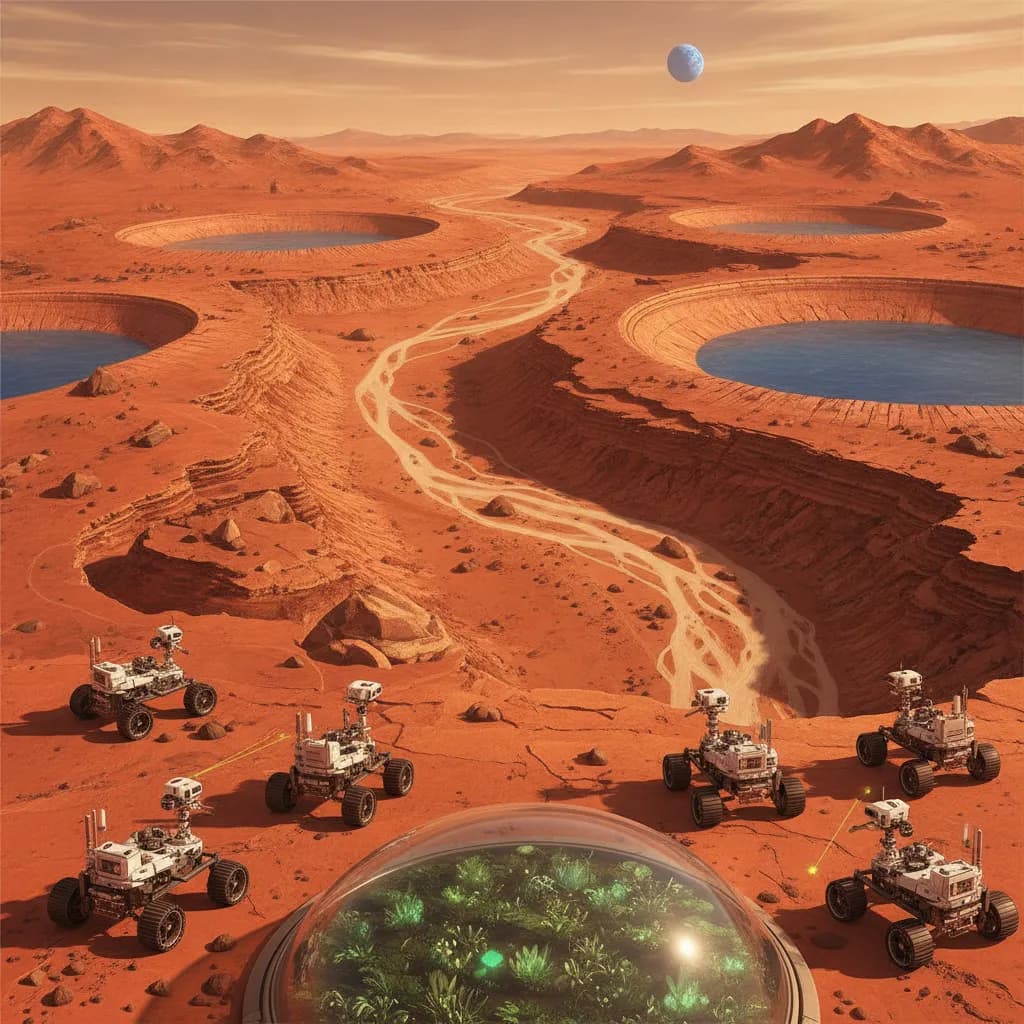
Mars Exploration
A planet that once likely had rivers and lakes, and that a fleet of robotic rovers has spent decades methodically trying to prove it.
Cheat Sheet
- Mars has been a major target of space exploration for decades, with dozens of missions launched by multiple countries, though many early attempts failed before reaching or successfully studying the planet.
- NASA's rover missions — including Spirit, Opportunity, Curiosity, and Perseverance — have provided the most detailed ground-level data about Mars's surface, geology, and history.
- Strong evidence suggests Mars once had substantial liquid water on its surface, based on ancient riverbeds, mineral deposits, and other geological features identified by orbiters and rovers.
- Mars's thin atmosphere, composed mostly of carbon dioxide, offers far less protection from radiation and temperature swings than Earth's atmosphere, a major challenge for any future human mission.
- NASA's Perseverance rover has been actively collecting and caching soil and rock samples specifically intended for a future sample-return mission to bring physical Mars material back to Earth.
- Multiple space agencies and private companies have stated ambitions for eventual crewed missions to Mars, though enormous technical, medical, and financial challenges remain unresolved.
The 60-Second Version
Mars has been a major target of space exploration for decades, with dozens of missions launched by multiple countries, though many early attempts failed before reaching or successfully studying the planet. NASA's rover missions, including Spirit, Opportunity, Curiosity, and Perseverance, have provided the most detailed ground-level data about Mars's surface, geology, and history. Strong evidence suggests Mars once had substantial liquid water on its surface, based on ancient riverbeds, mineral deposits, and other geological features identified by orbiters and rovers. Mars's thin atmosphere, composed mostly of carbon dioxide, offers far less protection from radiation and temperature swings than Earth's atmosphere, a major challenge for any future human mission. NASA's Perseverance rover has been actively collecting and caching soil and rock samples specifically intended for a future sample-return mission to bring physical Mars material back to Earth. Multiple space agencies and private companies have stated ambitions for eventual crewed missions to Mars, though enormous technical, medical, and financial challenges remain unresolved.
The Long Version
Decades of Missions, Many Failures Along the Way
Mars exploration has a long, mixed history, with dozens of missions attempted by the US, Soviet Union/Russia, Europe, India, China, and other space programs since the early 1960s. A significant share of early missions failed outright, whether due to launch failures, navigation errors, or lost communication, reflecting just how technically demanding successfully reaching and operating on Mars actually is.
What the Rovers Have Actually Found
NASA's series of rovers, Spirit and Opportunity beginning in 2004, Curiosity in 2012, and Perseverance in 2021, have dramatically expanded scientific understanding of Mars's surface geology, climate history, and potential past habitability, using onboard instruments to analyze rock and soil composition directly on the Martian surface rather than relying solely on orbital observation.
Evidence for Ancient Water
Multiple independent lines of evidence, ancient dried riverbeds and lake basins visible from orbit, specific mineral deposits that typically only form in the presence of liquid water, and rock formations studied directly by rovers, together strongly suggest Mars once had substantial surface water, raising serious scientific interest in whether the planet could have supported microbial life at some point in its distant past.
The Long Road Toward Sending Humans
Mars's thin, mostly carbon dioxide atmosphere provides far less protection against radiation and extreme temperature swings than Earth's atmosphere, posing serious unresolved challenges for any future crewed mission, alongside the sheer duration and distance of the journey itself. Despite these obstacles, NASA, other national space agencies, and private companies have all articulated long-term ambitions toward eventual human Mars missions, even as realistic timelines remain a subject of ongoing debate.
Ad slot (placeholder — set NEXT_PUBLIC_ADSENSE_SLOT_ID once an ad unit is created)
Glossary
- Rover
- A robotic vehicle designed to travel across a planetary surface, like NASA's Mars rovers, collecting data and samples.
- Orbiter
- A spacecraft designed to circle a planet, studying it from orbit rather than landing on the surface.
- Sample-return mission
- A mission specifically designed to physically bring collected extraterrestrial material back to Earth for study.
- Perseverance
- NASA's Mars rover, launched in 2020, tasked partly with caching samples for a future return mission.
- Habitable zone
- The range of distance from a star where conditions could theoretically support liquid water on a planet's surface.