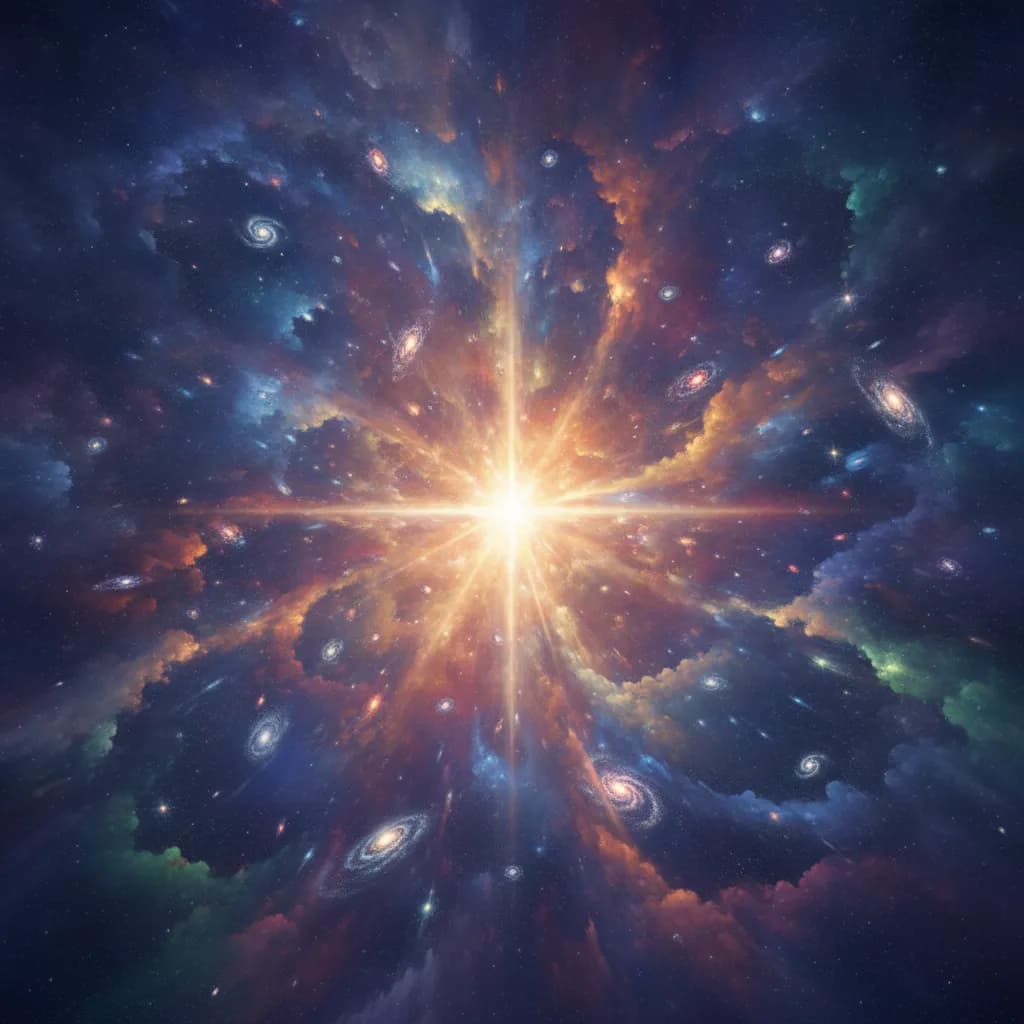
The Big Bang
Not actually an explosion in space — it was the expansion of space itself, everywhere at once, starting roughly 13.8 billion years ago.
Cheat Sheet
- The Big Bang theory describes the origin of the universe roughly 13.8 billion years ago, expanding rapidly from an extremely hot, dense initial state.
- Despite its name, the Big Bang wasn't an explosion happening at a single point in pre-existing space — it was the expansion of space itself, everywhere at once.
- Key evidence for the Big Bang includes the cosmic microwave background radiation (a faint afterglow of the early universe detected in every direction) and the observed expansion of the universe itself.
- Edwin Hubble's observation in the 1920s that distant galaxies are moving away from us, and doing so faster the farther away they are, provided crucial early evidence for cosmic expansion.
- The universe continues expanding today, and observations suggest this expansion is actually accelerating, an effect attributed to a still poorly understood force called dark energy.
- The Big Bang theory doesn't claim to fully explain what caused the initial expansion or what, if anything, existed before it — those remain open questions at the frontier of physics.
The 60-Second Version
The Big Bang theory describes the origin of the universe roughly 13.8 billion years ago, expanding rapidly from an extremely hot, dense initial state. Despite its name, the Big Bang wasn't an explosion happening at a single point in pre-existing space — it was the expansion of space itself, everywhere at once. Key evidence for the Big Bang includes the cosmic microwave background radiation, a faint afterglow of the early universe detected in every direction, and the observed expansion of the universe itself. Edwin Hubble's observation in the 1920s that distant galaxies are moving away from us, and doing so faster the farther away they are, provided crucial early evidence for cosmic expansion. The universe continues expanding today, and observations suggest this expansion is actually accelerating, an effect attributed to a still poorly understood force called dark energy. The Big Bang theory doesn't claim to fully explain what caused the initial expansion or what, if anything, existed before it — those remain open questions at the frontier of physics.
The Long Version
What the Big Bang Actually Describes
Rather than an explosion occurring at one specific location within an already-existing empty space, the Big Bang describes space itself expanding from an extremely hot, dense initial state, with that expansion happening uniformly everywhere at once rather than radiating outward from a central point. This distinction, while subtle, is important to understanding why the concept of "before the Big Bang" doesn't straightforwardly apply the way it would to an ordinary explosion.
The Evidence: Cosmic Background Radiation and Expansion
Two major independent lines of evidence support the Big Bang theory: the cosmic microwave background, a faint, remarkably uniform radiation detectable in every direction of the sky, understood as the leftover afterglow of the universe's early hot, dense state cooling over billions of years, and the observed ongoing expansion of the universe itself, both consistent with a universe that began in a much smaller, hotter, denser condition.
Hubble's Discovery That Galaxies Are Moving Away
In the 1920s, astronomer Edwin Hubble observed that distant galaxies show a redshift, meaning their light is stretched toward longer wavelengths, and that this redshift increases with distance, indicating that farther galaxies are moving away from us faster than closer ones. This relationship, now known as Hubble's Law, provided crucial early observational evidence that the universe is expanding, directly supporting the broader Big Bang framework.
What We Still Don't Know
The Big Bang theory describes how the universe evolved from its earliest observable state onward, but it doesn't claim to fully explain what triggered that initial expansion or what, if anything, existed prior to it, questions that remain at the genuine frontier of theoretical physics. Additionally, observations showing the universe's expansion is accelerating rather than slowing down have led scientists to propose dark energy, a still poorly understood force or property of space, to account for that acceleration.
Ad slot (placeholder — set NEXT_PUBLIC_ADSENSE_SLOT_ID once an ad unit is created)
Glossary
- Cosmic microwave background
- Faint radiation detected throughout the universe, considered strong evidence of the Big Bang's early hot, dense state.
- Redshift
- The stretching of light toward longer wavelengths, used to measure how fast distant galaxies are moving away from us.
- Dark energy
- A poorly understood force believed to be causing the universe's expansion to accelerate.
- Cosmic expansion
- The ongoing increase in distance between galaxies as space itself expands.
- Edwin Hubble
- The astronomer whose observations of galaxy movement provided key early evidence for the universe's expansion.