Satellites and Orbits
Every satellite currently orbiting Earth is technically falling toward the planet at every single moment — they just happen to be moving forward fast enough to keep missing it.
Cheat Sheet
- Sputnik 1, launched by the Soviet Union in 1957, was the first artificial satellite to orbit Earth.
- Geostationary orbit, roughly 22,236 miles above Earth, lets a satellite stay fixed over the same point on the ground — used heavily for communications and weather satellites.
- Low Earth orbit (LEO), generally below 1,200 miles altitude, is used by the International Space Station and most modern satellite mega-constellations.
- An orbit works because a satellite is essentially in constant freefall, moving forward fast enough that it continuously 'misses' the Earth as it falls.
- Space debris, defunct satellites and fragments left in orbit, has become a growing operational hazard for both active satellites and crewed spacecraft.
- As of the mid-2020s, tens of thousands of active satellites orbit Earth, a dramatic increase driven largely by low-cost satellite internet constellations.
The 60-Second Version
Satellites work by exploiting a surprisingly simple piece of physics: an object moving fast enough sideways while falling under gravity will continuously miss the planet it's falling toward, tracing out a stable orbit instead of crashing into the surface. That basic principle was first put into practice in 1957, when the Soviet Union launched Sputnik 1, the first artificial satellite, kicking off the space age and an intense period of competition to master orbital technology. Not all orbits serve the same purpose, which is why engineers use fundamentally different altitudes depending on a satellite's job: low Earth orbit, generally below about 1,200 miles up, hosts the International Space Station and most modern satellite constellations, while a much higher geostationary orbit lets a satellite's orbital period exactly match Earth's rotation, keeping it fixed above the same point on the ground indefinitely, ideal for communications and weather monitoring. The sheer number of satellites in orbit has exploded in recent years, driven largely by low-cost internet satellite constellations, pushing the total count of active satellites into the tens of thousands. That rapid growth has created a genuinely new operational problem in the form of space debris, defunct satellites and leftover fragments that now pose a real and growing collision hazard for both active satellites and crewed spacecraft alike.
The Long Version
The Physics Behind Staying Up There
An orbit works because an object moving fast enough sideways while falling under gravity continuously misses the planet it's falling toward, tracing a stable curved path around it rather than crashing into the surface, a deceptively simple principle underlying every satellite currently circling Earth.
The Launch That Started the Space Age
That principle was first put into practical use in 1957, when the Soviet Union launched Sputnik 1, the first artificial satellite ever placed into orbit, a moment that instantly kicked off the space age and triggered an intense period of geopolitical competition to master orbital technology.
Different Jobs, Different Altitudes
Modern satellites operate at meaningfully different altitudes depending on their specific purpose: low Earth orbit, generally below roughly 1,200 miles, hosts the International Space Station and the vast majority of today's satellite constellations, while the much higher geostationary orbit lets a satellite's orbital period exactly match Earth's own rotation, effectively keeping it fixed above the same point on the ground indefinitely, a property especially valuable for communications and weather satellites.
A Crowded, and Increasingly Cluttered, Orbit
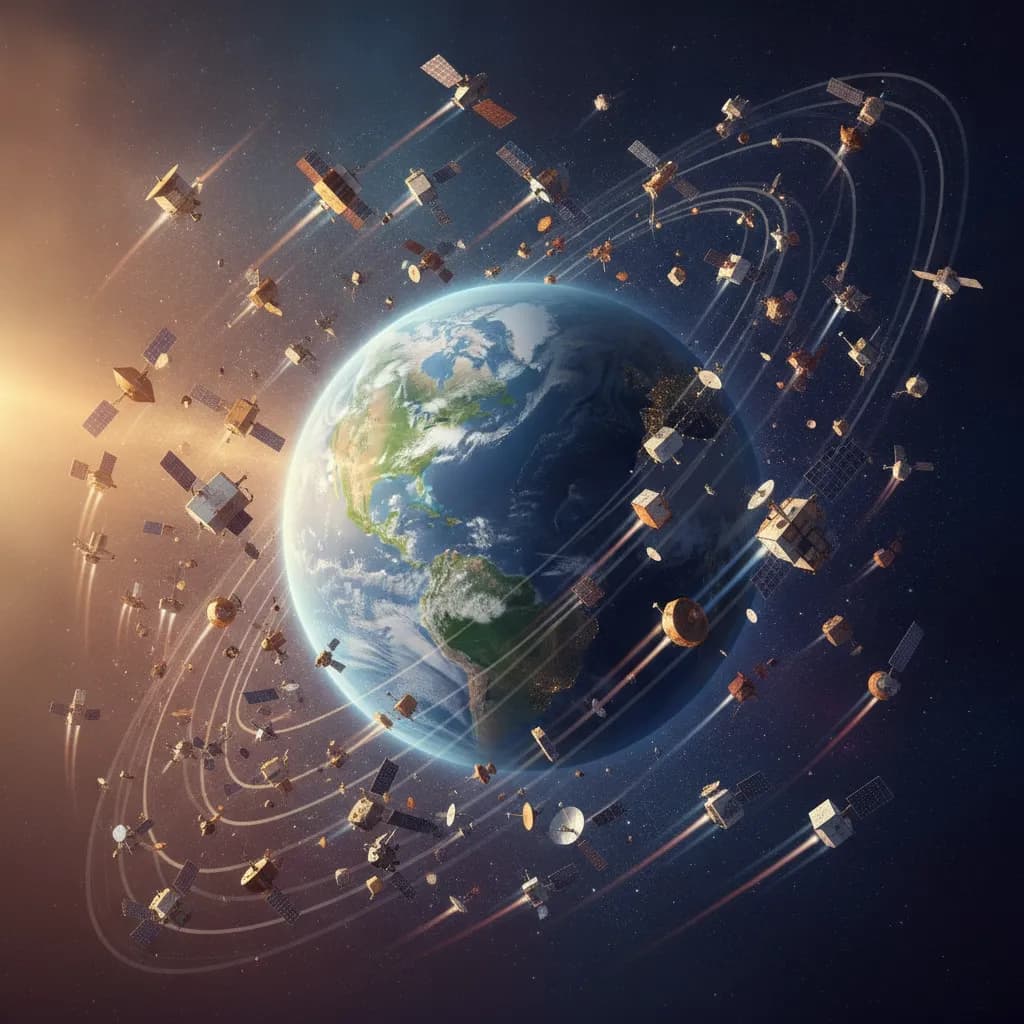
The sheer number of active satellites has grown explosively in recent years, driven substantially by the rise of low-cost satellite internet constellations, pushing the total count into the tens of thousands as of the mid-2020s. That rapid growth has created a genuinely new operational hazard in the form of space debris, defunct satellites and leftover fragments from past launches that now pose a real and growing collision risk to both active satellites and crewed spacecraft.
Ad slot (placeholder — set NEXT_PUBLIC_ADSENSE_SLOT_ID once an ad unit is created)
Why People Care
Satellites quietly underpin GPS navigation, weather forecasting, global communications, and internet access, and understanding the basic physics and growing congestion of orbital space explains both how indispensable this infrastructure has become and why space debris has emerged as a genuinely serious modern engineering concern.
Glossary
- Geostationary orbit
- An orbit roughly 22,236 miles above Earth's equator where a satellite's orbital period matches Earth's rotation, keeping it fixed over one point.
- Low Earth orbit (LEO)
- An orbital region generally below 1,200 miles altitude, used by the ISS and most modern communications satellite constellations.
- Orbital velocity
- The speed an object must travel to remain in a stable orbit, balancing gravitational pull with forward momentum.
- Space debris
- Defunct satellites, spent rocket stages, and fragments left in orbit, posing a growing collision hazard.
- Satellite constellation
- A coordinated group of satellites working together, often to provide continuous global coverage such as internet or navigation service.
Go Deeper
More to Explore
- The James Webb Space Telescope
If something breaks on the James Webb Space Telescope, there's no repair mission coming — it orbits nearly a million miles away, four times farther than the Moon.
- The Moon Landing
The computer that guided Apollo 11 safely onto the Moon had a small fraction of the processing power of a basic modern calculator.
- The Big Bang
Not actually an explosion in space — it was the expansion of space itself, everywhere at once, starting roughly 13.8 billion years ago.
- Mars Exploration
A planet that once likely had rivers and lakes, and that a fleet of robotic rovers has spent decades methodically trying to prove it.
- Exoplanets
A category of planet that scientists can't actually see directly in most cases — instead, they detect them by watching for a star's light flickering, ever so slightly, as something passes in front of it.