Hindu Mythology
One of Hindu mythology's central epics is so long that it's often described as roughly ten times the combined length of the Iliad and the Odyssey.
By Greg Goodwin · Published October 3, 2026 · Updated October 24, 2026
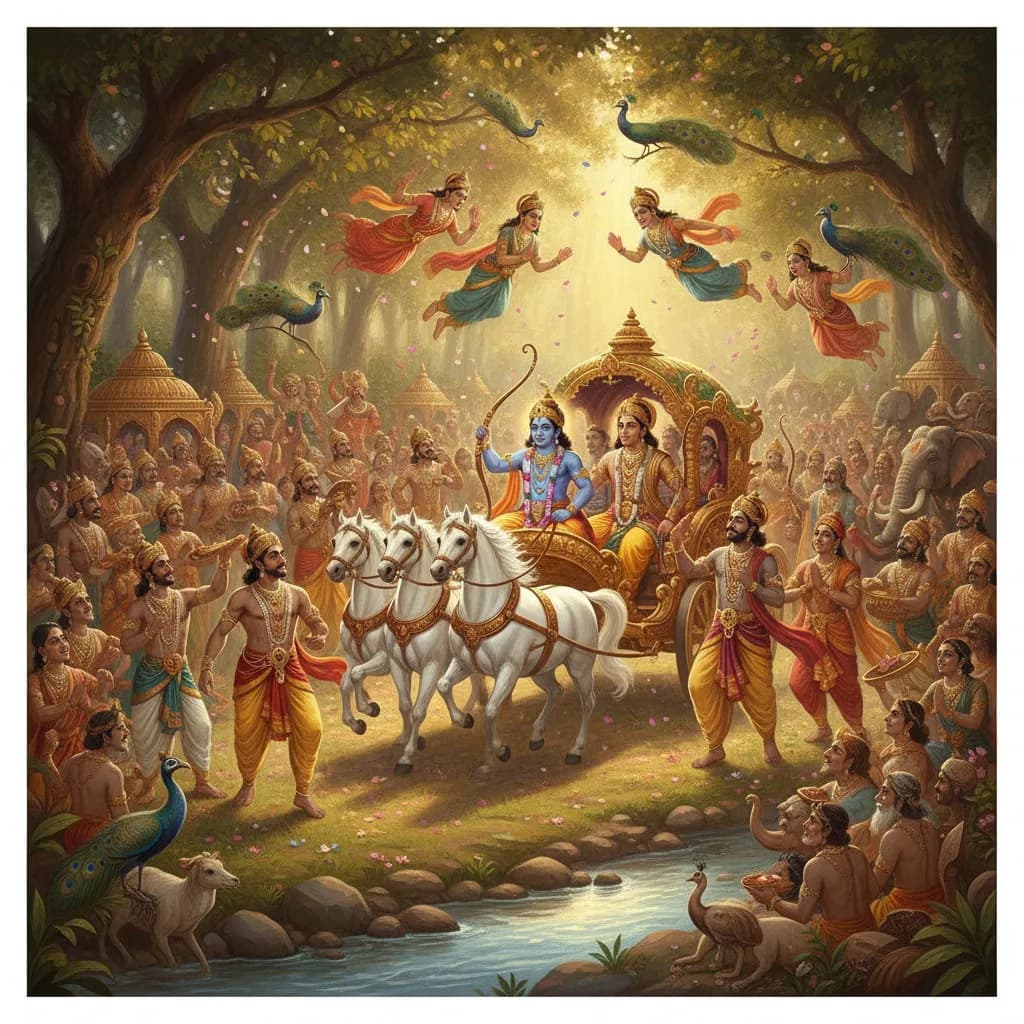
Cheat Sheet
- Hindu mythology draws on an enormous textual tradition, including the Vedas, the Puranas, and the epics Ramayana and Mahabharata.
- The Trimurti — Brahma (creator), Vishnu (preserver), and Shiva (destroyer) — represents a central organizing framework for cosmic function, though not a rigid hierarchy.
- Vishnu is said to take on avatars (earthly incarnations) during times of crisis, with Krishna and Rama among the most widely revered.
- The Mahabharata, one of the longest epic poems in world literature, contains the Bhagavad Gita, a foundational philosophical and spiritual text.
- Hindu mythology is not a single fixed canon — regional, sectarian, and historical variation means stories and emphases differ considerably across traditions.
- Many Hindu deities are depicted with multiple arms or animal associations, symbolic conventions representing divine power, multitasking, or specific attributes rather than literal anatomy.
The 60-Second Version
Hindu mythology draws on an extraordinarily vast textual tradition built up over thousands of years, spanning the ancient Vedas, the narrative Puranas, and the two great epics, the Ramayana and the Mahabharata. A central organizing framework within this tradition is the Trimurti, the triad of Brahma, Vishnu, and Shiva, representing the cosmic functions of creation, preservation, and destruction, though this isn't treated as a rigid hierarchy so much as a way of describing different aspects of divine activity. Vishnu in particular is said to take on earthly incarnations called avatars during moments of crisis or cosmic imbalance, with Krishna and Rama standing among the most widely revered of these forms across different regional and sectarian traditions. The Mahabharata, one of the longest epic poems in world literature, contains within it the Bhagavad Gita, a relatively short but enormously influential philosophical and spiritual dialogue that continues to shape Hindu thought well beyond its narrative context. It's worth understanding that Hindu mythology isn't a single fixed canon handed down unchanged, since considerable regional, sectarian, and historical variation means the same stories, and which deities receive the greatest emphasis, can differ meaningfully from one tradition to another.
The Long Version
An Enormous, Layered Textual Tradition
Hindu mythology draws on an extraordinarily vast textual tradition built up over thousands of years, spanning the ancient Vedas, the narrative Puranas, and the two great epics, the Ramayana and the Mahabharata, a scale and depth of source material that few other mythological traditions can match.
Creation, Preservation, and Destruction
A central organizing framework within this tradition is the Trimurti, the triad of Brahma, Vishnu, and Shiva, representing the cosmic functions of creation, preservation, and destruction respectively, though this isn't treated as a rigid hierarchy so much as a way of describing different, complementary aspects of divine cosmic activity.
Gods Who Walk Among Mortals
Vishnu in particular is said to take on earthly incarnations called avatars during moments of crisis or cosmic imbalance, intervening directly in the mortal world, with Krishna and Rama standing among the most widely revered of these forms across different regional and sectarian Hindu traditions.
An Epic Within an Epic
The Mahabharata, one of the longest epic poems in world literature, running many times the combined length of the Iliad and Odyssey, contains within it the Bhagavad Gita, a relatively short but enormously influential philosophical and spiritual dialogue that continues to shape Hindu thought and ethics well beyond its original narrative context.
No Single Fixed Version
It's worth understanding that Hindu mythology isn't a single fixed canon handed down unchanged across history, since considerable regional, sectarian, and historical variation means the same core stories, and which deities receive the greatest emphasis, can differ meaningfully from one tradition or community to another.
Why People Care
Hindu mythology's enormous textual scope and enduring philosophical depth have shaped religious and cultural life across South Asia and beyond for millennia, and understanding even its basic framework offers genuine insight into one of the world's oldest continuously practiced religious traditions.
Glossary
- Trimurti
- The triad of Brahma, Vishnu, and Shiva, representing creation, preservation, and destruction as cosmic functions in Hindu mythology.
- Avatar
- An earthly incarnation of a deity, particularly Vishnu, said to appear during times of crisis or cosmic imbalance.
- Mahabharata
- One of the longest epic poems in world literature, containing the Bhagavad Gita and central narratives of Hindu mythology.
- Ramayana
- A major Hindu epic recounting the story of Rama, an avatar of Vishnu, and his wife Sita.
- Puranas
- A genre of ancient Hindu texts containing myths, genealogies, and cosmological narratives supplementing the Vedas.
Go Deeper
- Encyclopaedia Britannica — Hinduism
- The Hindus: An Alternative History, by Wendy Doniger
More to Explore
- Mesoamerican Mythology
In the Maya Popol Vuh, the gods flopped at making humans from mud and wood before nailing it with corn.
- Celtic Mythology
Celtic myths were told aloud for centuries before medieval Christian scribes wrote them down, so what survives carries their fingerprints.
- Norse Mythology
A mythology where even the gods know exactly how and when the world ends — and are powerless to stop it.
- Egyptian Mythology
A belief system so focused on the afterlife that an entire elaborate industry, mummification, existed purely to prepare for it.
- Greek Mythology
A pantheon of gods who were vain, jealous, and constantly meddling in human affairs — basically reality TV with lightning bolts.