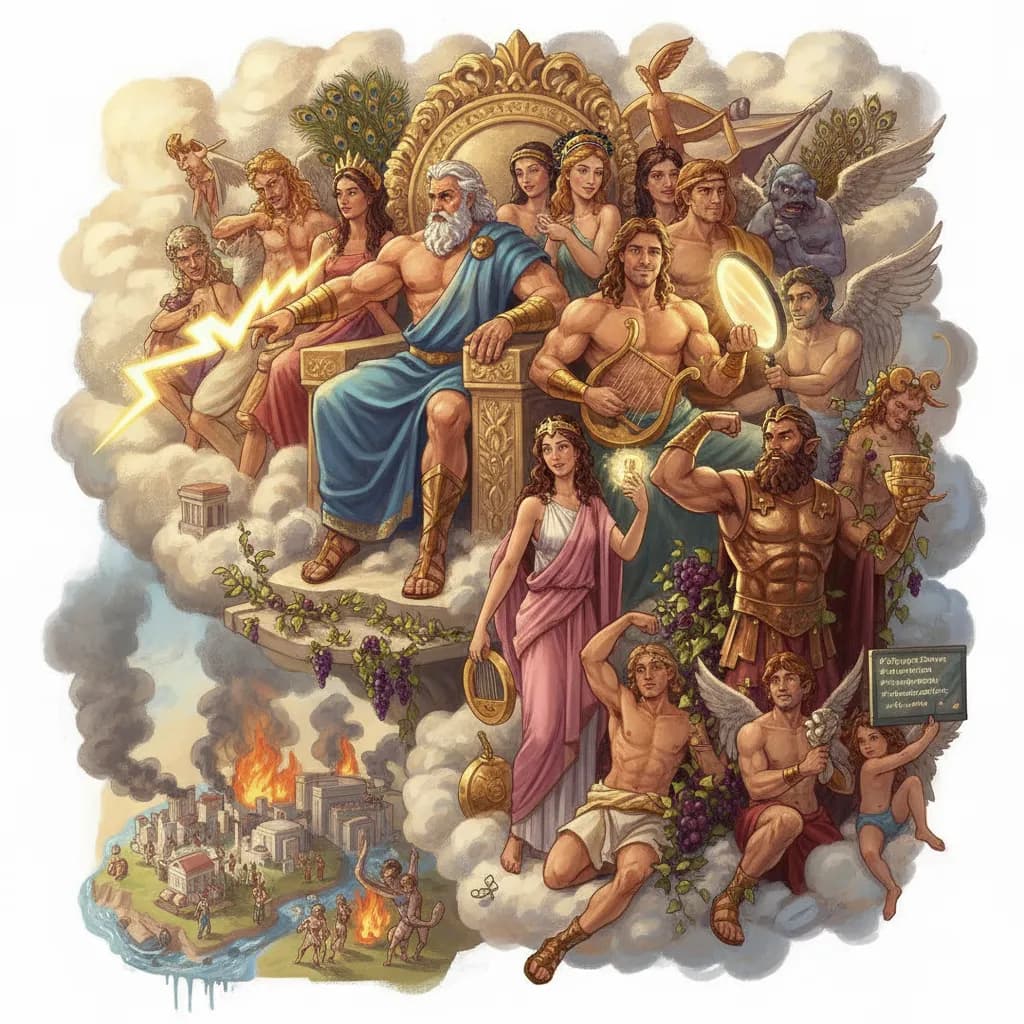
Greek Mythology
A pantheon of gods who were vain, jealous, and constantly meddling in human affairs — basically reality TV with lightning bolts.
Cheat Sheet
- The Greek gods lived on Mount Olympus and were famously not role models — jealous, petty, and prone to meddling directly in human affairs.
- The twelve major Olympians include Zeus (king of the gods), Hera, Poseidon, Athena, Apollo, Aphrodite, and Ares, among others.
- Myths served real cultural functions — explaining natural phenomena, reinforcing moral lessons, and entertaining — long before they were "just stories."
- The Trojan War, the Odyssey, and the labors of Hercules are among the most enduring and referenced myths.
- A huge amount of everyday vocabulary comes directly from Greek mythology — "narcissist," "tantalize," "herculean," and "chaos" all trace back to specific myths.
- Roman mythology largely absorbed and renamed the Greek gods (Zeus became Jupiter, Aphrodite became Venus), so the two systems overlap heavily.
The 60-Second Version
Greek mythology is the body of stories ancient Greeks used to explain the world, the gods, and human nature — centered on a pantheon of deities believed to live on Mount Olympus. Zeus ruled as king of the gods, alongside figures like Hera, Poseidon, Athena, Apollo, and Aphrodite, each governing different domains (the sea, wisdom, love, and so on) and each with very human flaws — jealousy, pride, and grudges included. These myths weren't just entertainment; they explained natural events, reinforced moral and cultural values, and shaped how Greeks understood their place in the world. Enduring stories like the Trojan War, Homer's Odyssey, and the twelve labors of Hercules have been retold for millennia, and Roman mythology later absorbed the same gods under new names (Zeus became Jupiter, Aphrodite became Venus).
The Long Version
Before the Olympians
Before the Olympians ruled, Greek myth tells of the Titans, an earlier generation of gods overthrown by Zeus and his siblings in a great, prolonged war for control of the cosmos. Prometheus, one Titan who sided with humanity rather than his fellow gods, was punished severely for stealing fire from the gods to give to people — a myth often read less as a simple morality tale and more as a story about the real cost, and value, of knowledge and progress itself.
Beyond the Twelve
Beyond the twelve Olympians, other major figures populated the wider mythology: Hades, ruler of the underworld, is technically not counted among the Olympians since he lived below the earth rather than atop Mount Olympus with his siblings, despite being one of the three most powerful gods after the overthrow of the Titans. The nine Muses, daughters of Zeus, inspired art, music, poetry, and literature, and are the direct origin of the modern English word "museum" — literally, a place devoted to the Muses.
Heroes and Their Quests
Hero myths extend well beyond Hercules's famous twelve labors. Perseus beheading the Gorgon Medusa, whose gaze turned onlookers to stone, remains one of the most retold monster-slaying stories in the entire mythology. Theseus defeating the Minotaur inside the Labyrinth on Crete combines a monster story with a clever escape using a simple ball of thread. And Jason leading the Argonauts on a long sea quest for the Golden Fleece gave Greek storytelling one of its earliest and most influential "team adventure" narratives, a structure countless later stories have echoed.
From Oral Tale to Modern Psychology
These stories were originally passed down orally for generations before ever being written down, most famously captured in Homer's epic poems the Iliad and the Odyssey, and in Hesiod's Theogony, which systematically laid out the gods' family tree and cosmic origins for the first time in writing. The myths went on to directly shape Roman religion, and much later became a foundational reference point for Renaissance art and literature across Europe. Modern psychology has also borrowed from this material directly — Carl Jung's concept of archetypes drew heavily on mythological figures as universal patterns of human experience, part of why these ancient stories still feel psychologically resonant today rather than merely historical curiosities.
Ad slot (placeholder — set NEXT_PUBLIC_ADSENSE_SLOT_ID once an ad unit is created)
Glossary
- Pantheon
- The full collection of gods recognized in a mythology or religion.
- Olympian
- One of the twelve major gods said to live on Mount Olympus.
- Hubris
- Excessive pride or defiance of the gods — a recurring cause of a mythological hero's downfall.