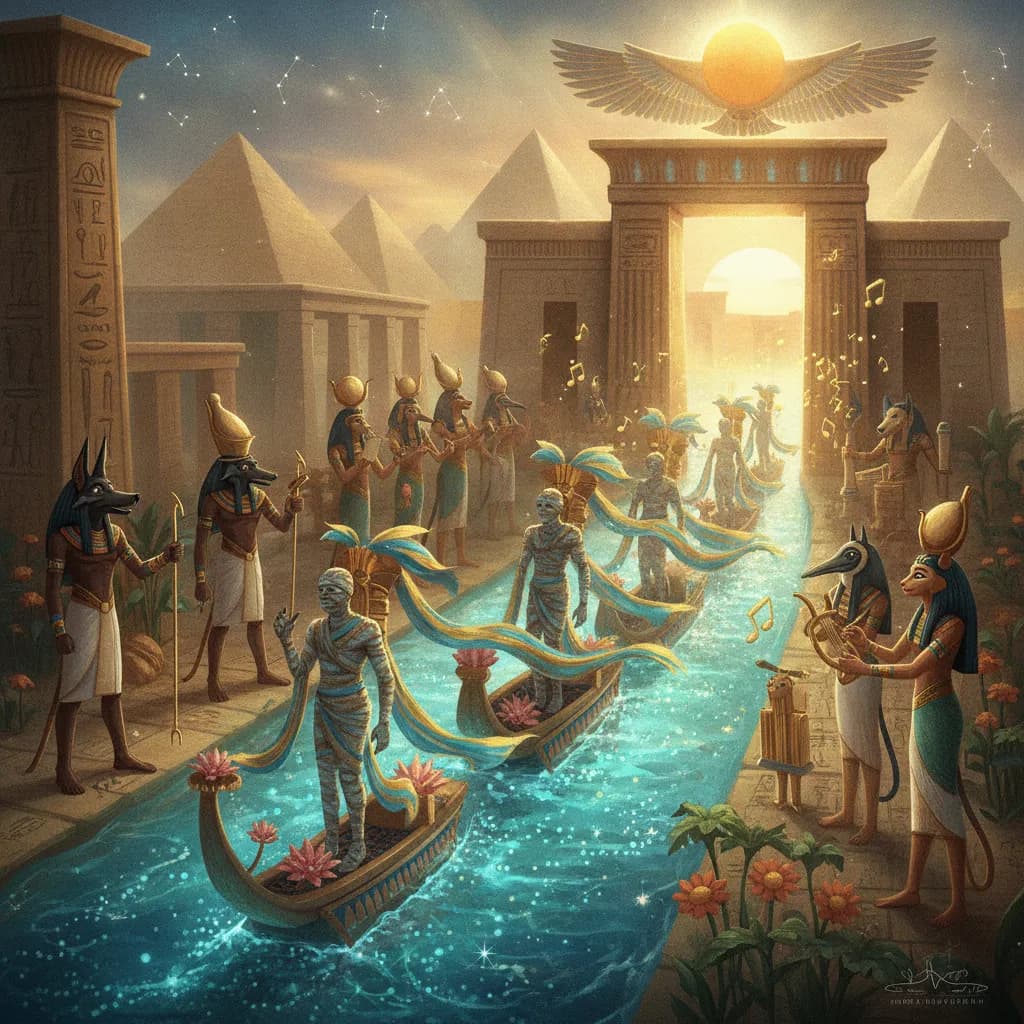
Egyptian Mythology
A belief system so focused on the afterlife that an entire elaborate industry, mummification, existed purely to prepare for it.
Cheat Sheet
- Egyptian mythology developed over roughly 3,000 years, making it one of the longest continuously evolving belief systems in human history.
- Ra, the sun god, was considered the most important deity for much of Egyptian history, believed to sail across the sky each day and through the underworld each night.
- Osiris, god of the afterlife, was murdered and dismembered by his brother Set, then resurrected by his wife Isis — a myth central to Egyptian beliefs about death and rebirth.
- The weighing of the heart ceremony determined a soul's fate after death: a heart weighed against the feather of Ma'at (truth) had to be light enough to pass into the afterlife.
- Anubis, the jackal-headed god, oversaw mummification and guided souls through the judgment process.
- Many Egyptian gods are depicted with animal heads, not because they were thought to look that way literally, but as a symbolic way of representing their specific powers and domains.
The 60-Second Version
Egyptian mythology developed continuously over roughly 3,000 years, making it one of the longest-running belief systems in human history, with gods and their relative importance shifting considerably across that vast span. Ra, the sun god, was considered the most important deity for much of Egyptian history, believed to sail across the sky by day and through the perilous underworld each night, only to be reborn again at dawn. Osiris, god of the afterlife, was murdered and dismembered by his jealous brother Set, then resurrected by his devoted wife Isis — a myth central to Egyptian beliefs about death and rebirth. After death, a soul faced the "weighing of the heart," a judgment ceremony where the heart was weighed against the feather of Ma'at, the goddess of truth and cosmic balance; a heart too heavy with wrongdoing meant the soul would not pass into the afterlife. Anubis, the jackal-headed god, oversaw mummification and guided souls through this judgment process.
The Long Version
Thousands of Years of Evolution
Egyptian mythology wasn't a fixed, unchanging system — it evolved continuously over roughly 3,000 years of ancient Egyptian civilization, with different gods rising and falling in relative importance as political power shifted between regions and dynasties. Ra, the sun god, held the most prominent position for much of this history, understood to sail across the sky in a solar barge each day and travel through the dangerous underworld each night, battling the chaos serpent Apep before being reborn at dawn — a daily cycle mirroring the Egyptians' broader preoccupation with death, renewal, and cosmic order.
Death, Judgment, and the Afterlife
The myth of Osiris sits at the center of Egyptian beliefs about death and rebirth: murdered and dismembered by his jealous brother Set, Osiris was gathered and resurrected by his wife Isis using powerful magic, becoming ruler of the afterlife rather than returning to the world of the living. This myth directly shaped Egyptian funerary practice, most visibly in the elaborate mummification process meant to preserve a body for eternity, mirroring Osiris's own preservation and rebirth. After death, a soul underwent the "weighing of the heart," a judgment ceremony in which the heart was weighed on a scale against the feather of Ma'at, goddess of truth and cosmic order; a heart burdened by wrongdoing would tip the scale and be devoured by a monstrous creature, denying the soul entry to the afterlife.
Gods with Animal Heads
Many Egyptian gods are depicted with animal heads atop human bodies, a convention meant symbolically rather than literally — the animal represented specific qualities or domains associated with that deity rather than an actual physical appearance the Egyptians believed the god possessed. Anubis, depicted with a jackal's head, oversaw mummification and guided souls through the judgment process, since jackals were associated with cemeteries in the Egyptian landscape. Horus, depicted as a falcon or falcon-headed man, represented kingship and the sky; Isis, usually shown in fully human form, represented magic and devoted motherhood; and Set, often shown with an unidentified composite animal head, represented chaos, violence, and the harsh desert.
Pharaohs and Divine Kingship
Egyptian religion and political power were deeply intertwined: the pharaoh was believed to be a living intermediary between the gods and mortal humans, often associated directly with Horus while alive and with Osiris after death, which gave Egyptian kingship a religious authority well beyond simple political rule. The Book of the Dead, a collection of spells and texts meant to guide and protect the deceased through the dangers of the afterlife journey, including the weighing of the heart, was often placed directly in tombs alongside the body, reflecting just how central successfully navigating death was to Egyptian religious life.
Ad slot (placeholder — set NEXT_PUBLIC_ADSENSE_SLOT_ID once an ad unit is created)
Glossary
- Ma'at
- The Egyptian concept of truth, balance, and cosmic order, personified as a goddess.
- Mummification
- The elaborate embalming process meant to preserve a body for the afterlife.
- Weighing of the heart
- The judgment ritual determining whether a soul could pass into the afterlife.
- Pharaoh
- Egypt's ruler, believed to be a living link between the gods and mortal humans.
- Book of the Dead
- A collection of spells and texts meant to guide the deceased safely through the afterlife.