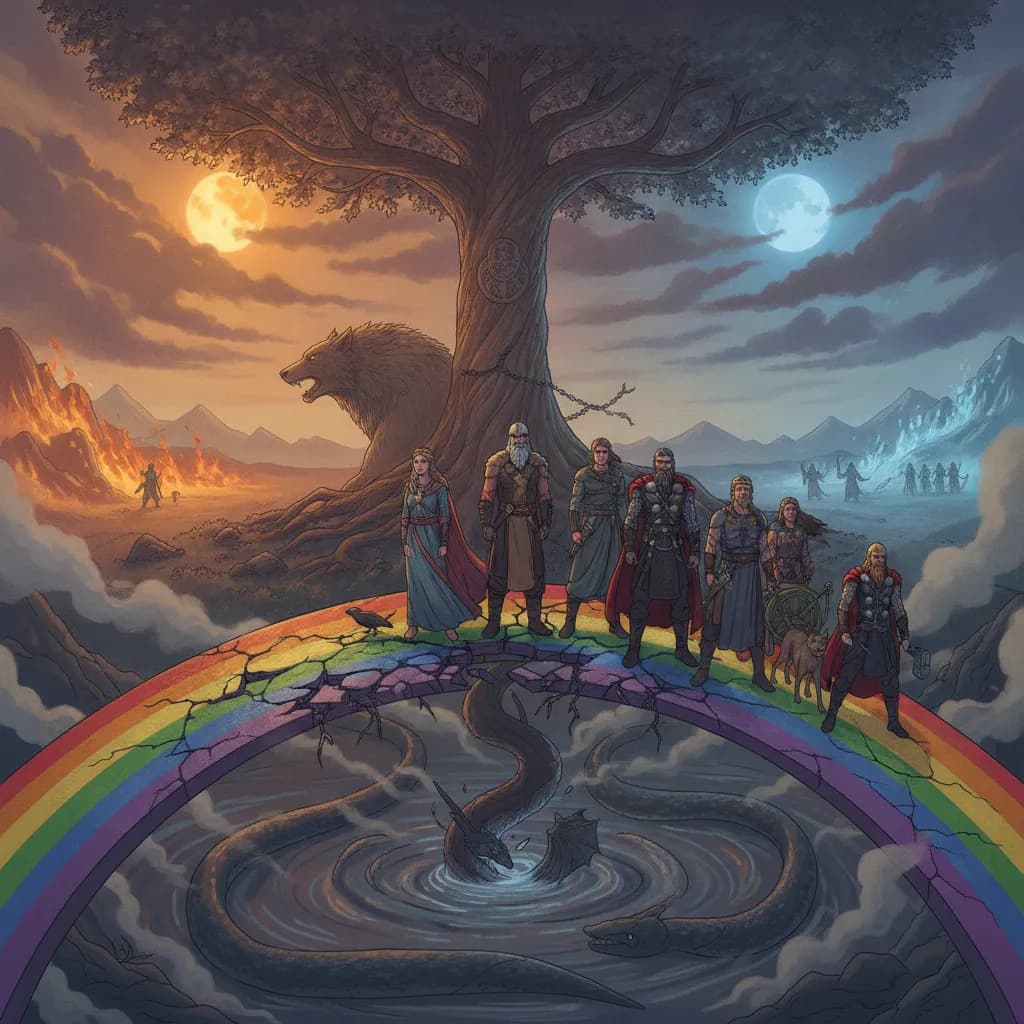
Norse Mythology
A mythology where even the gods know exactly how and when the world ends — and are powerless to stop it.
Cheat Sheet
- Norse mythology comes from Old Norse texts, primarily the Poetic Edda and Prose Edda, written down in Iceland centuries after the stories originated orally.
- Odin, the chief god, is associated with wisdom, war, and poetry — he famously sacrificed an eye for knowledge and hung himself from the world tree for nine days to gain the runes.
- Thor, god of thunder, wields the hammer Mjolnir and is the mythology's most physically powerful and popular deity.
- Ragnarök is the mythology's foretold apocalypse — a final battle where most gods, including Odin and Thor, are destined to die.
- Valhalla is the great hall where warriors who die bravely in battle are said to go, chosen by Odin's Valkyries, to prepare for Ragnarök.
- Marvel's Thor and Loki are loosely based on these myths but take substantial creative liberties — the real mythological Loki is a far stranger, more ambiguous trickster figure.
The 60-Second Version
Norse mythology comes down to us primarily through the Poetic Edda and Prose Edda, Old Norse texts written down in Iceland centuries after the stories themselves originated in oral tradition. Odin, the chief god, is associated with wisdom, war, and poetry, famously sacrificing an eye for knowledge and hanging himself from the world tree for nine days to gain the secret of the runes. Thor, god of thunder and wielder of the hammer Mjolnir, is the mythology's most physically powerful and broadly popular deity. The cosmology centers on Yggdrasil, an immense world tree connecting nine distinct realms, with Valhalla as the great hall where warriors who die bravely in battle are gathered by Odin's Valkyries to prepare for Ragnarök — the mythology's foretold apocalyptic final battle, in which most of the major gods, Odin and Thor included, are destined to die.
The Long Version
The Sources
Almost everything known about Norse mythology today comes from two Old Norse texts compiled in Iceland well after the Viking Age itself: the Poetic Edda, a collection of anonymous mythological and heroic poems, and the Prose Edda, written by the Icelandic scholar Snorri Sturluson in the 13th century as essentially a guidebook to traditional poetic techniques and the mythological references poets needed to know. Because these sources were written down centuries after Scandinavia's conversion to Christianity, by writers working within a changed religious context, scholars treat them as invaluable but imperfect windows into a much older oral tradition, filtered through later interpretation.
The Major Gods
Odin, ruler of the Aesir (the principal tribe of gods), is associated above all with wisdom, war, and poetic inspiration, and is defined by the sacrifices he makes to gain knowledge — trading an eye for wisdom at Mimir's well, and hanging himself from the world tree Yggdrasil for nine days to learn the secret of the runes. Thor, his son, wields the hammer Mjolnir and represents raw strength and the direct protection of both gods and humans against giants and chaos, making him the mythology's most broadly beloved figure. Loki, a complicated and shape-shifting trickster figure who is not straightforwardly evil but repeatedly causes chaos among the gods, and Freya, a goddess associated with love, fertility, war, and death, round out the mythology's most significant deities.
Cosmology
Norse cosmology imagines the universe organized around Yggdrasil, an immense world tree whose branches and roots connect nine distinct realms, including Asgard (home of the Aesir gods), Midgard (the realm of humans), and Jotunheim (home of the giants), among others. Valhalla, one of the halls within Asgard, is where warriors who die bravely in battle are gathered by the Valkyries, female figures who choose which fighters fall and which are brought to join Odin's forces, all in preparation for a battle everyone already knows is coming.
Ragnarök
Ragnarök is Norse mythology's prophesied apocalypse: a final, catastrophic battle in which the gods face the forces of chaos and giants, resulting in the deaths of most major deities, including Odin and Thor, followed by the world being submerged and eventually reborn anew. Unlike many mythological traditions where an apocalypse is an uncertain future threat, Ragnarök is treated as an already-known, unavoidable destiny — a fatalistic worldview that shapes much of the mythology's tone. Marvel's Thor and Loki films draw loosely on these figures and even reference Ragnarök directly, but take substantial creative liberties; the mythological Loki, for instance, is a far stranger and more genuinely ambiguous figure than his cinematic counterpart, eventually fathering monstrous children and playing a direct, antagonistic role in triggering Ragnarök itself.
Ad slot (placeholder — set NEXT_PUBLIC_ADSENSE_SLOT_ID once an ad unit is created)
Glossary
- Valhalla
- The great hall where slain warriors chosen by Odin are said to reside until Ragnarök.
- Ragnarök
- The prophesied apocalyptic battle in which many major gods are destined to die.
- Valkyrie
- A female figure who chooses which warriors die in battle and which go to Valhalla.
- Yggdrasil
- The immense world tree said to connect the nine realms of Norse cosmology.
- Aesir
- The principal tribe of gods in Norse mythology, including Odin and Thor.
Go Deeper
- The Poetic Edda (various translations)
- Norse Mythology for Smart People