The Sumerians
They invented a way to press ideas into clay, and in doing so gave history its first draft.
By Greg Goodwin · Published October 24, 2026
Cheat Sheet
- Location: southern Mesopotamia, in what is now southern Iraq, between the Tigris and Euphrates rivers.
- Language: Sumerian was non-Semitic, and cuneiform was first used to write it.
- Earliest writing: tablets from Uruk date to roughly 3400 to 3300 BCE, though sources vary by a few centuries.
- Sargon of Akkad: conquered the Sumerian city-states around 2334 BCE, a date that depends on which chronology you use.
- Third Dynasty of Ur: ruled about 2112 to 2004 BCE and marked a Sumerian revival.
- Ur-Nammu law code: dated to about 2100 to 2050 BCE and cited as the oldest surviving law code.
The 60-Second Version
The Sumerians were the people of southern Mesopotamia who built some of the world's earliest cities, including Uruk, Ur and Lagash, in what is now southern Iraq. They spoke a language unrelated to the Semitic tongues of their neighbors, and they were the first to use cuneiform, a script of wedge-shaped marks pressed into clay. Sumer was not a single country but a collection of rival city-states, each centered on a temple and a patron god, and each fighting over water, land and trade. Around 2334 BCE, Sargon of Akkad conquered the region and created a larger empire. Sumerian culture then enjoyed a revival under the Third Dynasty of Ur, before the political power of the Sumerians faded around 2000 BCE. Their writing, literature and laws were adopted by later civilizations and became part of the bedrock of Mesopotamian culture. Exact dates vary by chronology.
The Long Version
Land Between the Rivers
Sumer lay in the south of Mesopotamia, the flat plain between the Tigris and Euphrates. Rain was scarce, so farming depended on irrigation canals, and organizing that labor required cities, officials and records. Sources describe the Sumerians as the dominant group in southern Mesopotamia until about 2000 BCE. Each city-state, from Uruk to Ur to Lagash, had its own ruler and its own god, and they competed and cooperated in turn. This patchwork helps explain why Sumerian history reads as a series of rivalries rather than one smooth national story.
The Invention of Writing
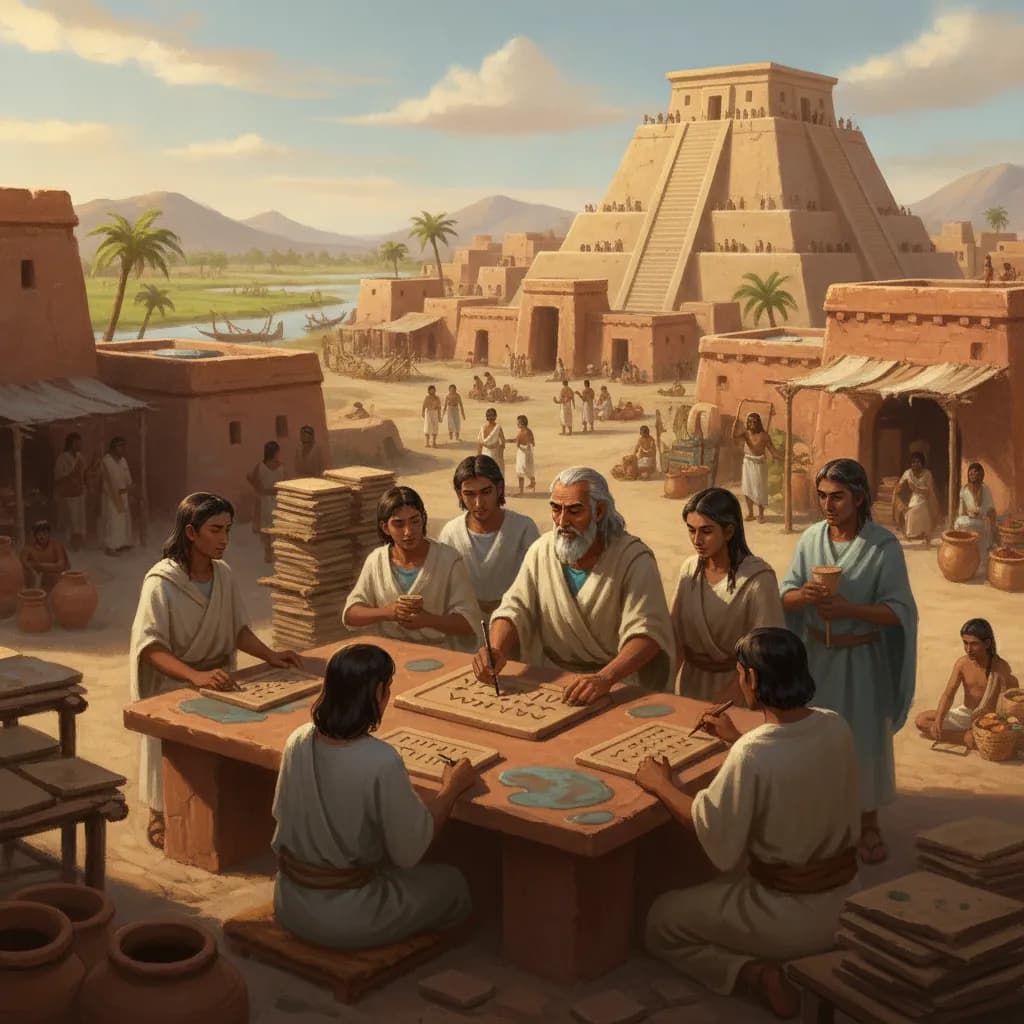
The earliest known writing in southern Mesopotamia comes from Uruk, with dates cited between roughly 3400 and 3300 BCE. A museum exhibition page describes it beginning as pictographs, and by about 2600 BCE it had developed into cuneiform. The first purpose was bookkeeping: tracking grain, livestock and labor for temple and palace economies. Over time scribes used it for letters, legal contracts, hymns and stories. Cuneiform was first used to write Sumerian, a language not related to Semitic languages, and later was adapted for many other tongues across the region.
Sargon and the Akkadians
Around 2334 BCE, Sargon of Akkad conquered the Sumerian city-states and forged what is often called the first empire. Dates for his reign differ by source, and one chronology gives 2334 to 2279 BCE. Akkadian, a Semitic language, became the language of administration, though Sumerian continued as a language of religion and learning. One famous figure of this era is Enheduanna, a daughter of Sargon who served as high priestess at Ur and is celebrated as an early named author. The Akkadian period shows that Sumerian culture could be absorbed without disappearing.
The Third Dynasty of Ur
After Akkad collapsed, Sumerian rule revived in the Third Dynasty of Ur, dated to about 2112 to 2004 BCE. The dynasty's founder Ur-Nammu is linked to the oldest surviving law code, composed around 2100 to 2050 BCE. The first copy was found in two fragments at Nippur and was translated by Samuel Kramer in 1952, and later tablets from Ur let scholars reconstruct about 30 of 57 laws. Scholars differ on whether the code was written by Ur-Nammu or by his son Shulgi. Only part of the code survives, so scholars treat its full scope with caution.
What They Left Behind
By around 2000 BCE, Sumerian political power was gone, but the culture endured. Cuneiform stayed in use for thousands of years, scribes kept copying Sumerian texts long after the language faded from daily speech, and later Mesopotamian civilizations inherited its religion, law and learning. Ziggurats, the great stepped temples, became a lasting symbol of the region. The Sumerians also gave the world a counting system with sixty as a base, which survives today in the sixty minutes of an hour. Because chronologies are revised as new evidence emerges, dates for early Sumer should always be read as approximate.
Why People Care
The Sumerians are where many of civilization's firsts begin: cities, writing, written law and recorded literature. Knowing them helps you understand where history itself starts, and why every date before 2000 BCE comes with a built-in asterisk.
Glossary
- Cuneiform
- A writing system made by pressing a wedge-shaped stylus into wet clay, used for Sumerian and many later languages.
- City-state
- An independent urban center and its surrounding farmland, such as Uruk, Ur or Lagash.
- Ziggurat
- A massive stepped temple platform characteristic of Mesopotamian cities.
- Mesopotamia
- The land between the Tigris and Euphrates rivers, home to Sumer, Akkad, Babylon and Assyria.
- Akkadian
- A Semitic language of Mesopotamia, spoken by the empire Sargon founded and eventually replacing Sumerian in daily use.
Go Deeper
More to Explore
- The Spartans
Sparta built an entire society around its army, and the cost fell heavily on the people it ruled.
- The Phoenicians
The Phoenicians never built a great land empire, yet the letters you're reading right now trace back to their merchants.
- The Minoans
Europe's first advanced civilization left us dazzling paintings, a labyrinth legend, and a script nobody can read.
- The Indus Valley Civilization
The Indus Valley built grid-planned cities with serious drainage, then left behind a writing system nobody has ever deciphered.
- Ancient China
Farmers digging a well in 1974 stumbled onto thousands of life-sized clay soldiers, buried for over two millennia to guard an emperor.