The Phoenicians
The Phoenicians never built a great land empire, yet the letters you're reading right now trace back to their merchants.
By Greg Goodwin · Published October 16, 2026 · Updated October 24, 2026
Cheat Sheet
- Homeland: a narrow coastal strip of the Levant, roughly modern Lebanon, with parts of Syria and Israel.
- Era: they flourished from about 1500 BCE to the 4th century BCE, with their peak around 1200-800 BCE.
- Key cities: Tyre, Sidon, Byblos, and Arwad, each an independent city-state.
- Alphabet: about 22 consonant signs, spread by trade, ancestor of Greek, Latin, Hebrew, and Arabic scripts.
- Carthage: traditionally founded from Tyre around 814 BCE, in modern Tunisia.
- Exports: cedar timber, glass, and murex-dyed purple cloth.
The 60-Second Version
The Phoenicians were a group of related city-states on the coast of what is now Lebanon. Cut off from the interior by mountains, they took to the sea, trading timber, glass, and purple-dyed cloth for metals and other goods across the Mediterranean. Their cities, including Tyre, Sidon, and Byblos, founded colonies from Cyprus to North Africa to Spain, the most famous being Carthage. They were never a single state, and they usually paid tribute to whichever empire dominated the region, from Egypt to Assyria to Persia. Their most lasting legacy was a simple alphabet of about 22 letters, which the Greeks adopted and adapted, and which became the ancestor of the Latin alphabet used for English.
The Long Version
A Sea-Facing People
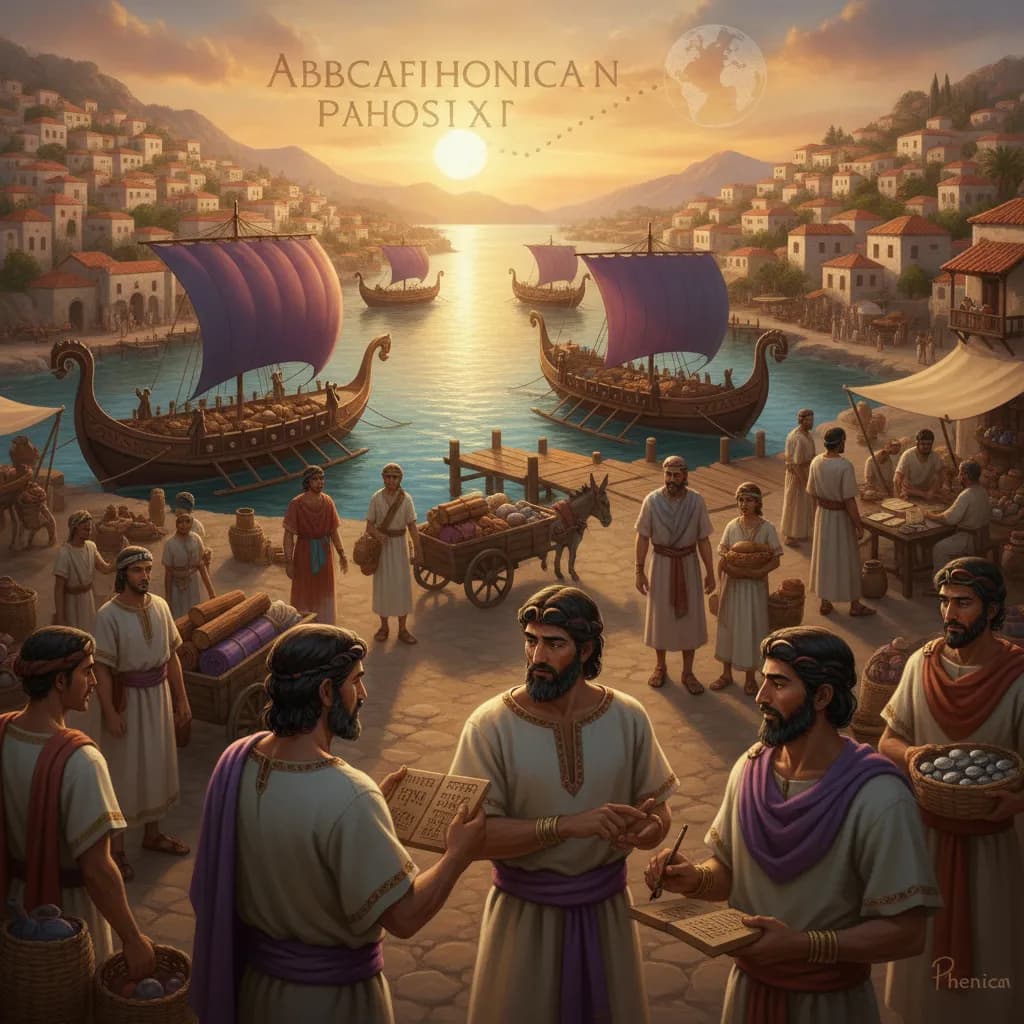
The Phoenicians were the descendants of the Canaanites, and the name "Phoenician" comes from Greek, probably related to the word for purple or crimson (phoinix). They did not call themselves by that name; they identified with their cities. After the collapse of Bronze Age powers around 1200 BCE, the Phoenician cities flourished in the vacuum, thanks to their harbors and shipbuilders. They built sturdy vessels from Lebanon's famous cedar, and sailors navigated using coastlines and, reportedly, the North Star, known to Greeks as "the Phoenician star."
Trade and Colonies
Phoenician merchants carried glass, metalwork, ivory, and cloth, and they sought silver from Spain and tin from farther north. To support the long journeys, they built outposts a day's sail apart, including Utica and Carthage in North Africa, Gadir (modern Cádiz) in Spain, and settlements in Sicily, Sardinia, and Malta. Biblical accounts describe King Hiram of Tyre supplying cedar and craftsmen for Solomon's temple, and some ancient writers claim Phoenician crews circumnavigated Africa around 600 BCE, though the story is debated.
Purple and Craft
The dye known as Tyrian purple was extracted from murex snails, which required thousands of animals for a small amount. The process was smelly and expensive, and the cloth became a status symbol reserved for kings and later Roman senators. Phoenician craftsmen also produced glassware, carved ivory, and metalwork. Their artisans were prized across the ancient world.
The Alphabet
Earlier writing systems, such as Egyptian hieroglyphs and cuneiform, required learning hundreds of signs. The Phoenician script used a small set of letters representing sounds, written right to left. Merchants carried it around the Mediterranean. The Greeks adopted it around the 8th century BCE and added letters for vowels. Latin came from a Greek variant used in Italy, and Hebrew and Arabic scripts descend from related Semitic writing. The simplicity of the system made literacy possible for more than scribes.
Carthage and the End
Tyre fell to Babylon and later to Alexander the Great after a seven-month siege in 332 BCE. Carthage, by contrast, grew into an independent power, fighting Rome in three Punic Wars before being destroyed in 146 BCE. Phoenician culture gradually blended into Greek and Roman worlds, and the language faded. Because Phoenician writing was often on papyrus, little survived, and much of what we know comes from outsiders.
Why People Care
The Phoenicians show that influence doesn't require armies. Their ships linked far-flung cultures, and their alphabet is among the most consequential inventions ever made, the basis for most of the writing systems used by billions of people today.
Glossary
- Tyrian purple
- A costly dye made from murex sea snails, associated with royalty and wealth.
- Abjad
- A writing system that records consonants only, leaving vowels to be inferred.
- Trireme
- A warship with three banks of oars, which Phoenicians helped develop.
- Punic
- The Latin word for Phoenician, used especially for Carthage, as in the Punic Wars.
- Levant
- The region along the eastern Mediterranean coast.
Go Deeper
More to Explore
- The Sumerians
They invented a way to press ideas into clay, and in doing so gave history its first draft.
- The Spartans
Sparta built an entire society around its army, and the cost fell heavily on the people it ruled.
- The Minoans
Europe's first advanced civilization left us dazzling paintings, a labyrinth legend, and a script nobody can read.
- The Indus Valley Civilization
The Indus Valley built grid-planned cities with serious drainage, then left behind a writing system nobody has ever deciphered.
- Ancient China
Farmers digging a well in 1974 stumbled onto thousands of life-sized clay soldiers, buried for over two millennia to guard an emperor.