The Spartans
Sparta built an entire society around its army, and the cost fell heavily on the people it ruled.
By Greg Goodwin · Published October 16, 2026 · Updated October 24, 2026
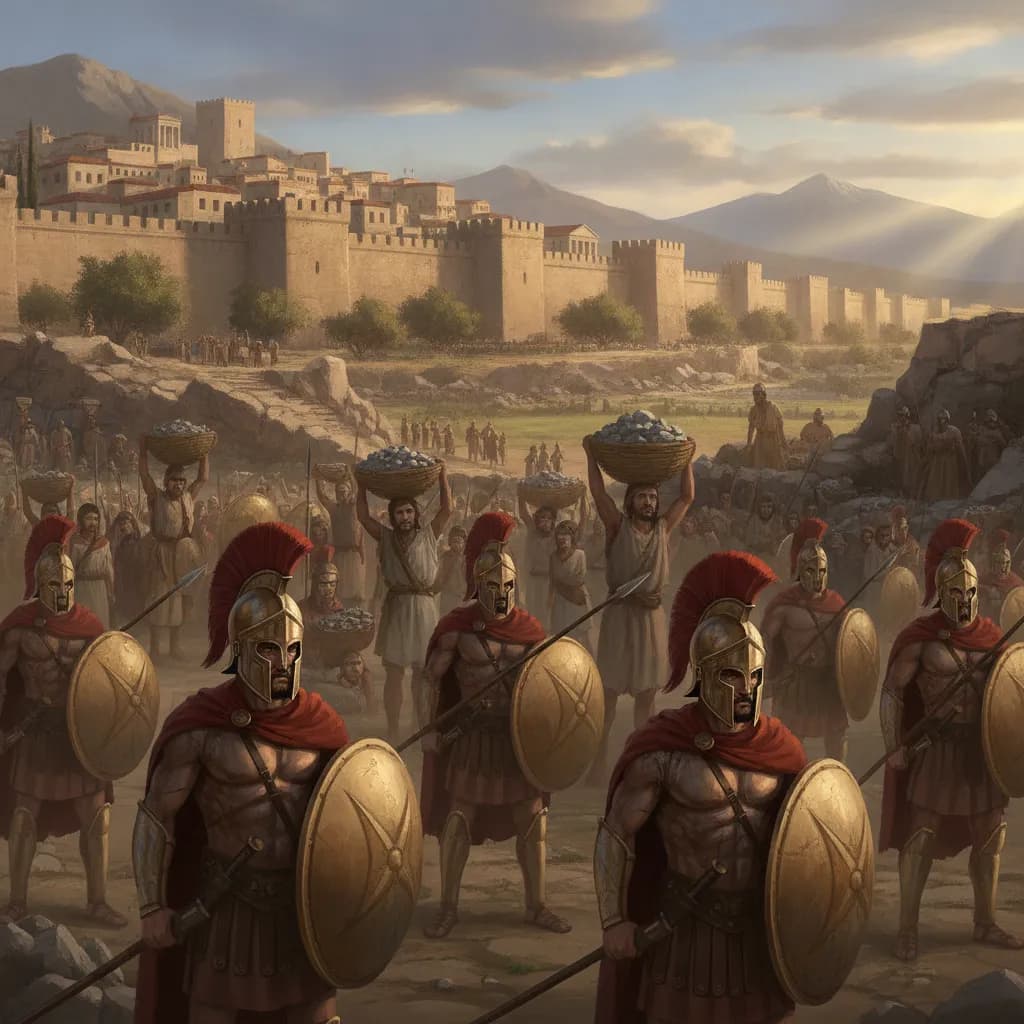
Cheat Sheet
- Place: Sparta (Lacedaemon), a Greek city-state in the southern Peloponnese, at its height from about 650 to 371 BCE.
- Training: boys entered the state-run agoge at about age seven; adults ate in common messes (syssitia).
- Class system: full citizens (Spartiates), perioikoi (free non-citizens), and helots (a subjugated, serf-like workforce).
- Government: two hereditary kings, a council of elders (gerousia), and five annually elected ephors.
- Thermopylae (480 BCE): about 300 Spartans fought alongside several thousand other Greeks against the Persian army.
- Decline: Spartiate numbers fell from roughly 8,000 around 480 BCE to about 1,000 by 371 BCE, when Thebes won at Leuctra.
The 60-Second Version
Sparta was a Greek city-state whose male citizens devoted their lives to military service. Boys left home at seven for the agoge, a harsh system of training and discipline, and adult men lived in barracks-like messes. This was possible because helots, a large population of subjugated people, did the farming. Sparta's government mixed two kings, a council of elders, and elected ephors. Its soldiers had a fearsome reputation, and Sparta led the Greek alliance against Persia, famously at Thermopylae in 480 BCE. It later defeated Athens in the Peloponnesian War but then declined as its citizen population shrank. Much of what we know comes from admirers or critics outside Sparta, so the popular image mixes fact and legend.
The Long Version
The Spartan System
Tradition credited a lawgiver named Lycurgus with creating Sparta's way of life, though he may be legendary. The system emerged after Sparta conquered neighboring Laconia and then Messenia in the 8th and 7th centuries BCE. Controlling a much larger population of helots required constant vigilance and a strong army, and helots occasionally revolted. Each year the ephors formally declared war on the helots, according to later sources, to remove religious penalties for killing them. Spartiates were barred from trade and farming, and in theory held equal plots of land, though inequality grew over time.
The Agoge
Boys were organized in groups, taught reading and writing at a basic level, and trained in athletics, hunting, and fighting, with an emphasis on endurance, obedience, and cunning. They were underfed to encourage them to steal, and punished if caught. At twenty they joined a mess and had to contribute food to remain a citizen. Girls were also educated in athletics, and Spartan women could own and inherit property, giving them more freedom than women in most Greek cities. Stories that Spartans left weak infants to die rely on a late source, Plutarch, and archaeology has not supported them.
War with Persia and Athens
In 480 BCE, Spartan King Leonidas led a force of 300 Spartiates plus allies, totaling several thousand, to hold the pass at Thermopylae against the vast army of Xerxes. They were outflanked and wiped out after delaying the Persians for days. The next year, a Spartan-led army won the decisive land battle of Plataea. Later, rivalry between Sparta and Athens exploded in the Peloponnesian War (431-404 BCE). With Persian funding for a fleet, Sparta defeated Athens and imposed a short-lived oligarchy.
Decline
Sparta's victory made it a hegemon, but it handled the role poorly. Its small citizen body, shrinking through war, concentration of land, and the loss of citizenship for those who could not pay their mess dues, could not sustain empire. In 371 BCE, a Theban army under Epaminondas crushed the Spartans at Leuctra, and Thebes then liberated Messenia in 369, stripping Sparta of its helots and economic base. Sparta survived as a minor city under Macedonian and later Roman rule.
Myth and Reality
Even in antiquity, writers romanticized Sparta. Modern popular culture often does the same, with films and games portraying them as uniformly heroic. Archaeology has found little monumental architecture, in line with Thucydides's remark that future visitors would underestimate Sparta's power from its modest ruins. The helots, who lived in constant subordination, are largely missing from the heroic version.
Why People Care
Sparta is a lasting example of a society organized around militarism, and a contrast with democratic Athens. Studying it raises questions about discipline, equality, and the price of security that still resonate today.
Glossary
- Agoge
- Sparta's compulsory education and military training program for boys.
- Helots
- State-owned laborers, mostly from conquered Messenia and Laconia, who farmed Spartan land.
- Perioikoi
- Free inhabitants of Spartan territory who ran crafts and trade but had no political rights.
- Ephors
- Five elected magistrates who held substantial power, including over the kings.
- Hoplite
- A heavily armed Greek foot soldier who fought in a tight formation called a phalanx.
Go Deeper
More to Explore
- The Sumerians
They invented a way to press ideas into clay, and in doing so gave history its first draft.
- The Phoenicians
The Phoenicians never built a great land empire, yet the letters you're reading right now trace back to their merchants.
- The Minoans
Europe's first advanced civilization left us dazzling paintings, a labyrinth legend, and a script nobody can read.
- The Indus Valley Civilization
The Indus Valley built grid-planned cities with serious drainage, then left behind a writing system nobody has ever deciphered.
- Ancient China
Farmers digging a well in 1974 stumbled onto thousands of life-sized clay soldiers, buried for over two millennia to guard an emperor.