The Minoans
Europe's first advanced civilization left us dazzling paintings, a labyrinth legend, and a script nobody can read.
By Greg Goodwin · Published October 16, 2026 · Updated October 24, 2026
Cheat Sheet
- Location and time: the island of Crete, Bronze Age, with the palace period starting around 1900 BCE and ending by about 1450 BCE.
- Name: coined by archaeologist Arthur Evans after the legendary King Minos; their own name for themselves is unknown.
- Palaces: Knossos, Phaistos, Malia, and Zakros, with storerooms, workshops, courtyards, and elaborate plumbing.
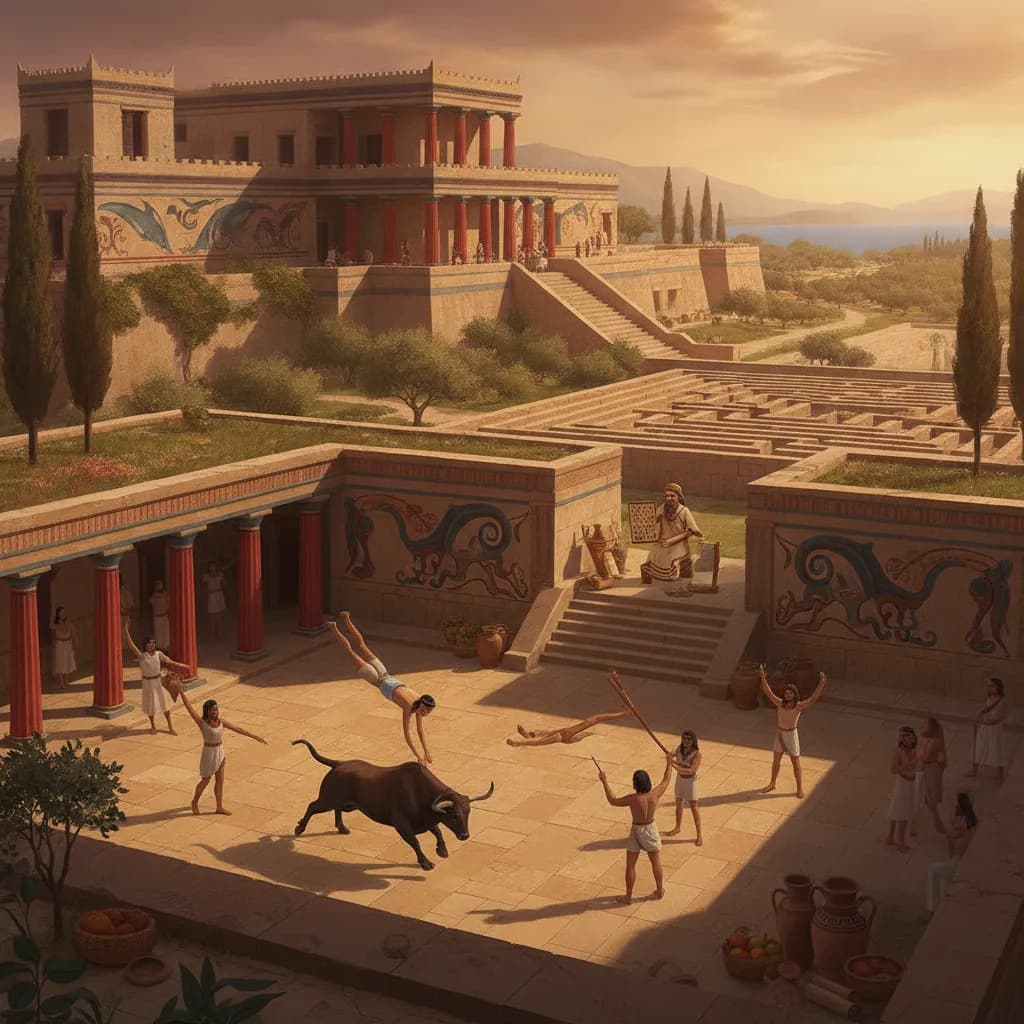
- Art: bright frescoes of bull-leaping, dolphins, and processions; the 'Snake Goddess' figurines.
- Writing: Linear A is undeciphered; Linear B, used later at Knossos, was deciphered in 1952 as early Greek.
- Decline: the Thera (Santorini) eruption, earthquakes, and Mycenaean takeover of Crete around 1450 BCE.
The 60-Second Version
More than 3,500 years ago, the island of Crete was home to the Minoans, the first major civilization in Europe. Their wealth came from farming and especially from seafaring trade with Egypt, the Levant, and the Aegean islands. They built large palace complexes, like Knossos, that served as centers of administration, storage, religion, and craft production, decorated with lively frescoes. Their writing, Linear A, remains unreadable. Around 1600 BCE, a huge volcanic eruption on the island of Thera (Santorini) to the north damaged Minoan sites, and by about 1450 BCE, Mycenaean Greeks from the mainland had taken over Crete. Later Greek myths about King Minos, the Minotaur, and the Labyrinth may preserve faint memories of this world.
The Long Version
Rediscovering a Lost World
Before 1900, the Minoans were known only through legend. That year, British archaeologist Arthur Evans began excavating a mound near Heraklion and found the vast palace of Knossos, with more than a thousand rooms, painted walls, and clay tablets in an unknown script. He named the culture after Minos. Evans's extensive reconstructions, using concrete and imaginative repainting, helped popularize the site but are criticized by scholars today for being speculative.
Palaces and Daily Life
Minoan palaces were built around central courts and included storerooms with huge jars of olive oil, wine, and grain, as well as workshops for pottery and metalwork. They had advanced drainage, with clay pipes and what appear to be flush toilets. Surrounding towns had houses of several stories. Frescoes show people in elaborate dress, with women notably prominent in religious scenes, though interpretations vary. There are few signs of heavy fortifications, leading some scholars to describe the Minoans as peaceful, though others point out that evidence for weaponry exists and that the argument rests partly on absence.
Sea Trade
Crete sat at a crossroads of Mediterranean routes. The Minoans exported timber, oil, wine, pottery, and textiles and imported copper, tin, ivory, and gold. Minoan-style pottery and frescoes have been found in Egypt, Cyprus, and on islands like Thera, where the town of Akrotiri was buried in ash and preserved in remarkable condition. Egyptian texts mention a people called the Keftiu, probably Minoans, bearing gifts.
Scripts and Mysteries
Three writing systems appear on Crete: an early hieroglyphic script, Linear A, and Linear B. Linear A, used for administrative records, has resisted decipherment because the language it records is unknown and the surviving texts are short. Linear B was deciphered in 1952 by Michael Ventris, with help from John Chadwick, and turned out to be an early form of Greek, evidence that Mycenaeans were running Knossos by about 1450 BCE. Religious practice centered on goddesses, peak sanctuaries, and caves, but we know little about their beliefs.
Collapse
The Thera eruption, which scholars date between roughly 1630 and 1500 BCE, was among the largest volcanic events of the past several thousand years. Ash, tsunamis, and climate effects may have damaged Minoan fleets and farmland, though how much is debated. Around 1450 BCE, many Cretan sites were destroyed by fire, and Mycenaeans took control. Knossos itself was destroyed around 1375 BCE or later. The Minoan culture then faded.
Why People Care
The Minoans link myth to archaeology and show that sophisticated, wealthy societies existed in Europe long before classical Greece. They also remind us how much of the past is unreadable, since their language remains unknown.
Glossary
- Bull-leaping
- A ritual or sport shown in frescoes in which acrobats vault over a charging bull.
- Linear A
- The Minoan script, which has not been deciphered.
- Linear B
- A script used for early Greek at Knossos and on the mainland, deciphered by Michael Ventris and John Chadwick.
- Thalassocracy
- A state whose power rests on control of the sea, a term often applied to Minoan Crete.
- Mycenaeans
- The mainland Greek Bronze Age culture that came to dominate Crete.
Go Deeper
More to Explore
- The Sumerians
They invented a way to press ideas into clay, and in doing so gave history its first draft.
- The Spartans
Sparta built an entire society around its army, and the cost fell heavily on the people it ruled.
- The Phoenicians
The Phoenicians never built a great land empire, yet the letters you're reading right now trace back to their merchants.
- The Indus Valley Civilization
The Indus Valley built grid-planned cities with serious drainage, then left behind a writing system nobody has ever deciphered.
- Ancient China
Farmers digging a well in 1974 stumbled onto thousands of life-sized clay soldiers, buried for over two millennia to guard an emperor.