The Hittites
They ran a Bronze Age superpower, fought Egypt to a draw, and then helped write history's oldest surviving peace treaty.
By Greg Goodwin · Published November 4, 2026
Cheat Sheet
- Capital: Hattusa, near modern Boğazkale in Turkey, a UNESCO World Heritage Site.
- Peak: the empire period runs roughly 1400 to 1200 BCE, with the height under Suppiluliumas I (c. 1380 to c. 1346 BCE).
- City walls: Hattusa's enclosure wall is more than 8 km long, and the upper city's wall has over 100 towers.
- Excavation: German archaeologist Hugo Winckler began digging at Boğazköy in 1906.
- Decipherment: Czech scholar Bedřich Hrozný showed in 1915 that Hittite is an Indo-European language.
- Collapse: the empire fell suddenly around 1193 BCE, with Britannica linking it to large-scale migrations including the Sea Peoples.
The 60-Second Version
The Hittites were an ancient Indo-European people who appeared in Anatolia, in modern Turkey, at the start of the second millennium BCE. From their capital at Hattusa they built a kingdom and later an empire that, by about 1340 BCE, was one of the dominant powers of the Middle East. They competed with Egypt for control of Syria, and clashed with the pharaoh Ramesses II at the great Battle of Kadesh. Afterward the two powers signed a peace treaty, the oldest surviving one of its kind. The Hittites left thousands of clay tablets written in cuneiform, which later gave scholars their political, social, and religious life. Their empire collapsed suddenly around 1193 BCE, but small successor states in Syria survived for centuries more.
The Long Version
Who They Were
Britannica describes the Hittites as an Indo-European people, probably originating beyond the Black Sea, who first occupied central Anatolia and made their capital at Hattusa. Early kings of the Old Kingdom, such as Hattusilis I, extended Hittite control over much of Anatolia and northern Syria. His grandson Mursilis I raided down the Euphrates to Babylon and ended the Amorite dynasty there around 1590 BCE. A dynastic power struggle followed, until Telipinus gained control around 1530 BCE and issued an edict to end lawlessness and regulate royal succession. Records are then scarce until the New Kingdom, or empire, c. 1400 to c. 1200 BCE.
Empire and Government
Under Suppiluliumas I, who ruled from c. 1380 to c. 1346 BCE, the empire reached its height, fighting the kingdom of Mitanni and gaining a firm foothold in Syria. The Hittite king was chief ruler, military leader, and supreme judge, and also the earthly deputy of the storm god; after death he became a god himself. Britannica describes Hittite society as essentially feudal and agrarian. Anatolia was rich in metals, especially silver and iron, and during the empire period the Hittites developed iron-working technology, helping to initiate the Iron Age. Their religion was a tolerant polytheism that absorbed Anatolian, Syrian, and Hurrian deities, so conquered peoples' gods were welcome in the pantheon.
Kadesh and the Treaty With Egypt
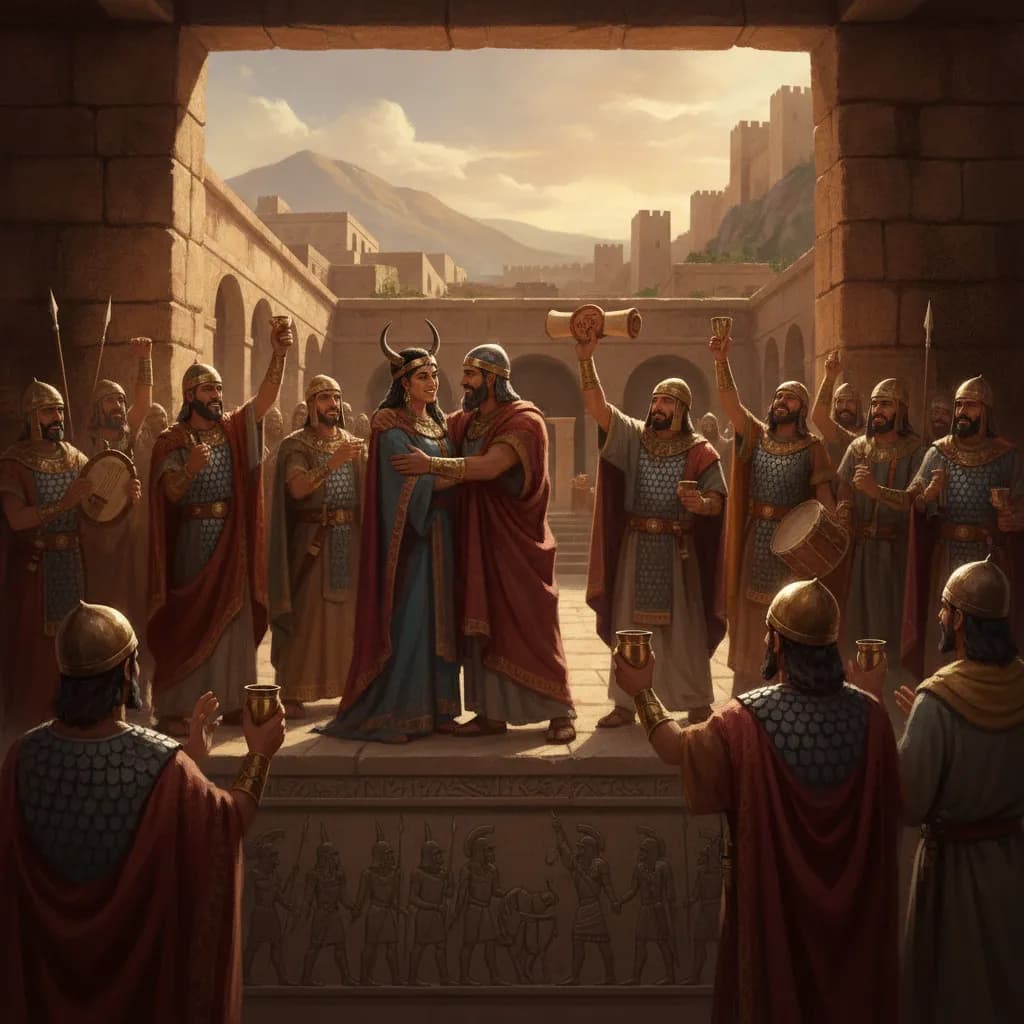
Under Muwatallis, a struggle for Syria with Egypt under Seti I and Ramesses II led to one of the greatest battles of the ancient world, at Kadesh on the Orontes. Ramesses claimed a great victory, but Britannica says the result was probably indecisive. Dates differ by chronology: Britannica gives 1299 BCE for the battle, while many other sources use about 1274 BCE, and scholars debate the exact figures. The peace treaty, concluded between Hattusilis III and Ramesses II, is most commonly dated to about 1259 BCE. It included a mutual defense pact, and a dynastic marriage followed. Notably, the treaty text itself does not mention the battle.
Rediscovering Hattusa
For a long time the Hittites were poorly understood. In 1906 Hugo Winckler began excavating at Boğazköy under the auspices of the German Orient Society and found thousands of clay tablets from what were probably royal archives. A few were in Akkadian, the diplomatic language of the era, and a copy of the peace treaty between Hattusilis III and Ramesses II helped identify the site as the Hittite capital. Most tablets used an unknown language, which Bedřich Hrozný showed in 1915 to be Indo-European, related to Greek, Latin, and Sanskrit. UNESCO now protects Hattusa, noting its fortifications, the Lion's Gate, the King's Gate, and the rock sanctuary of Yazılıkaya.
The Fall
The empire's end was sudden. Britannica dates the fall to about 1193 BCE and attributes it to large-scale migrations including the Sea Peoples, while Phrygians flooded the heartland. Some Cilician and Syrian territories kept their Hittite identity for another five centuries as small independent principalities and city-states, which the Assyrians gradually absorbed. By 710 BCE the last traces of Neo-Hittite political independence were gone. Exactly why a powerful empire collapsed so quickly is still debated, which is part of the Hittites' appeal.
Why People Care
The Hittites show that the ancient Middle East was a diplomatic world of rival superpowers, treaties, and marriages, not just pharaohs and ziggurats. Their tablets also gave us the oldest written Indo-European language, a key to the deep history of languages like English.
Glossary
- Hattusa
- The Hittite capital in central Anatolia, whose ruins include temples, royal residences, fortifications, and the Lion's Gate.
- Anatolia
- The large peninsula of modern Turkey, the Hittite heartland.
- Cuneiform
- A wedge-shaped writing system pressed into clay tablets, used for Hittite records and diplomacy.
- Indo-European
- A vast language family including Greek, Latin, and Sanskrit, to which Hittite was shown to belong.
- Great King
- The title of the Hittite ruler, who was chief ruler, military leader, supreme judge, and deputy of the storm god.
Go Deeper
More to Explore
- The Sumerians
They invented a way to press ideas into clay, and in doing so gave history its first draft.
- The Spartans
Sparta built an entire society around its army, and the cost fell heavily on the people it ruled.
- The Phoenicians
The Phoenicians never built a great land empire, yet the letters you're reading right now trace back to their merchants.
- The Minoans
Europe's first advanced civilization left us dazzling paintings, a labyrinth legend, and a script nobody can read.
- The Indus Valley Civilization
The Indus Valley built grid-planned cities with serious drainage, then left behind a writing system nobody has ever deciphered.