Ancient Greece
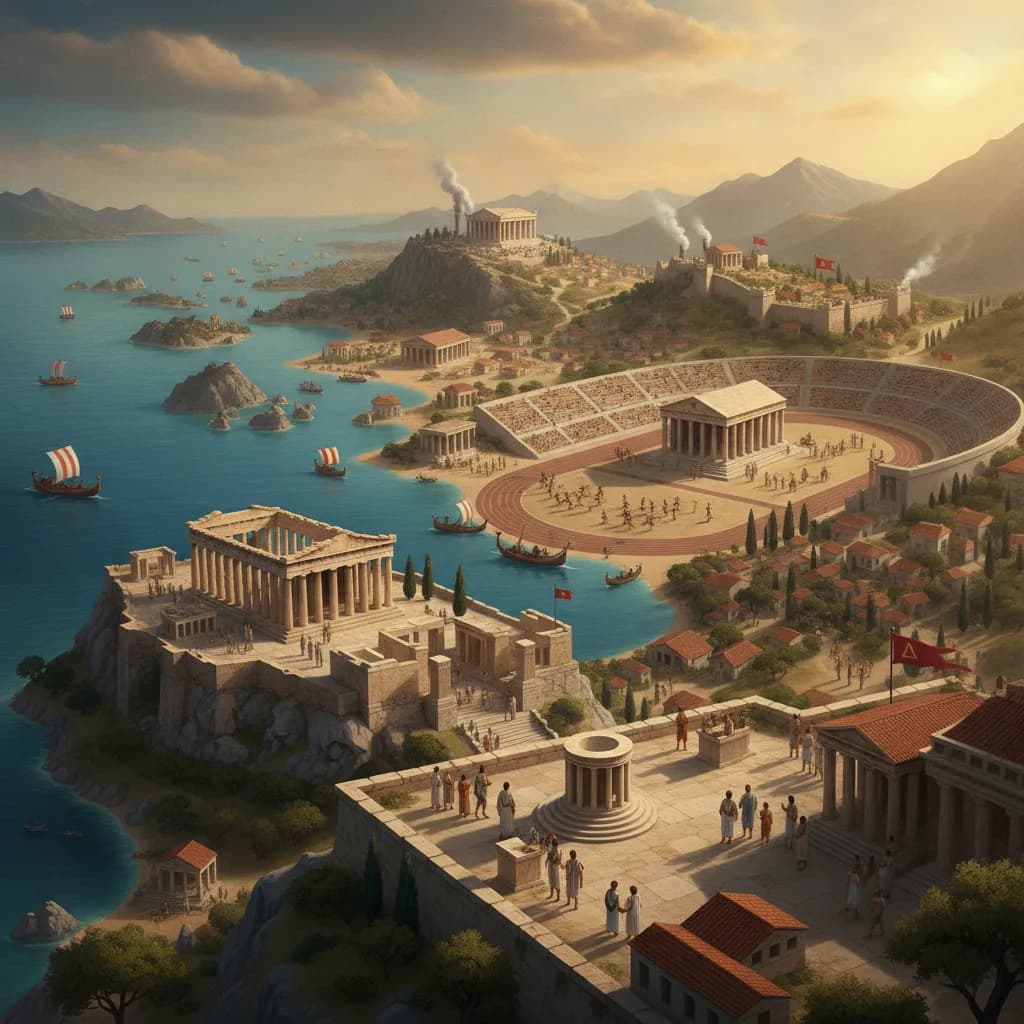
Ancient Greece never existed as one country — it was a patchwork of fiercely independent city-states that somehow still managed to invent democracy, philosophy, and the Olympics.
Cheat Sheet
- Ancient Greece was not a single unified nation but a collection of independent city-states, such as Athens and Sparta, each with its own government, laws, and military.
- Athens is widely credited with developing the earliest known form of democracy, in which eligible citizens could vote directly on laws and policy, though voting rights were limited to free adult men.
- Ancient Greek philosophers, most notably Socrates, Plato, and Aristotle, established foundational approaches to logic, ethics, and inquiry that continue to shape Western philosophy today.
- The ancient Olympic Games began in Greece around the 8th century BCE as a religious festival honoring Zeus, held every four years at Olympia.
- Greek mythology, featuring gods such as Zeus, Athena, and Poseidon, was deeply woven into daily religious, artistic, and civic life rather than existing as separate entertainment.
- Alexander the Great, a Macedonian king educated by Aristotle, spread Greek culture and language across a vast empire stretching into Egypt and Central Asia, a period known as the Hellenistic era.
The 60-Second Version
Ancient Greece was not a single unified nation but a collection of independent city-states, such as Athens and Sparta, each with its own government, laws, and military. Athens is widely credited with developing the earliest known form of democracy, in which eligible citizens could vote directly on laws and policy, though voting rights were limited to free adult men. Ancient Greek philosophers, most notably Socrates, Plato, and Aristotle, established foundational approaches to logic, ethics, and inquiry that continue to shape Western philosophy today. The ancient Olympic Games began in Greece around the 8th century BCE as a religious festival honoring Zeus, held every four years at Olympia. Greek mythology, featuring gods such as Zeus, Athena, and Poseidon, was deeply woven into daily religious, artistic, and civic life rather than existing as separate entertainment. Alexander the Great, a Macedonian king educated by Aristotle, spread Greek culture and language across a vast empire stretching into Egypt and Central Asia, a period known as the Hellenistic era.
The Long Version
A Patchwork of City-States, Not One Nation
Ancient Greece was not a single unified nation but a collection of independent city-states, known as poleis, such as Athens and Sparta, each with its own government, laws, currency, and military, and often fiercely competitive or openly hostile toward one another despite sharing a common language, religion, and broader cultural identity. This fragmented structure shaped much of Greek history, including periods of temporary alliance against outside threats and prolonged internal conflicts, such as the Peloponnesian War between Athens and Sparta.
The Birth of Democracy in Athens
Athens is widely credited with developing the earliest known form of democracy, a system in which eligible citizens could vote directly on laws and policy rather than being ruled solely by a king or small governing elite, though this direct democracy was considerably narrower than modern democracies, since voting rights were limited to free adult male citizens, excluding women, enslaved people, and foreign residents.
Philosophy, Mythology, and the Games
Ancient Greek philosophers, most notably Socrates, Plato, and Aristotle, established foundational approaches to logic, ethics, and rigorous inquiry that continue to shape Western philosophy today, developing methods of questioning and argument still taught and used centuries later. Alongside this intellectual tradition, Greek mythology, featuring gods such as Zeus, Athena, and Poseidon, was deeply woven into daily religious, artistic, and civic life rather than existing as separate entertainment, and it directly gave rise to major cultural institutions like the ancient Olympic Games, which began around the 8th century BCE as a religious festival honoring Zeus, held every four years at Olympia.
Alexander the Great and the Hellenistic Spread
Alexander the Great, a Macedonian king educated personally by Aristotle, spread Greek culture, language, and political influence across a vast empire stretching from Greece through Egypt and into Central Asia, a period historians call the Hellenistic era, during which Greek ideas blended with local cultures across an enormous geographic range, extending Greek influence far beyond what the city-states themselves ever could have achieved independently.
Ad slot (placeholder — set NEXT_PUBLIC_ADSENSE_SLOT_ID once an ad unit is created)
Glossary
- City-state (polis)
- An independent, self-governing city and its surrounding territory, such as Athens or Sparta — the basic political unit of ancient Greece.
- Democracy
- A system of government in which citizens vote directly on laws and policy, first developed in ancient Athens.
- Hellenistic era
- The period following Alexander the Great's conquests during which Greek culture and language spread widely across the Mediterranean and parts of Asia.
- Philosophy
- A structured pursuit of questions about knowledge, ethics, and existence, foundationally shaped by ancient Greek thinkers like Socrates, Plato, and Aristotle.
- Pantheon
- The full collection of gods and goddesses recognized in a religious tradition, such as the Greek pantheon led by Zeus.