The Skeletal System
Your scaffolding is alive: it banks calcium, brews blood, and quietly rebuilds itself while you sit there.
By Greg Goodwin · Published October 17, 2026 · Updated October 24, 2026
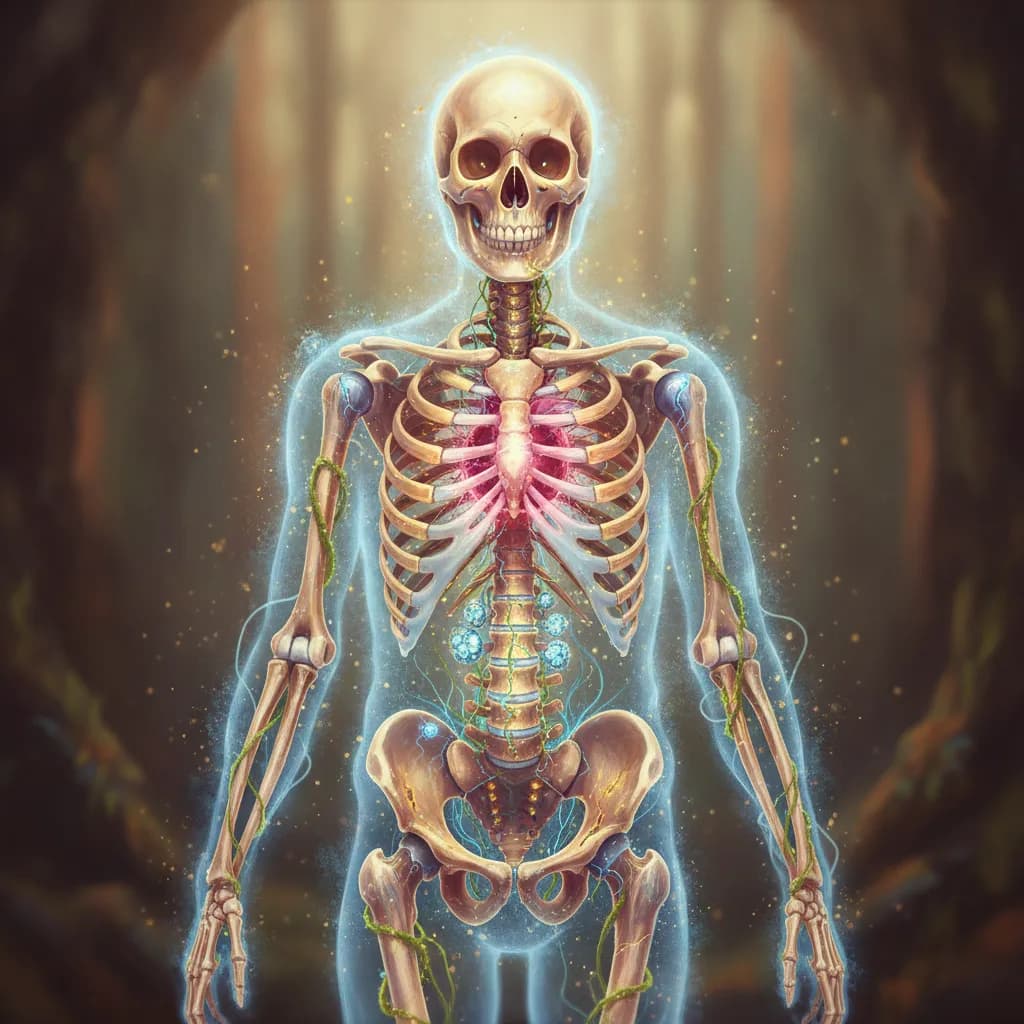
Cheat Sheet
- Newborns: often said to have around 300 bones (estimates vary), which fuse down toward the adult count as they grow.
- Weight: the skeletal system accounts for about 20 percent of body weight.
- Calcium: bones contain more calcium than any other organ, mostly as calcium phosphate.
- Adult red marrow: limited to spongy bone in the skull, ribs, sternum, clavicles, vertebrae, and pelvis.
- Extremes: the femur (thigh) is usually described as the longest bone and the stapes (middle ear) as the smallest.
- Common problems: fractures, osteoporosis, arthritis, and scoliosis are among the topics MedlinePlus files under bones, joints, and muscles.
The 60-Second Version
The skeletal system is the body's internal frame: bones, plus the cartilage, ligaments, and tendons that connect and cushion them. A typical adult has 206 bones, divided into the axial skeleton of 80 bones (skull, spine, and rib cage) and the appendicular skeleton of 126 (the limbs). The skeleton holds you up against gravity, shields soft organs such as the brain, heart, and lungs, and works with muscles as a system of levers to produce movement. Bones are not inert props, though. They are living tissue with a blood supply, and they reshape themselves in response to stress. They also act as a calcium reserve, releasing the mineral into the blood when it runs low, and the red marrow inside certain bones manufactures blood cells. This is general information, not medical advice, so anyone with a personal concern about their bones should see a clinician.
The Long Version
Two Skeletons in One
Anatomists split the skeleton into two divisions. The axial skeleton, with 80 bones, runs along the body's midline. Its fused cranial bones surround the brain, its vertebrae enclose and protect the spinal cord, and its rib cage helps shield the heart and lungs. The appendicular skeleton, with 126 bones, makes up the limbs. The large bones of the lower limbs carry the weight of the trunk when you stand, while the arms and hands are built more for reach and manipulation. Together the two divisions add up to the familiar adult count of 206, though the exact number can differ slightly from person to person because some people have small extra bones.
Bone Is Living Tissue
It is tempting to picture bone as dry and chalky, like the specimens in a classroom. Living bone is nothing like that. It takes in oxygen, gives off metabolic waste, consumes nutrients, and needs a steady blood supply. Because it remodels in response to mechanical stress, bone that is loaded regularly adapts to the demand. The skeletal system, counting cartilage, ligaments, and tendons along with bone, accounts for roughly a fifth of body weight.
A Calcium Bank and a Blood Factory
Bones hold more calcium than any other organ, locked into the bone matrix mainly as calcium phosphate. That store is dynamic. When blood calcium falls below normal, calcium is released from bone; when it rises, the excess is stored away, and this exchange goes on almost continuously. Bones are also where most blood cells are made. In infants, red marrow fills the bone cavities, but with age much of it is replaced by yellow marrow, which stores fat. In adults, red marrow persists mainly in the spongy bone of the skull, ribs, sternum, collarbones, vertebrae, and pelvis, where it produces red cells, white cells, and platelets.
From Hundreds of Pieces to 206
A newborn's skeleton contains more separate bony elements than an adult's. Figures in popular sources range from roughly 270 to 350, with around 300 the most common estimate, so treat any single number with caution. They do not vanish as a child grows. Instead, many fuse together, bringing the total down toward 206. Two superlatives are widely repeated: the femur, in the thigh, is usually described as the longest bone, and the stapes, one of the tiny bones of the middle ear, as the smallest.
When Things Go Wrong
Because bones, joints, and the tissues around them do so many jobs, problems are common and varied. MedlinePlus lists topics including fractures, osteoporosis, arthritis, scoliosis, back pain, and bone infections. Joints, where bones meet, are a frequent site of trouble. Many conditions can be diagnosed and managed, and early evaluation often helps, so persistent pain, an injury, or a worry about bone health is a reason to talk with a doctor rather than rely on general reading like this.
Why People Care
Every fall, sprain, and fracture is a lesson in how much depends on bone. Knowing the basics explains why injuries heal the way they do, why calcium and bone density come up at checkups, and why doctors treat joints, spine, and marrow as part of one system.
Glossary
- Axial skeleton
- The 80 bones along the body's central axis, including the skull, spine, and rib cage.
- Appendicular skeleton
- The 126 bones of the limbs and their attachments to the trunk.
- Red marrow
- Soft tissue inside certain bones that makes red blood cells, white blood cells, and platelets.
- Hematopoiesis
- The formation of blood cells, which mostly takes place in the red marrow of bones.
- Remodeling
- The ongoing process by which living bone changes shape and renews itself in response to mechanical stress.
Go Deeper
More to Explore
- The Respiratory System
You breathe about 20,000 times a day without ever thinking about it.
- The Endocrine System
Your body runs a slow, long-distance messaging service using chemicals instead of wires.
- The Digestive System
Despite its name, the small intestine is actually the longest section of your entire digestive tract — it's just narrower than the large intestine.
- The Circulatory System
Your heart beats roughly 100,000 times a day without you ever consciously thinking about it — a lifetime total in the billions.
- The Nervous System
Your body's wiring runs on electricity and chemistry, and it keeps your heart beating without ever asking your opinion.