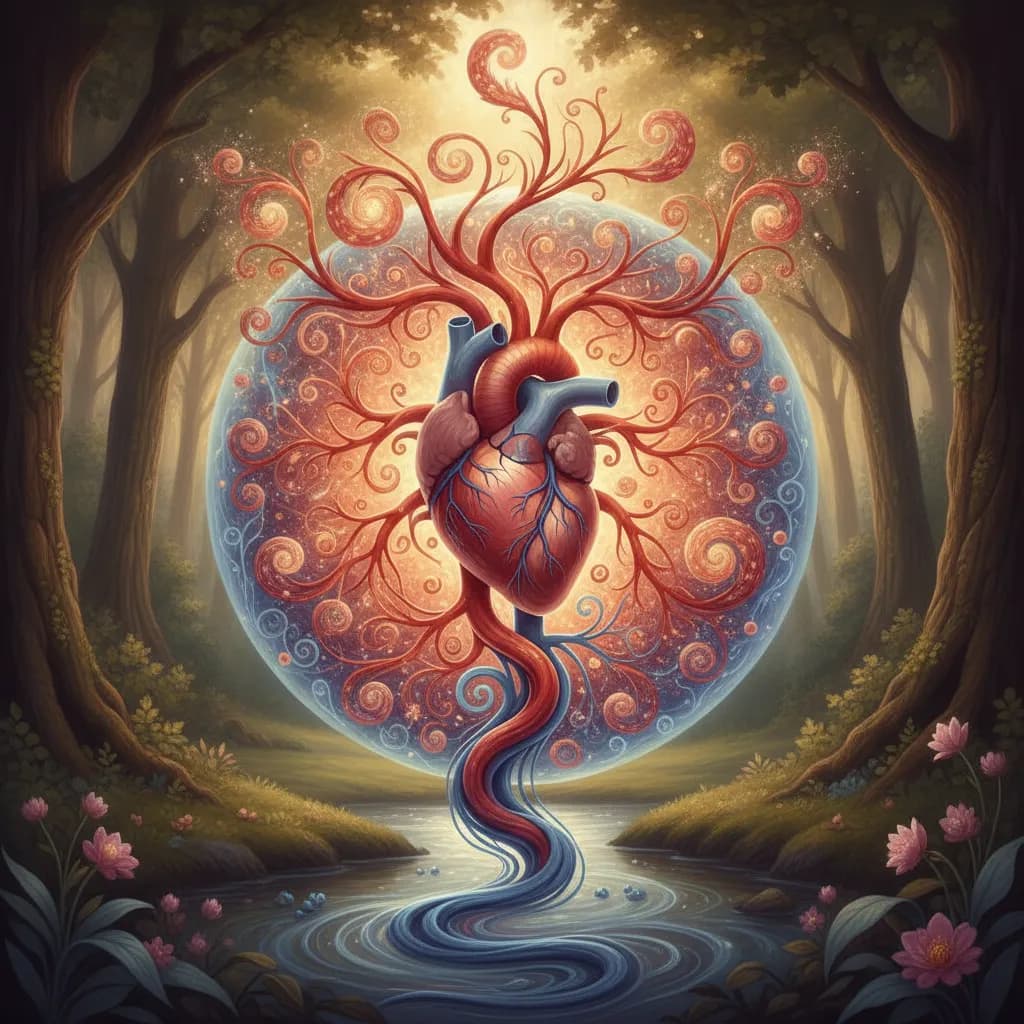
The Circulatory System
Your heart beats roughly 100,000 times a day without you ever consciously thinking about it — a lifetime total in the billions.
Cheat Sheet
- The circulatory system consists of the heart, blood vessels, and blood, working together to deliver oxygen and nutrients throughout the body while removing waste products.
- The heart, a muscular pump roughly the size of a closed fist, beats approximately 100,000 times per day, circulating blood through a closed network of vessels.
- Blood travels through three main types of vessels: arteries, which carry oxygen-rich blood away from the heart; veins, which return blood to the heart; and capillaries, where nutrient and gas exchange actually occurs.
- The circulatory system operates as two connected loops: pulmonary circulation, which moves blood between the heart and lungs, and systemic circulation, which moves blood between the heart and the rest of the body.
- Blood pressure, measured as two numbers (systolic over diastolic), reflects the force of blood pushing against artery walls and is a key indicator of cardiovascular health.
- Cardiovascular disease, which affects the heart and blood vessels, remains one of the leading causes of death worldwide, making circulatory system health a major focus of preventive medicine.
The 60-Second Version
The circulatory system consists of the heart, blood vessels, and blood, working together to deliver oxygen and nutrients throughout the body while removing waste products. The heart, a muscular pump roughly the size of a closed fist, beats approximately 100,000 times per day, circulating blood through a closed network of vessels. Blood travels through three main types of vessels: arteries, which carry oxygen-rich blood away from the heart; veins, which return blood to the heart; and capillaries, where nutrient and gas exchange actually occurs. The circulatory system operates as two connected loops: pulmonary circulation, which moves blood between the heart and lungs, and systemic circulation, which moves blood between the heart and the rest of the body. Blood pressure, measured as two numbers (systolic over diastolic), reflects the force of blood pushing against artery walls and is a key indicator of cardiovascular health. Cardiovascular disease, which affects the heart and blood vessels, remains one of the leading causes of death worldwide, making circulatory system health a major focus of preventive medicine.
The Long Version
The Heart as a Tireless Pump
The heart, a muscular pump roughly the size of a closed fist, beats approximately 100,000 times per day, circulating blood through a closed network of vessels without ever needing conscious control or rest, powered by its own specialized electrical system that keeps it beating in a steady, coordinated rhythm from before birth until death.
Three Types of Vessels, Different Jobs
Blood travels through three main types of vessels, each with a distinct role: arteries, which carry oxygen-rich blood away from the heart under relatively high pressure; veins, which return oxygen-depleted blood back to the heart at lower pressure; and capillaries, the tiny, thin-walled vessels where the actual exchange of oxygen, nutrients, and waste products with surrounding body tissue occurs, making capillaries the true functional destination of the entire circulatory journey.
Two Connected Loops
The circulatory system operates as two connected loops working in continuous sequence: pulmonary circulation, which moves oxygen-depleted blood from the heart to the lungs to pick up fresh oxygen and release carbon dioxide, and systemic circulation, which moves that newly oxygenated blood from the heart out to the rest of the body's organs and tissues before returning it, now oxygen-depleted again, to start the cycle over.
Blood Pressure and Cardiovascular Health
Blood pressure, measured as two numbers, systolic over diastolic, reflects the force of blood pushing against artery walls during and between heartbeats, and it serves as a key indicator of overall cardiovascular health, since consistently elevated blood pressure can gradually damage blood vessels over time. This matters enormously at a population level, since cardiovascular disease, affecting the heart and blood vessels, remains one of the leading causes of death worldwide, making circulatory system health a major and ongoing focus of preventive medicine and public health efforts.
Ad slot (placeholder — set NEXT_PUBLIC_ADSENSE_SLOT_ID once an ad unit is created)
Glossary
- Artery
- A blood vessel that carries oxygen-rich blood away from the heart to the rest of the body.
- Vein
- A blood vessel that carries oxygen-depleted blood back toward the heart.
- Capillary
- A tiny, thin-walled blood vessel where the actual exchange of oxygen, nutrients, and waste occurs between blood and body tissue.
- Pulmonary circulation
- The loop of blood circulation between the heart and the lungs, where blood picks up oxygen and releases carbon dioxide.
- Blood pressure
- A measurement of the force of blood pushing against artery walls, expressed as systolic over diastolic pressure.