Mystery and Detective Fiction
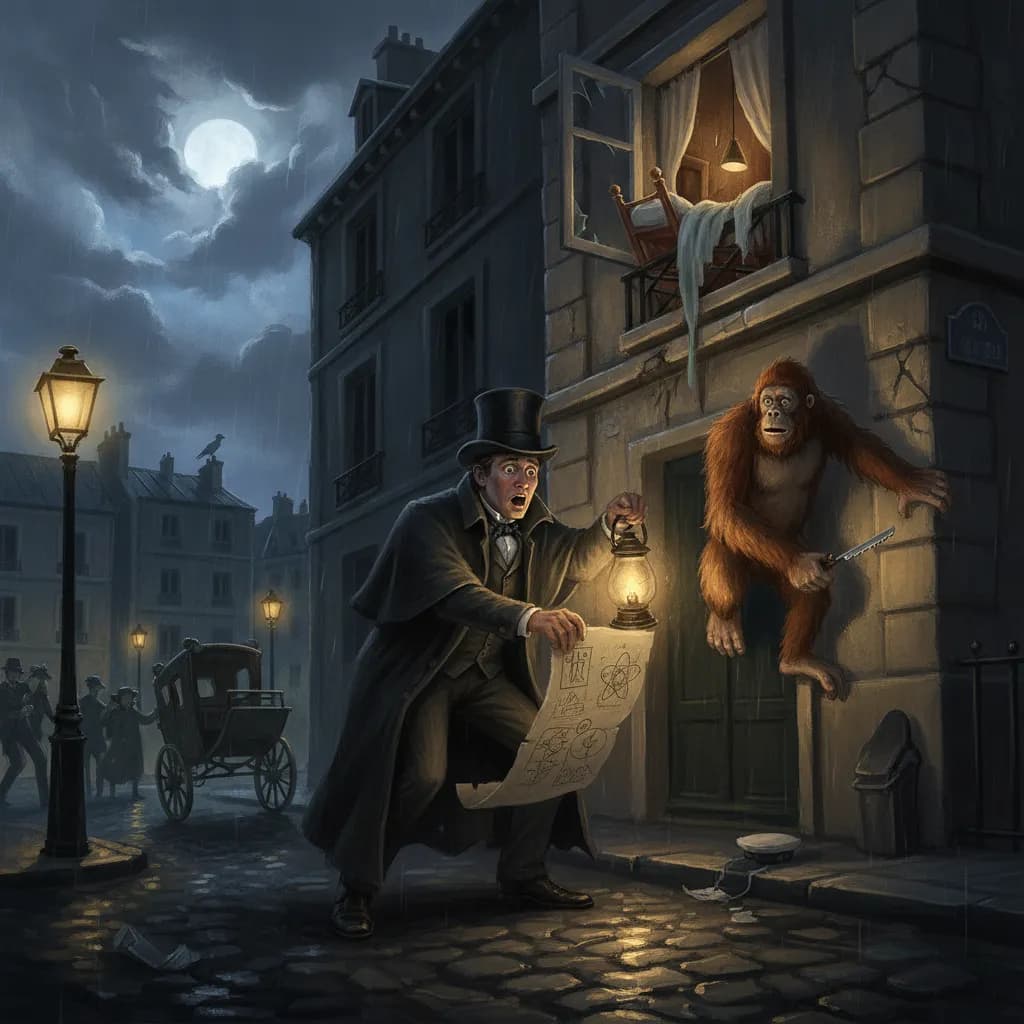
The entire genre of detective fiction can be traced back to a single Edgar Allan Poe short story about a killer who, in a twist nobody saw coming in 1841, turns out not to be human at all.
Cheat Sheet
- Edgar Allan Poe's 1841 short story 'The Murders in the Rue Morgue' is widely credited as the first modern detective fiction.
- Arthur Conan Doyle's Sherlock Holmes, debuting in 1887, established many genre conventions still used today, including the brilliant-detective/loyal-companion pairing.
- The 'Golden Age' of detective fiction (roughly 1920s-1930s) produced Agatha Christie and popularized the fair-play 'whodunit' structure.
- 'Fair-play' mysteries follow an informal convention that all clues needed to solve the case must be presented to the reader before the reveal.
- The 'hardboiled' subgenre, pioneered by writers like Dashiell Hammett in the 1920s-30s, shifted toward morally ambiguous detectives and gritty urban settings.
- The Mystery Writers of America's Edgar Awards, named after Poe, are among the genre's most prestigious annual honors.
The 60-Second Version
Detective fiction as a distinct genre traces back to Edgar Allan Poe's 1841 short story "The Murders in the Rue Morgue," widely credited as the first modern detective story and the template countless later writers would build on. That template got massively popularized decades later through Arthur Conan Doyle's Sherlock Holmes stories, which cemented genre conventions still recognizable today, including the pairing of a brilliant, unconventional detective with a more grounded companion who narrates the story. The genre reached a defining creative peak during its so-called Golden Age in the 1920s and 1930s, an era that produced Agatha Christie and popularized the puzzle-driven "whodunit" structure built around an informal but widely respected rule: every clue needed to solve the mystery has to be given to the reader before the final reveal. Around roughly the same period, a very different subgenre emerged in the form of hardboiled fiction, trading polished drawing-room puzzles for morally ambiguous detectives navigating gritty, dangerous urban settings. Both traditions remain alive and actively read today, and the genre's most prestigious annual awards are fittingly named after the writer who arguably started the whole thing.
The Long Version
Where Detective Fiction Actually Began
Detective fiction as a distinct literary genre is widely traced back to Edgar Allan Poe's 1841 short story "The Murders in the Rue Morgue," a story that introduced the basic template of a brilliant amateur investigator solving a baffling crime through careful reasoning, a structure countless later writers would go on to directly build from.
Sherlock Holmes Cements the Formula
That early template got massively popularized decades later through Arthur Conan Doyle's Sherlock Holmes stories, first appearing in 1887, which cemented genre conventions still instantly recognizable today, including the now-familiar pairing of a brilliant, eccentric detective and a more grounded companion who narrates the story from the sidelines.
The Golden Age and the Fair-Play Rule
The genre reached a defining creative peak during its so-called Golden Age, roughly spanning the 1920s and 1930s, an era that produced Agatha Christie among other major writers and popularized the puzzle-driven "whodunit" format built around an informal but widely respected convention: every clue genuinely needed to solve the mystery has to be presented to the reader before the story's final reveal.
A Grittier Alternative Emerges
Around roughly the same period, a starkly different subgenre known as hardboiled fiction emerged through writers like Dashiell Hammett, trading the Golden Age's polished drawing-room puzzles for morally ambiguous detectives navigating considerably grittier, more dangerous urban settings, a tonal split that still defines two major, distinct branches of the genre today. Both traditions remain widely read, and fittingly, the genre's most prestigious annual honors, the Edgar Awards, are named directly after the writer credited with starting it all.
Ad slot (placeholder — set NEXT_PUBLIC_ADSENSE_SLOT_ID once an ad unit is created)
Why People Care
Mystery and detective fiction remains one of publishing's most consistently popular genres, and understanding its historical split between puzzle-driven Golden Age mysteries and grittier hardboiled fiction explains the genuinely different reading experience each still offers today.
Glossary
- Whodunit
- A mystery structured around the central puzzle of identifying the perpetrator of a crime, typically revealed near the story's end.
- Fair-play mystery
- A detective fiction convention requiring that all clues needed to solve the case be presented to the reader before the solution is revealed.
- Hardboiled fiction
- A gritty detective fiction subgenre featuring morally ambiguous protagonists and urban crime settings, pioneered in the 1920s-30s.
- Golden Age of detective fiction
- A period roughly spanning the 1920s-1930s marked by the genre's rise in popularity and refinement of puzzle-based mystery structure.
- Red herring
- A misleading clue deliberately planted in a mystery story to distract the reader from the true solution.
Go Deeper
- Mystery Writers of America
- Bloody Murder, by Julian Symons
More to Explore
- Science Fiction
A genre that's repeatedly predicted, and sometimes arguably helped inspire, real technology decades before it actually existed.
- Poetry
A literary form that often does more with fewer words than an entire novel — sometimes intentionally leaving room for every reader to find a different meaning.
- Magical Realism
A literary style where a character might casually witness something genuinely impossible — and the story simply moves on, treating it as an entirely unremarkable part of everyday life.
- Graphic Novels
A medium that had to win a special Pulitzer Prize just to prove to critics that a comic book could tell a story as seriously as any novel.
- Reality TV
Reality TV markets itself as "unscripted," yet much of what makes it watchable comes from an editing trick that can stitch together a sentence a cast member never actually said.