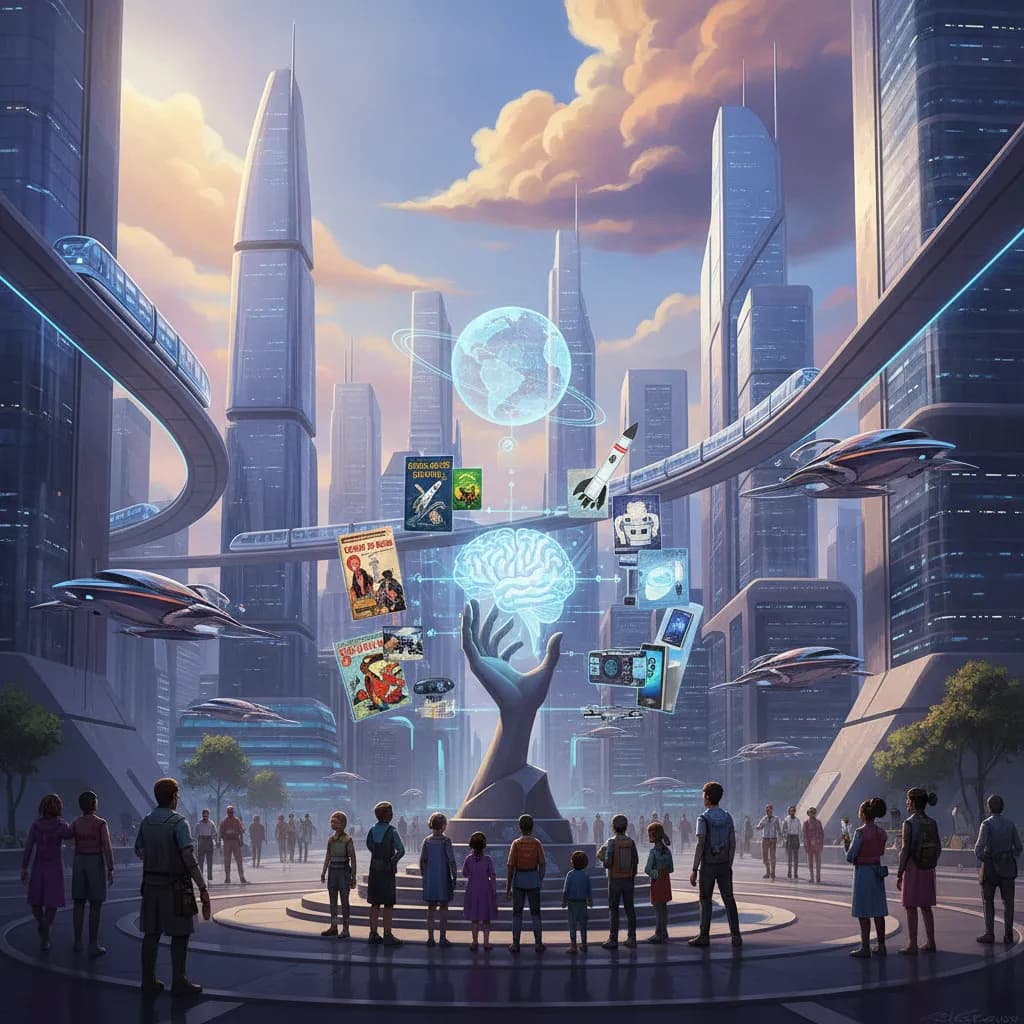
Science Fiction
A genre that's repeatedly predicted, and sometimes arguably helped inspire, real technology decades before it actually existed.
Cheat Sheet
- Science fiction is a literary genre exploring speculative, often futuristic concepts — advanced technology, space travel, alternate societies — grounded in some degree of scientific plausibility.
- The genre is often credited to authors like Mary Shelley (Frankenstein, 1818) and Jules Verne, though it grew into a distinct, recognized genre through 20th-century pulp magazines.
- "Hard" science fiction emphasizes scientific accuracy and plausibility, while "soft" science fiction prioritizes character, society, or philosophical ideas over strict technical realism.
- Science fiction has a long history of anticipating, or directly influencing, real technological developments, from submarines to space travel to smartphone-like communicators.
- The genre frequently uses futuristic or alien settings as a way to explore present-day social and political issues at a safe narrative distance.
- Major science fiction awards, the Hugo and Nebula Awards among the most prominent, have shaped and reflected the genre's evolving themes and standards for decades.
The 60-Second Version
Science fiction is a literary genre exploring speculative, often futuristic concepts — advanced technology, space travel, alternate societies — grounded in some degree of scientific plausibility. The genre is often credited to authors like Mary Shelley, whose Frankenstein was published in 1818, and Jules Verne, though it grew into a distinct, recognized genre through 20th-century pulp magazines. "Hard" science fiction emphasizes scientific accuracy and plausibility, while "soft" science fiction prioritizes character, society, or philosophical ideas over strict technical realism. Science fiction has a long history of anticipating, or arguably directly influencing, real technological developments, from submarines to space travel to smartphone-like communicators. The genre frequently uses futuristic or alien settings as a way to explore present-day social and political issues at a safe narrative distance. Major science fiction awards, the Hugo and Nebula Awards among the most prominent, have shaped and reflected the genre's evolving themes and standards for decades.
The Long Version
Origins: From Frankenstein to Pulp Magazines
Many literary historians point to Mary Shelley's Frankenstein (1818) as an early foundational work of science fiction, grounding its horror in the era's contemporary scientific ideas rather than purely supernatural elements. Jules Verne and H.G. Wells further developed the genre's conventions through the 19th century, but science fiction truly crystallized as a distinct, popularly recognized genre through 20th-century American pulp magazines, inexpensive publications that gave the genre a dedicated commercial home and audience.
Hard vs. Soft Science Fiction
Science fiction is often divided into "hard" and "soft" subcategories based on how central rigorous scientific plausibility is to the work: hard science fiction emphasizes technically accurate, carefully reasoned extrapolations of real science, while soft science fiction is more concerned with character, society, or philosophical ideas, using scientific concepts more loosely as a backdrop rather than a strict technical constraint.
Using the Future to Talk About the Present
One of science fiction's most consistent functions throughout its history has been using futuristic, alien, or otherwise displaced settings to examine present-day social and political issues from a safer narrative distance, allowing authors to critique contemporary society, technology, or politics without directly naming real-world targets, a technique found across dystopian fiction and countless other subgenres.
The Genre's Major Awards and Standards
Science fiction's evolving standards and themes are closely reflected in its major literary awards, particularly the Hugo Awards, voted on by fans, and the Nebula Awards, voted on by genre professionals, both of which have recognized and helped elevate influential works and authors for decades, tracking the genre's shifting concerns from early space-exploration optimism through later, more critical dystopian and social themes.
Ad slot (placeholder — set NEXT_PUBLIC_ADSENSE_SLOT_ID once an ad unit is created)
Glossary
- Speculative fiction
- A broad literary category including science fiction, fantasy, and related genres exploring hypothetical or fantastical premises.
- Hard science fiction
- A science fiction subgenre emphasizing scientific accuracy and technical plausibility.
- Soft science fiction
- A science fiction subgenre prioritizing character, society, or ideas over strict scientific detail.
- Pulp magazine
- Inexpensive early-20th-century magazines that played a major role in establishing science fiction as a distinct popular genre.
- Dystopia
- A science fiction setting depicting a bleak, oppressive future society, a recurring genre theme.