Saxophone
A brass-colored instrument that is secretly a woodwind, invented by a man who spent a decade in court defending it.
By Greg Goodwin · Published October 24, 2026
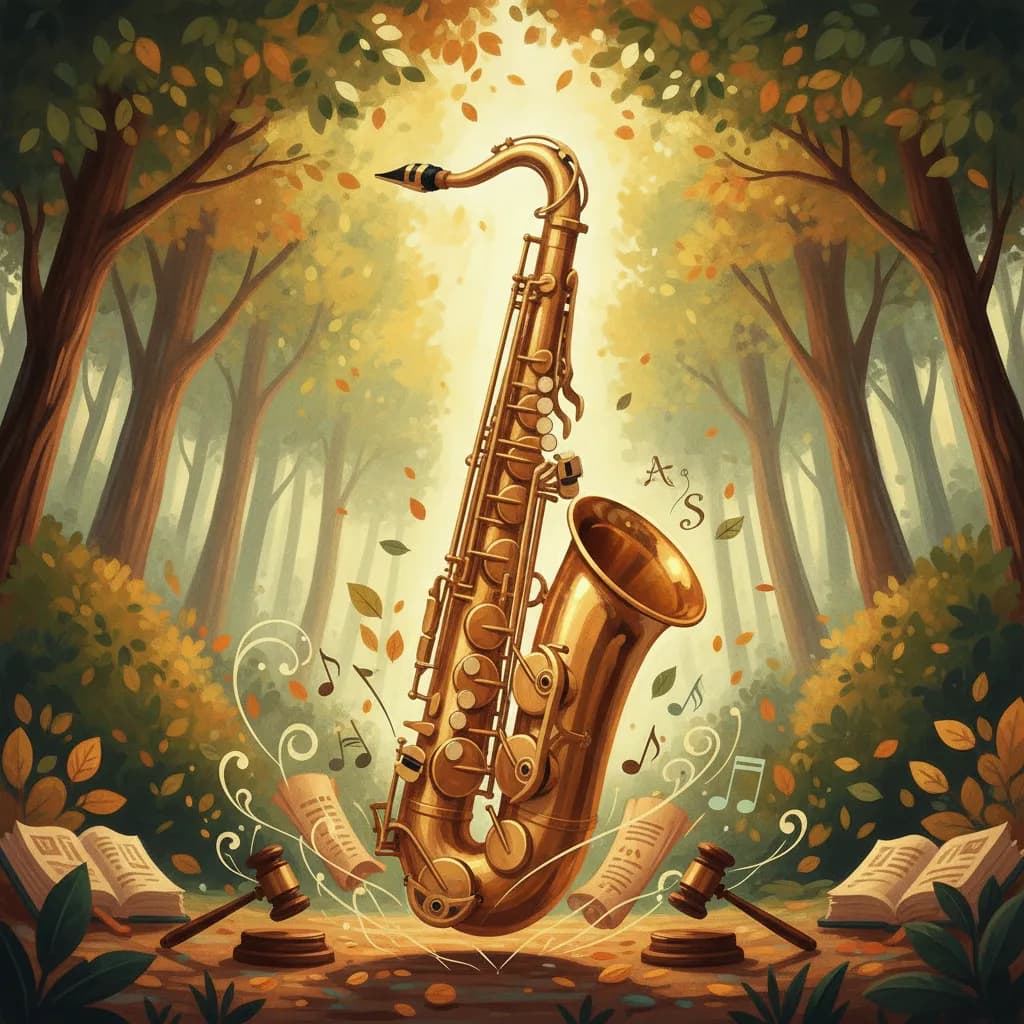
Cheat Sheet
- Inventor: Adolphe Sax, born November 6, 1814, in Dinant, Belgium, died February 7, 1894, in Paris.
- Patent year: 1846, though sources disagree on the exact day (21 March and 28 June both appear).
- Construction: a single-reed instrument made of metal with a conical bore that overblows at the octave.
- Family size: the patent is reported to cover a range of eight saxophones, from small to large.
- Related invention: Sax's saxhorn was patented in 1845.
- Teaching post: Sax was appointed saxophone instructor at the Paris Conservatory in 1857.
The 60-Second Version
The saxophone is a family of metal instruments that produce sound with a single reed, like a clarinet, yet are usually made of brass. That is why it counts as a woodwind despite its shiny look. Its tube widens gradually in a cone shape, which gives it a sound that can be warm, breathy, edgy, or sweet depending on the player. Belgian instrument maker Adolphe Sax invented it in the 1840s while trying to improve the tone of the bass clarinet, and patented it in 1846. Sax designed a whole range of sizes, from small soprano to large baritone, so that the instrument could blend with both wind and brass groups. The saxophone found its great home in jazz, but it also appears in classical music, military bands, concert bands, and pop and rock recordings.
The Long Version
The Inventor and His Idea
Adolphe Sax was born on November 6, 1814, in Dinant, Belgium, the son of Charles Joseph Sax, a maker of wind and brass instruments, as well as pianos, harps, and guitars. He studied flute and clarinet at the Brussels Conservatory and moved to Paris in 1842. There he exhibited the saxophone, which emerged from his efforts to improve the tone of the bass clarinet. Britannica describes it as a single-reed instrument made of metal, with a conical bore that overblows at the octave. Sax also believed that the proportions of the vibrating column of air, and those alone, determine an instrument's timbre.
Patent, Lawsuits, and Hard Times
The saxophone was patented in 1846. The exact day is disputed among sources: Wikipedia gives 28 June 1846, while a Selmer history page cites patent number 3226 of 21 March 1846 and says it covered a range of eight saxophones. Sax also developed the saxhorn, patented in 1845, along with other brass instruments, and many of his instruments were accepted by French army bands. Success did not protect him from rivals. For about ten years he was entangled in lawsuits with competing instrument makers who tried to have his patents revoked, and later improvements never gave him a lasting commercial footing. In his eightieth year he was living in poverty, and the composers Emmanuel Chabrier, Jules Massenet, and Camille Saint-Saens petitioned the minister of fine arts to help him.
How It Works and the Family
A player blows across a reed fixed to a mouthpiece, and the vibrating reed sets the air inside the body into motion. Pressing keys opens and closes holes along the tube to change the pitch. Because the bore is conical, the saxophone overblows at the octave, so a similar fingering pattern can be used across two registers. The common members of the family are soprano, alto, tenor, and baritone. The alto is pitched in E-flat and the tenor in B-flat, which means written music is transposed for them, though players move between sizes with relative ease because the fingering is consistent.
From the Conservatory to the Bandstand
Sax was appointed instructor of the saxophone at the Paris Conservatory in 1857, and composers in France began writing for it. The instrument took off most famously in jazz, where its expressive, voice-like quality suited improvisation. Players such as Charlie Parker and John Coltrane are widely regarded as defining voices of the instrument. It has also been a fixture of pop, rock, and soul recordings, where a saxophone solo can instantly signal a mood. Concert bands and saxophone quartets keep a classical repertoire alive too.
Starting to Play
Many beginners choose the alto saxophone, which is smaller and easier to hold than a tenor or baritone. The first challenges are producing a steady tone and learning to control breath and embouchure, which takes patience. Reeds are consumable and come in different strengths, so beginners usually start with softer ones. Renting for the first few months, taking lessons or joining a school band, and keeping the instrument dry and clean after playing will prevent the most common frustrations and repair bills.
Why People Care
The saxophone is one of the most recognizable sounds in jazz and popular music, and its story is a good example of a single inventor reshaping the musical world. Knowing how it works and where it came from makes listening and learning more rewarding.
Glossary
- Reed
- A thin strip of cane clamped to the mouthpiece that vibrates against it to produce sound.
- Conical bore
- An instrument tube that widens gradually along its length, which shapes the saxophone's warm, flexible tone.
- Overblowing
- Blowing harder or changing the embouchure to make the instrument sound a higher register, here at the octave.
- Embouchure
- The way a player shapes the lips, tongue, and face muscles around the mouthpiece.
- Transposing instrument
- An instrument whose written notes sound at a different pitch, such as the E-flat alto and B-flat tenor saxophones.
Go Deeper
More to Explore
- Woodwind Instruments
The flute counts as a woodwind even though modern ones are typically metal, a naming leftover from history.
- Violin
Stradivarius violins from the early 1700s have sold for over $10 million, and their acoustic magic is still debated.
- Synthesizers
A synthesizer records nothing and amplifies nothing: it builds every sound electronically from scratch.
- Piano and Keyboard
The piano's original Italian name means roughly "soft-loud," a brag about dynamics the harpsichord couldn't deliver.
- Music Theory Basics
Music theory is a vocabulary for describing how music works, not a universal rulebook: even the 12-note scale is a cultural choice.