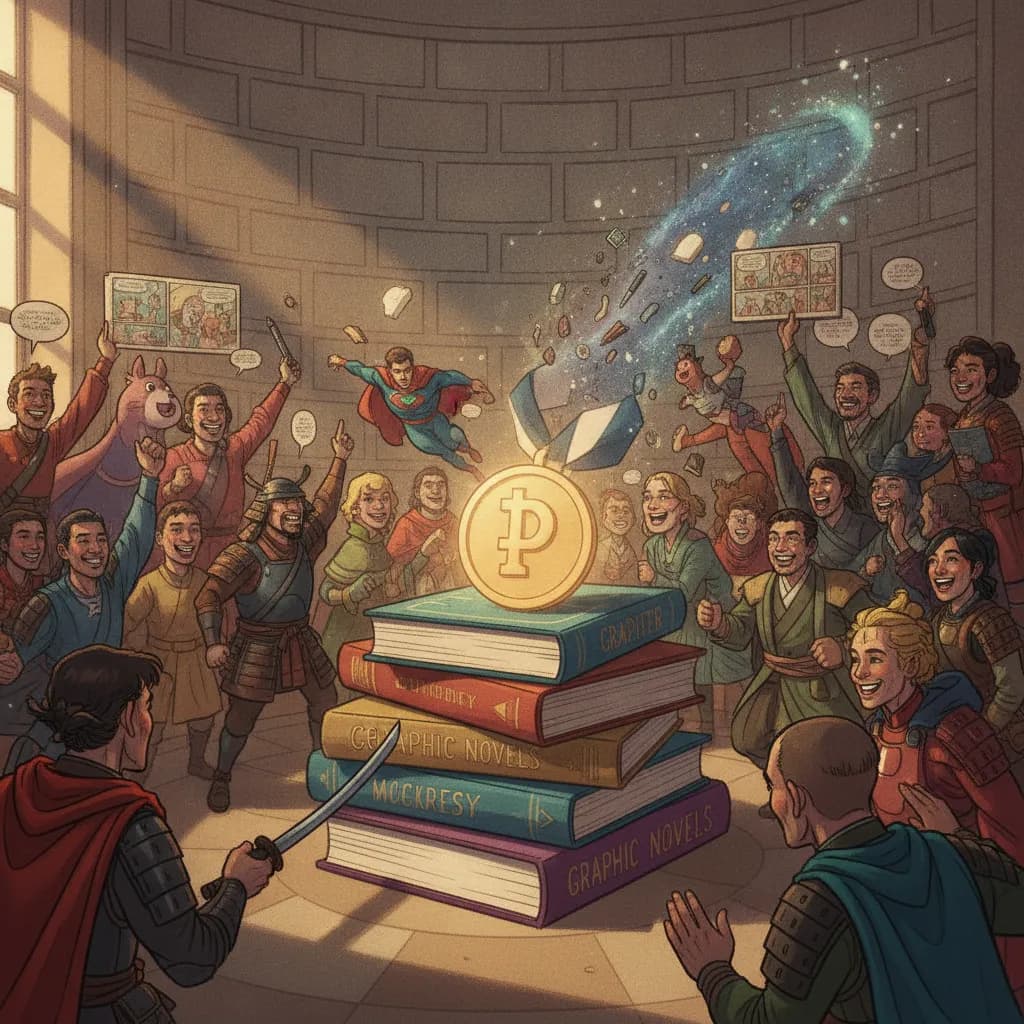
Graphic Novels
A medium that had to win a special Pulitzer Prize just to prove to critics that a comic book could tell a story as seriously as any novel.
Cheat Sheet
- A graphic novel is a longer, self-contained narrative told through comic-style sequential art and text, distinguishing it from ongoing serialized comic book issues.
- The term gained mainstream recognition partly through Will Eisner's A Contract with God (1978), often cited as one of the earliest works explicitly marketed as a "graphic novel."
- Maus, Art Spiegelman's graphic novel depicting his father's Holocaust experience using anthropomorphic animals, won a special Pulitzer Prize in 1992, a major milestone for the medium's literary legitimacy.
- Graphic novels span every genre prose fiction does — memoir, journalism, historical fiction, fantasy — rather than being limited to superhero stories, a common outside misconception.
- The visual grammar of graphic novels, panel layout, pacing, and the interplay between image and text, is considered its own distinct storytelling craft, separate from either pure illustration or pure prose.
- Graphic novels have increasingly been adopted in school curricula and libraries as a legitimate literary form, reflecting a broader critical shift away from viewing the medium as lesser than traditional prose.
The 60-Second Version
A graphic novel is a longer, self-contained narrative told through comic-style sequential art and text, distinguishing it from ongoing serialized comic book issues. The term gained mainstream recognition partly through Will Eisner's A Contract with God (1978), often cited as one of the earliest works explicitly marketed as a "graphic novel." Maus, Art Spiegelman's graphic novel depicting his father's Holocaust experience using anthropomorphic animals, won a special Pulitzer Prize in 1992, a major milestone for the medium's literary legitimacy. Graphic novels span every genre prose fiction does, memoir, journalism, historical fiction, fantasy, rather than being limited to superhero stories, a common outside misconception. The visual grammar of graphic novels, panel layout, pacing, and the interplay between image and text, is considered its own distinct storytelling craft, separate from either pure illustration or pure prose. Graphic novels have increasingly been adopted in school curricula and libraries as a legitimate literary form, reflecting a broader critical shift away from viewing the medium as lesser than traditional prose.
The Long Version
What Actually Makes It a "Graphic Novel"
The term "graphic novel" primarily describes format and scope rather than a specific genre: a longer, self-contained story told through sequential art, distinguishing it from ongoing serialized comic book issues that continue indefinitely across many separate releases. Will Eisner's A Contract with God, published in 1978 and explicitly marketed using the term, is often cited as a pivotal early work in establishing "graphic novel" as a recognized, distinct format in publishing and bookstores.
Maus and the Fight for Literary Legitimacy
Art Spiegelman's Maus, which depicts his father's experience surviving the Holocaust using anthropomorphic animals, mice for Jewish characters and cats for Nazis, became a landmark work for the medium's broader critical legitimacy when it won a special Pulitzer Prize in 1992, a category created specifically to accommodate a work that didn't fit neatly into any existing Pulitzer classification, but that judges felt deserved serious literary recognition regardless.
Beyond Superheroes: The Genre's Real Range
Despite a persistent outside perception that graphic novels are primarily about superheroes, the format actually spans essentially every genre found in prose fiction and nonfiction: memoir, journalism, historical fiction, fantasy, and literary fiction, among many others, with acclaimed works covering everything from personal family history to war reporting to deeply introspective fiction.
The Visual Grammar of Sequential Art
Graphic novels rely on a distinct visual storytelling craft: how panels are sized and arranged on a page controls pacing, the "gutter," the blank space between panels, requires readers to mentally construct the action implied to happen between one image and the next, and the specific interplay between illustrated image and accompanying text creates meaning neither element could achieve fully on its own, a genuinely distinct narrative skill separate from either pure illustration or traditional prose writing.
Ad slot (placeholder — set NEXT_PUBLIC_ADSENSE_SLOT_ID once an ad unit is created)
Glossary
- Graphic novel
- A longer, self-contained narrative told through comic-style sequential art and text.
- Panel
- An individual framed image within a page of sequential art, the basic visual unit of comics and graphic novels.
- Sequential art
- Art telling a story through an ordered sequence of images, the core storytelling method of comics and graphic novels.
- Gutter
- The space between panels on a comic page, where readers mentally fill in the action happening between images.
- Memoir comic
- A graphic novel genre depicting real, autobiographical personal experience through comic-style storytelling.
Go Deeper
- Comic Book Legal Defense Fund
- "Understanding Comics" by Scott McCloud