Camouflage and Mimicry
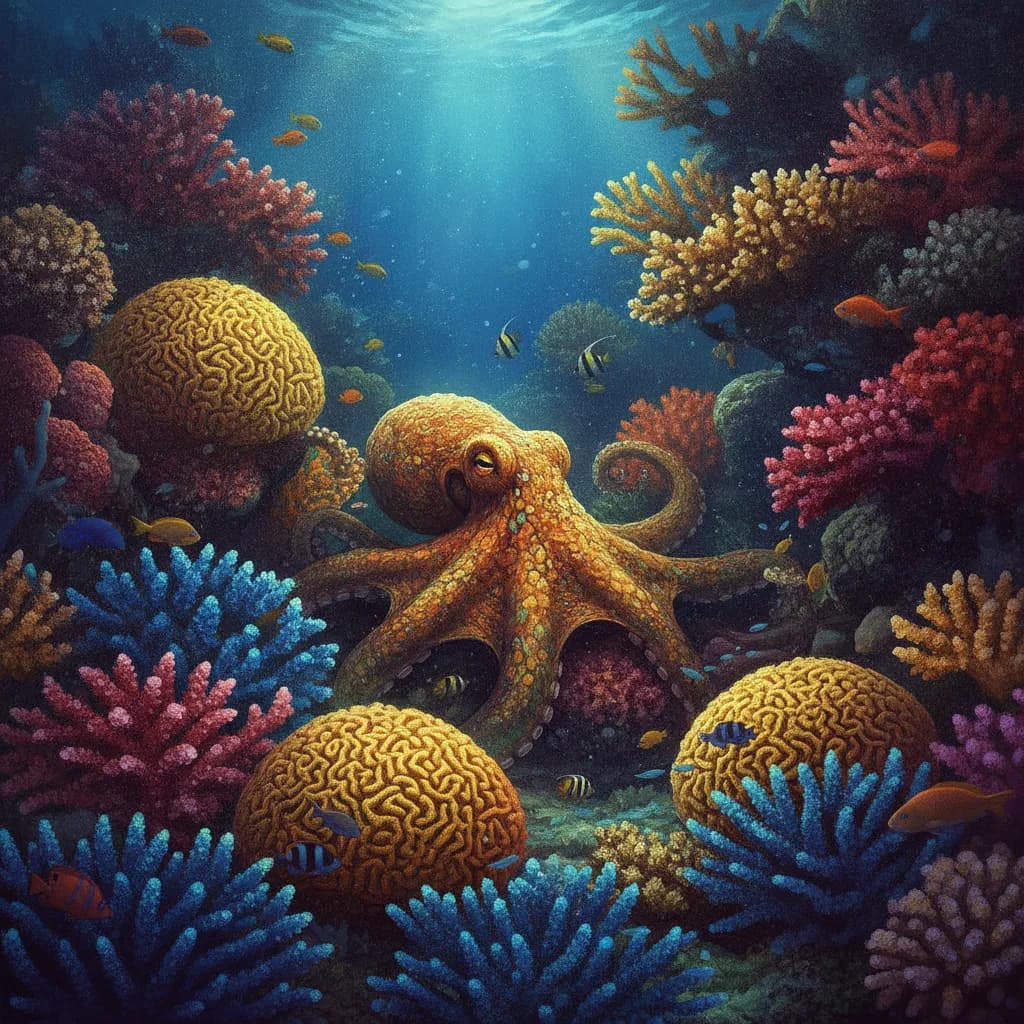
An octopus can rearrange its entire skin pattern to disappear against coral in under a second — no other animal on Earth changes its look that fast.
Cheat Sheet
- Crypsis: blending into the background; the broadest scientific term for camouflage.
- Batesian mimicry: a harmless species copies a dangerous one's warning colors (e.g. hoverflies mimicking wasps).
- Müllerian mimicry: two genuinely dangerous species evolve to look alike, splitting the 'teaching cost' of predators learning to avoid them.
- Cephalopods (octopuses, cuttlefish) change color in under a second using skin cells called chromatophores.
- Countershading: dark on top, light on the belly — used by sharks and deer to flatten their silhouette against light from above.
- Disruptive coloration (zebra stripes, giraffe patches) works by breaking up an outline, not by matching a background color.
The 60-Second Version
Hiding in plain sight and pretending to be something else are two very different survival strategies, and animals across the tree of life have refined both into remarkably specific tricks. Camouflage, or crypsis, works by matching or breaking up an animal's appearance against its surroundings, while mimicry works by copying another species entirely, usually one predators already know to avoid. The two strategies sometimes overlap in the same animal and sometimes get combined with clever tricks like shading the body opposite to how sunlight naturally falls, which flattens an otherwise three-dimensional shape into something far harder to spot. What's often surprising is how much of this happens not through slow-changing fur or feathers but through fast, living cellular machinery, letting some animals shift their appearance in real time rather than being stuck with one look for life. Scientists also distinguish between mimicry aimed at predators and mimicry that runs the other way, with some predators disguising themselves to fool their prey instead.
The Long Version
Two Different Goals, One Word
People often use "camouflage" loosely to cover any kind of animal disguise, but biologists split the concept into crypsis, staying hidden by resembling the environment, and mimicry, standing out just enough to be mistaken for a different, better-defended species — two strategies solving the same underlying problem of survival through completely different means.
Copying the Dangerous Guy
Batesian mimicry is the trick of a harmless animal borrowing the bright warning colors of something genuinely dangerous, banking on a predator's learned caution rather than any real defense of its own, while Müllerian mimicry involves two species that are both actually dangerous converging on a similar appearance, which spreads the cost of "teaching" predators to avoid that pattern across both species instead of each bearing it alone.
Living, Breathing Disguises
Some animals don't rely on fixed coloring at all: cephalopods like octopuses and cuttlefish control specialized skin cells called chromatophores to shift color and even texture within moments, giving them a level of real-time disguise control that fur- or feather-based camouflage simply can't match.
Fooling the Eye With Geometry, Not Just Color
Not every trick is about color-matching a background — countershading, where an animal is dark on top and pale underneath, counteracts the way sunlight naturally falls and flattens its three-dimensional shape, while disruptive patterns like zebra stripes work by breaking up a recognizable outline rather than blending into any single background at all.
Ad slot (placeholder — set NEXT_PUBLIC_ADSENSE_SLOT_ID once an ad unit is created)
Why People Care
Camouflage and mimicry reveal just how much evolutionary ingenuity has gone into the simple act of not being seen or not being recognized, and the same principles have directly inspired everything from military camouflage patterns to modern materials science.
Glossary
- Crypsis
- The general biological term for camouflage, or avoiding detection by blending into an environment.
- Batesian mimicry
- An evolutionary strategy where a harmless species mimics the warning signals of a dangerous one.
- Müllerian mimicry
- Convergent evolution between two genuinely defended species toward a similar warning appearance.
- Chromatophore
- A pigment-containing skin cell that allows animals like octopuses and cuttlefish to change color rapidly.
- Disruptive coloration
- A patterning strategy that breaks up an animal's visible outline rather than matching its background.
Go Deeper
- National Geographic — Animal Camouflage
- Sensory Ecology, by Martin Stevens
More to Explore
- Apex Predators
Reintroducing a single predator species to Yellowstone in 1995 ended up changing the actual physical course of the park's rivers — a chain reaction almost nobody predicted.
- Animal Communication
A honeybee returning to the hive can tell its colony the exact direction and distance of a food source using nothing but a carefully choreographed dance.
- Marine Life
A planet whose oceans cover most of its surface, contain most of its biodiversity, and remain, even today, mostly unexplored.
- Insects
The single most numerous and diverse group of animals on the entire planet isn't mammals, birds, or fish — it's insects, by an overwhelming margin.
- Extinct Species
More than 99% of every species that has ever existed on Earth is already extinct — meaning extinction, not survival, is actually the historical norm.