Octopuses and Cephalopods
Eight arms, three hearts, blue blood, and a skin that doubles as a mood ring and a disguise kit.
By Greg Goodwin · Published October 24, 2026
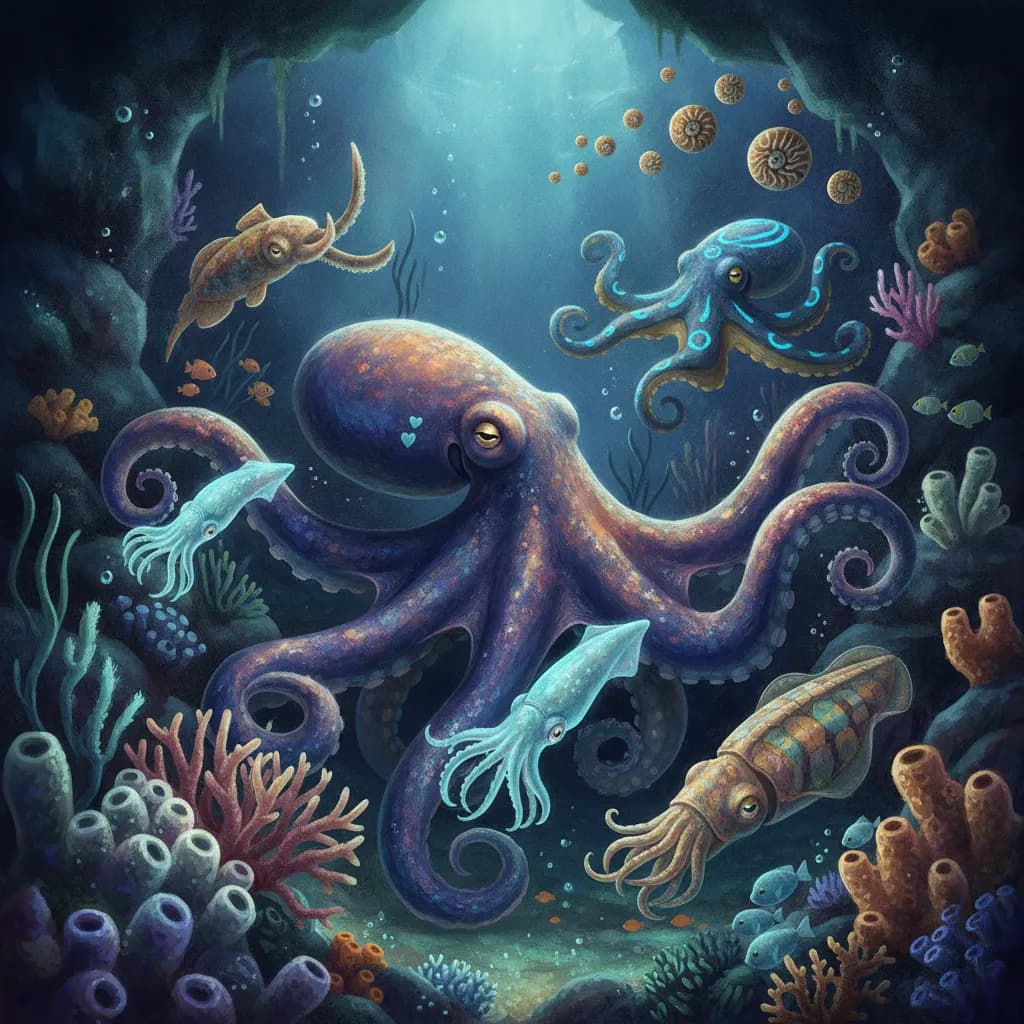
Cheat Sheet
- Octopuses have eight arms; squid and cuttlefish have eight arms plus two longer feeding tentacles.
- The beak is the only hard part of an octopus, so the body fits through any gap the beak can pass.
- Nautiluses are the shelled outlier, keeping an external chambered shell.
- Giant squid reach at least 13 meters including tentacles, per Guinness; the colossal squid is heavier, up to 495 kilograms.
- Work on the squid giant axon helped earn Alan Hodgkin and Andrew Huxley the 1963 Nobel Prize in Physiology or Medicine.
- The UK's Animal Welfare (Sentience) Act 2022 recognizes cephalopod mollusks as sentient.
The 60-Second Version
Cephalopods are a class of mollusks that includes octopuses, squid, cuttlefish, and nautiluses. The name means head-foot in Greek, because their arms grow from the head. Octopuses are the celebrities: soft-bodied and boneless, with three hearts, blue copper-based blood, and eight arms lined with suckers. Britannica says cephalopods have the most highly developed nervous system among invertebrates. The Smithsonian notes that the common octopus has roughly 200 million neurons in its brain, with about two-thirds of a cephalopod's neurons located in its arms, which can act with a good deal of independence. Many species camouflage by changing skin color and texture in a blink, squirt ink to escape, and squeeze through tiny gaps. Giant and colossal squid, meanwhile, are huge deep-sea invertebrates with the largest eyes of any living animal. Most octopuses and squid live only a few years.
The Long Version
A Family of Four Kinds
Cephalopods divide into two broad groups. The soft-bodied coleoids include octopuses, with eight arms and no shell; squid and cuttlefish, which have eight arms plus two longer feeding tentacles; and a few related animals. Squid keep a thin internal support called a pen, while cuttlefish keep a chalky cuttlebone that helps them control buoyancy. The other group contains the nautiluses, which keep an external chambered shell and have many tentacles. All are marine, and most are active predators that hunt crabs, fish, and other prey, using a parrot-like beak to bite.
The Brain in the Arms
The Smithsonian reports that the common octopus has roughly 200 million neurons in its brain, compared with roughly 86 billion in humans by the most common estimate, but that cephalopods are on par with dogs and some monkeys when you count the neurons in their arms, which hold about two-thirds of the total. That is the origin of the popular line that an octopus has nine brains: one central brain plus clusters of nerve cells at the base of each arm that help control movement. In captivity, giant Pacific octopuses at Monterey Bay Aquarium have learned to open jars, play with toys, and recognize their handlers. Comparing intelligence across such different animals is hard, so scientists treat the nine-brain line as a vivid shorthand rather than a precise description.
Built Without a Skeleton
Octopus anatomy reads like science fiction. Two branchial hearts pump blood through the gills and one systemic heart sends oxygenated blood to the rest of the body. Their blood is blue because it carries oxygen with hemocyanin, a copper-based molecule, rather than iron-based hemoglobin. With no bones, the only hard part of an octopus is its beak, so it can flow through any opening the beak can pass. Chromatophores, pigment sacs controlled by muscles, let the skin change color and pattern in a fraction of a second, and jet propulsion and ink clouds help with escapes.
The Giants of the Deep
Giant squid and colossal squid are the largest invertebrates. Guinness World Records lists the giant squid at at least 13 meters in length, much of it tentacles, while the colossal squid is heavier, with a complete specimen caught in 2007 weighing about 495 kilograms. Both have the largest eyes of any living animal, according to the Museum of New Zealand. Different sources give somewhat different typical maximums, and reports of larger animals have not been scientifically verified. Giant squid stayed mostly a mystery until the 2010s, when footage began capturing them alive in their deep-sea habitat, including a widely reported 2012 recording off Japan.
Science, Welfare, and Open Questions
Cephalopods have shaped science more than their size suggests. The squid giant axon, a large nerve fiber, helped Alan Hodgkin and Andrew Huxley work out how nerve impulses travel, earning them the 1963 Nobel Prize in Physiology or Medicine. More recently, evidence of complex behavior pushed governments to act: the UK's Animal Welfare (Sentience) Act 2022 recognizes cephalopod mollusks, along with decapod crustaceans, as sentient. Researchers still debate how to compare cephalopod minds with our own, which makes them a favorite subject for studying how intelligence can evolve in a completely different body plan.
Why People Care
Octopuses and their relatives show that complex minds can arise from a lineage that split from ours more than half a billion years ago, in a body with no skeleton at all. They also raise live questions about animal welfare, fishing, and the limits of what we know about intelligence.
Glossary
- Cephalopod
- A member of the mollusk class that includes octopuses, squid, cuttlefish, and nautiluses; the name means head-foot.
- Hemocyanin
- A copper-based oxygen-carrying molecule that makes cephalopod blood blue.
- Chromatophore
- A pigment-filled skin cell that muscles stretch or shrink to change color quickly.
- Mantle
- The muscular body wall that houses the organs and helps drive jet propulsion.
- Coleoid
- A soft-bodied cephalopod without a large external shell, such as an octopus, squid, or cuttlefish.
Go Deeper
More to Explore
- Mammals
If you have fur, milk, or a cat, you are in the club, and so is a blue whale.
- Wolves
Every dog you have ever met descends from a wolf, but wolves are far more than ancestors.
- Sharks
Sharks are older than trees, and the vast majority are no threat to people.
- Symbiosis
Nature is full of odd couples, and some of those partnerships are the reason complex life exists at all.
- Hibernation
Some animals handle winter by nearly switching themselves off.