Sharks
Sharks are older than trees, and the vast majority are no threat to people.
By Greg Goodwin · Published October 16, 2026 · Updated October 24, 2026
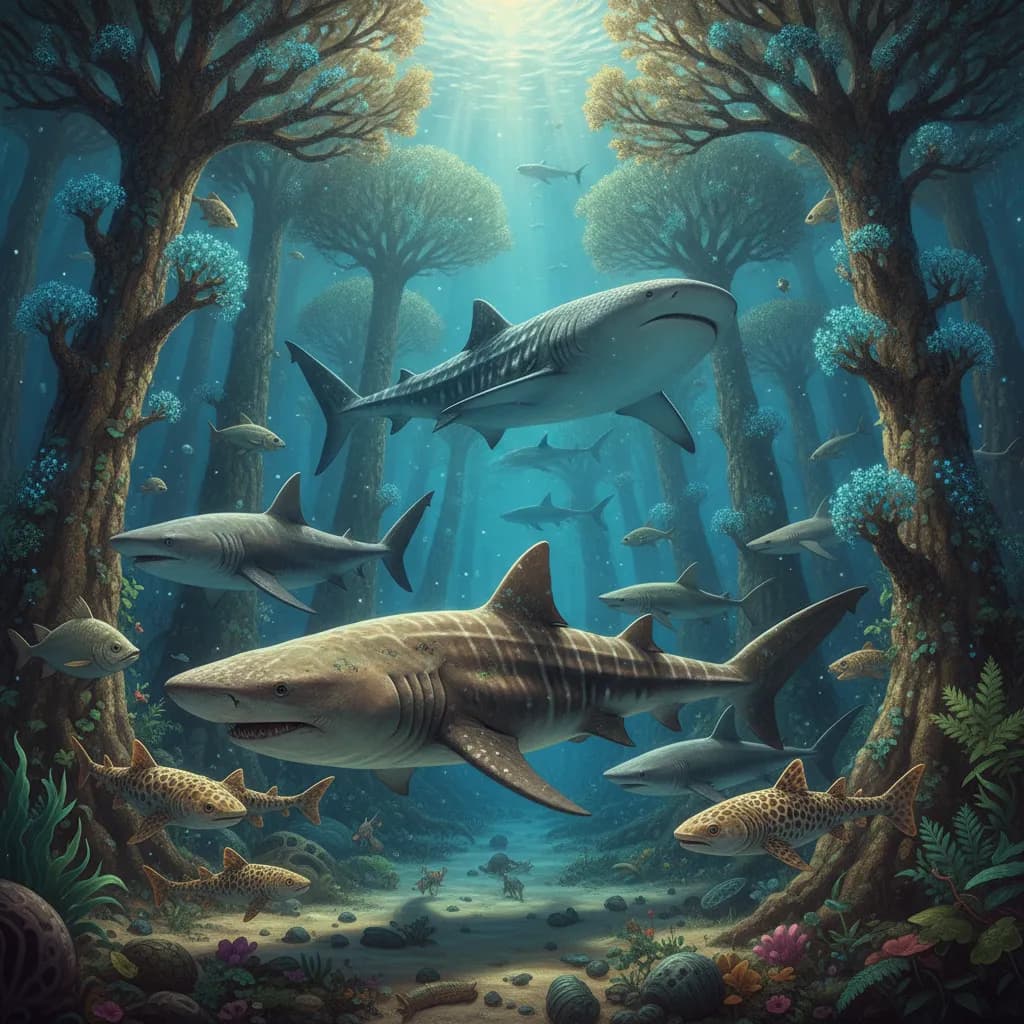
Cheat Sheet
- Diversity: more than 500 known species, from the roughly 20 cm dwarf lanternshark to the whale shark, the largest fish.
- Age: sharks have existed for more than 400 million years, older than trees and dinosaurs.
- Skeleton: made of cartilage rather than bone, and skin covered in tooth-like scales called dermal denticles.
- Diet: whale sharks, basking sharks, and megamouth sharks are filter feeders; great whites hunt seals and fish.
- Longevity: the Greenland shark may live 250 to 500 years, the longest-lived vertebrate known.
- Human risk: roughly 60 to 80 unprovoked bites per year worldwide, with about 5 to 10 fatalities.
The 60-Second Version
Sharks are a diverse group of fish with cartilage skeletons, extraordinary senses, and teeth that are constantly replaced. They fill ocean niches from tiny deep-sea species to giant plankton-eaters, and many are top predators that help keep marine ecosystems balanced. They detect smells in minute concentrations, feel vibrations through a lateral line, and sense the electrical fields of hidden prey. Reproduction varies: some lay eggs, others give birth to live young. Though fear of sharks dominates popular culture, people are a far greater threat to them. Overfishing kills tens of millions each year, and roughly a third of species are threatened with extinction.
The Long Version
An Ancient Design
The earliest shark-like fossils date back more than 400 million years. The cartilage skeleton is lighter and more flexible than bone, and dermal denticles on the skin streamline water flow, an effect that inspired some swimsuit and boat-hull designs. Unlike bony fish, sharks have no swim bladder. Many rely on large, oil-rich livers for buoyancy and on the lift from their fins to keep from sinking. Some species must keep swimming to push water over their gills, while others, like nurse sharks, can rest on the bottom and pump water through their mouths.
Super Senses
A shark's sense of smell can detect blood diluted to parts per billion. The lateral line along the body picks up pressure waves from struggling prey, and electroreceptors on the snout sense the weak electric fields produced by animals' muscles, even those buried in sand. Their eyes have a reflective layer that improves vision in dim water. Together, these senses make sharks efficient hunters, though they are often cautious about unfamiliar objects.
Diverse Lifestyles
Great white sharks, which grow to roughly 4 to 5 meters, ambush seals near the surface. Hammerheads use their wide heads to scan for rays hidden on the seabed. Whale sharks, which reach about 12 meters, swim with mouths open to strain plankton. The Greenland shark, living in cold Arctic waters, grows slowly, and radiocarbon dating of its eye lens suggests some individuals may be centuries old. The extinct megalodon, which died out some 3.6 million years ago, was far larger than any living shark.
Slow to Grow, Slow to Recover
Many sharks mature late and produce few young. Some do not breed until a decade or more old, and females may carry pups for a year or longer. That makes populations vulnerable to overfishing. Fishing, including bycatch and the demand for fins, kills an estimated tens of millions of sharks annually, and a 2021 assessment by the IUCN found that roughly a third of shark and ray species are threatened. Fishing limits, protected areas, and finning bans help, but enforcement is uneven.
Putting the Risk in Perspective
Most of the 500 or so species are harmless to humans. Unprovoked bites are rare, and many are cases of mistaken identity in murky water. In a typical year, far more people are killed by dogs, or by drowning, than by sharks. Still, precautions like avoiding swimming at dawn or dusk, away from seals, and not wearing shiny jewelry are common advice.
Why People Care
Sharks play a key role in ocean food webs, and their decline can ripple through ecosystems. Learning the facts can replace fear with understanding, and support for conservation efforts.
Glossary
- Elasmobranch
- The group of cartilaginous fishes including sharks, rays, and skates.
- Dermal denticles
- Tiny, tooth-like scales that reduce drag and protect a shark's skin.
- Ampullae of Lorenzini
- Jelly-filled pores that detect the faint electric fields of prey.
- Ram ventilation
- Breathing by swimming with the mouth open so water flows over the gills.
- Finning
- Cutting off a shark's fins, often leaving the animal to die, to supply the shark fin trade.
Go Deeper
More to Explore
- Octopuses and Cephalopods
Eight arms, three hearts, blue blood, and a skin that doubles as a mood ring and a disguise kit.
- Mammals
If you have fur, milk, or a cat, you are in the club, and so is a blue whale.
- Wolves
Every dog you have ever met descends from a wolf, but wolves are far more than ancestors.
- Symbiosis
Nature is full of odd couples, and some of those partnerships are the reason complex life exists at all.
- Hibernation
Some animals handle winter by nearly switching themselves off.