Animal Communication
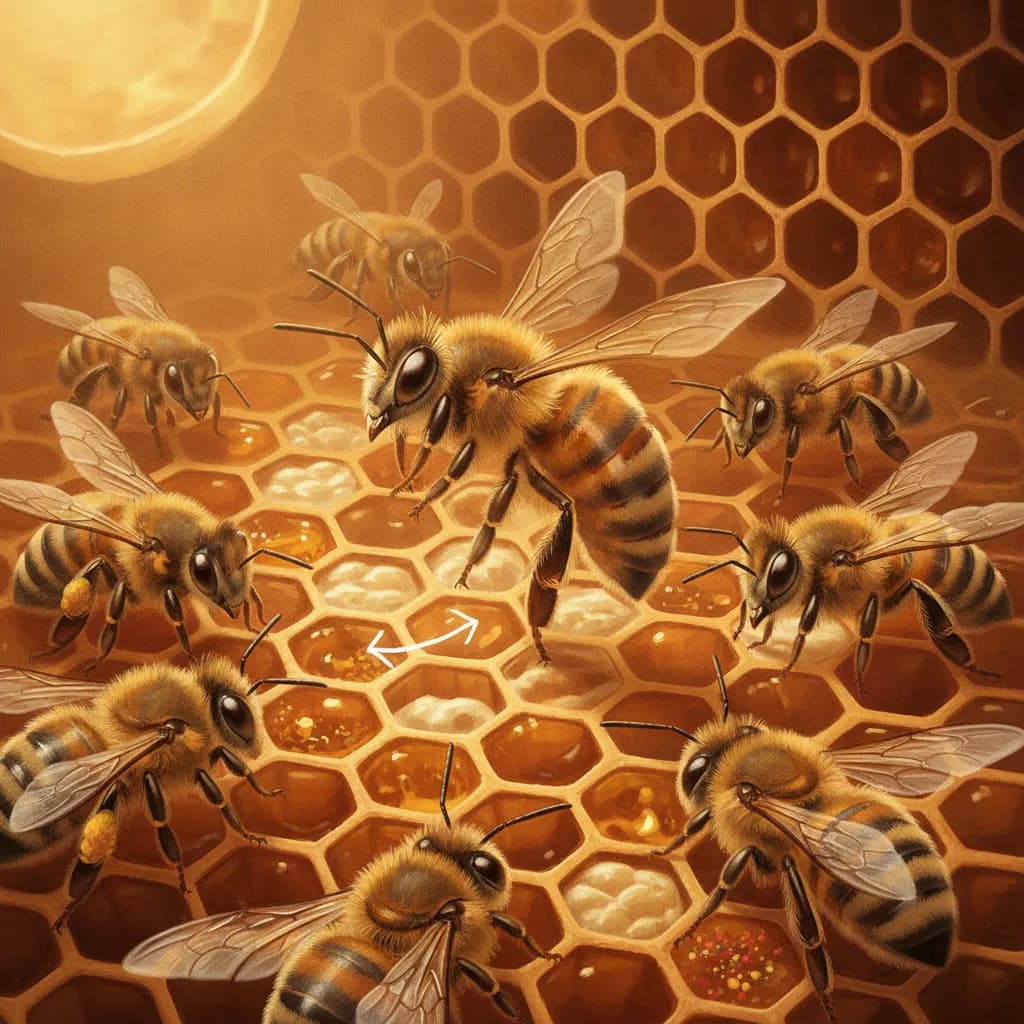
A honeybee returning to the hive can tell its colony the exact direction and distance of a food source using nothing but a carefully choreographed dance.
Cheat Sheet
- Animal communication spans multiple distinct channels: vocal (calls, song), visual (color, posture), chemical (pheromones), and tactile (touch).
- Honeybees perform a 'waggle dance' that encodes both the direction and distance of a food source relative to the sun's position.
- Pheromones are chemical signals detected by smell, used by many insects and mammals to communicate reproductive status, territory, or alarm.
- Some researchers debate whether any animal communication system qualifies as true 'language' in the linguistic sense, versus a fixed set of signals.
- Elephants communicate partly through infrasound — extremely low-frequency sounds below human hearing range — detectable by other elephants miles away.
- Cephalopod (octopus, squid) skin can visually communicate mood and intention through rapid color and pattern changes, a form of communication some researchers describe as remarkably expressive.
The 60-Second Version
Animal communication takes far more forms than the calls and songs most people picture first, spanning vocal signals, visual displays, chemical messages, and even direct physical touch, each channel suited to different environments and social needs. Some of the most sophisticated known examples come from surprisingly small creatures, like honeybees, which perform a precise figure-eight "waggle dance" that encodes both the direction and distance of a food source relative to the position of the sun. Many species also rely heavily on chemical communication through pheromones, scent-based signals detected by smell that can convey information like reproductive status, territorial boundaries, or an alarm warning to nearby members of the same species. Some animals communicate on frequencies entirely outside human perception, including elephants, which use extremely low-frequency infrasound to coordinate with other elephants located miles away, well beyond the reach of any sound a human ear could detect. Whether any of these systems actually qualify as true "language" in the strict linguistic sense, rather than simply a fixed repertoire of specific signals, remains a genuinely unresolved and actively debated question among researchers.
The Long Version
More Channels Than Just Sound
Animal communication spans far more than the vocal calls and songs most people think of first, including visual displays like color and posture, chemical signals detected through smell, and direct physical touch, with different species relying on different combinations of these channels depending on their environment and social structure.
A Dance That Encodes a Map
Among the most sophisticated known examples of animal communication comes from an unexpectedly small creature: honeybees perform a precise figure-eight "waggle dance" upon returning to the hive that encodes both the direction and the distance of a food source relative to the current position of the sun, effectively transmitting a functional map through movement alone.
Talking Through Smell
Many species rely heavily on chemical communication through pheromones, scent-based signals detected by smell rather than sight or sound, which can convey specific information like reproductive readiness, territorial boundaries, or an urgent alarm warning to nearby members of the same species, often over distances or in conditions where visual or vocal signals wouldn't work as well.
Sounds and Signals Beyond Human Perception
Some animals communicate entirely outside the range of human perception, most notably elephants, which use extremely low-frequency infrasound, sound below the threshold of human hearing, to coordinate with other elephants located miles away. Whether any of these communication systems, from waggle dances to infrasound, actually qualify as true "language" in the strict linguistic sense, rather than simply a fixed repertoire of specific signals, remains a genuinely unresolved and actively debated question among researchers studying animal cognition.
Ad slot (placeholder — set NEXT_PUBLIC_ADSENSE_SLOT_ID once an ad unit is created)
Why People Care
Studying animal communication reveals just how much sophisticated information exchange happens across the natural world without anything resembling human language, and it continues to reshape scientific understanding of animal intelligence and social complexity.
Glossary
- Waggle dance
- A figure-eight movement pattern performed by honeybees that encodes the direction and distance of a food source.
- Pheromone
- A chemical signal released by an animal, detected by smell, used to communicate information like reproductive status or alarm.
- Infrasound
- Extremely low-frequency sound below the range of human hearing, used by animals like elephants for long-distance communication.
- Alarm call
- A vocalization used by many animal species to warn nearby individuals of a specific type of threat or predator.
- Animal language debate
- An ongoing scientific and philosophical debate over whether any animal communication system meets the formal linguistic definition of a language.
Go Deeper
- Smithsonian Magazine — How Animals Talk to Each Other
- Karl von Frisch's honeybee dance research (Nobel Prize, 1973)
More to Explore
- Apex Predators
Reintroducing a single predator species to Yellowstone in 1995 ended up changing the actual physical course of the park's rivers — a chain reaction almost nobody predicted.
- Camouflage and Mimicry
An octopus can rearrange its entire skin pattern to disappear against coral in under a second — no other animal on Earth changes its look that fast.
- Marine Life
A planet whose oceans cover most of its surface, contain most of its biodiversity, and remain, even today, mostly unexplored.
- Insects
The single most numerous and diverse group of animals on the entire planet isn't mammals, birds, or fish — it's insects, by an overwhelming margin.
- Extinct Species
More than 99% of every species that has ever existed on Earth is already extinct — meaning extinction, not survival, is actually the historical norm.