The Treaty of Versailles
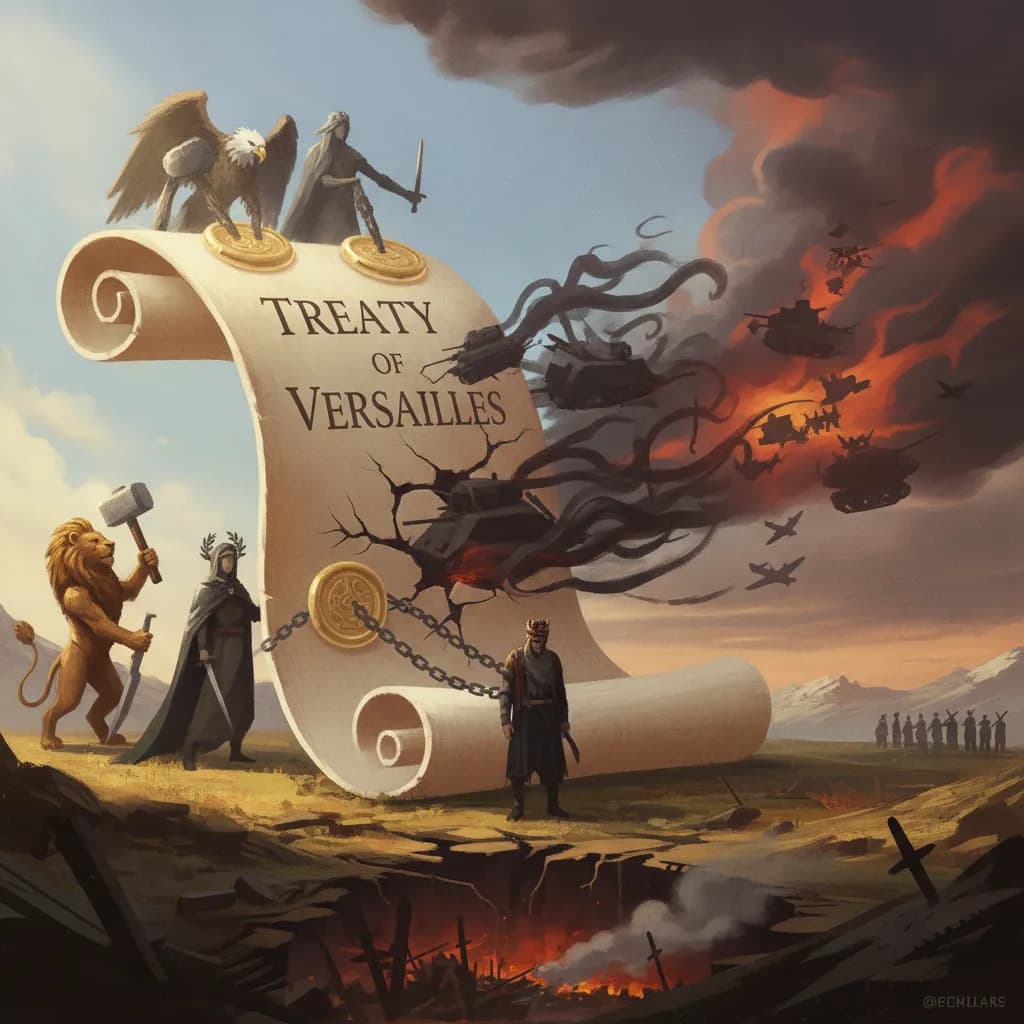
The treaty meant to prevent another world war is often blamed for helping cause the next one.
By Greg Goodwin · Published October 16, 2026 · Updated October 24, 2026
Cheat Sheet
- Signed June 28, 1919, in the Hall of Mirrors at Versailles, five years to the day after Archduke Franz Ferdinand was assassinated.
- Big Three: Woodrow Wilson (US), David Lloyd George (Britain), and Georges Clemenceau (France); Germany was not allowed to negotiate.
- Territory: Germany lost about 13% of its land and about 10% of its population, including Alsace-Lorraine to France.
- Military limits: army capped at 100,000 men, no air force, no tanks, and a small navy.
- Reparations: set at 132 billion gold marks in 1921, though much was later reduced or never paid.
- US stance: the Senate rejected the treaty, so the United States never joined the League of Nations.
The 60-Second Version
World War I ended with an armistice in November 1918, but the formal peace took months of bargaining in Paris. The winners, led by Britain, France, and the United States, drew up terms that stripped Germany of territory and colonies, capped its military, and made it accept responsibility for the war and pay reparations. Germany's delegates were summoned to sign what they regarded as a dictated peace. The treaty also created the League of Nations, a new body meant to settle disputes before they became wars, but the US Senate refused to ratify it. Many Germans resented the terms, and the new democratic government was tarred as having accepted them. Historians still argue over how harsh the treaty truly was and how much it contributed to the rise of the Nazis.
The Long Version
The Peace Conference
The Paris Peace Conference opened in January 1919, with delegates from over 30 countries but with the major decisions made by the Big Three. Wilson arrived with the Fourteen Points and hope for a just peace. Clemenceau, whose country had been invaded twice in his lifetime and had suffered devastating losses, wanted security and compensation. Lloyd George, under public pressure to make Germany pay, tried to moderate French demands. The result was a compromise that satisfied no one fully. Russia, then in revolution, was absent, and defeated nations were excluded.
What the Treaty Required
Germany returned Alsace-Lorraine to France, gave up land to Poland (creating the "Polish Corridor" to the sea), Belgium, and Denmark, and lost all overseas colonies. The Saar coal region came under League administration, and the Rhineland was demilitarized. The army was limited to 100,000 volunteers, conscription was banned, and Germany could have no air force or submarines. Article 231, the war guilt clause, provided the legal basis for reparations, though the Allies used it narrowly; many Germans read it as a moral accusation.
Reparations and Their Impact
The reparations bill was fixed in 1921 at 132 billion gold marks, payable in installments, a sum most economists considered too large to pay quickly. Germany struggled to pay, and in 1923 France and Belgium occupied the Ruhr, triggering hyperinflation. Later arrangements like the Dawes Plan (1924) and Young Plan (1929) reduced the burden, and payments largely ended in 1932. Germany ultimately paid only a fraction of the total. Economist John Maynard Keynes famously attacked the treaty in 1919 as a "Carthaginian peace" that would damage Europe's economy.
A Contested Legacy
The treaty's critics say it humiliated Germany without disarming it permanently, fueling nationalism and the "stab-in-the-back" myth that the army had been betrayed at home. Defenders point out that Germany's own treaty with Russia in 1918, Brest-Litovsk, was far harsher, and that Germany remained the strongest economy in Europe. Many historians now emphasize that the Great Depression, political instability, and the choices of German elites were more decisive than the treaty itself. The failure to enforce the terms, as when Hitler remilitarized the Rhineland in 1936, further undermined it.
The League Without America
Wilson campaigned for the treaty but was incapacitated by a stroke in 1919. The Senate, led by Henry Cabot Lodge, objected to commitments under the League's Covenant, and it voted against ratification. The US signed a separate peace with Germany in 1921. The League, lacking American membership and strong enforcement, struggled to address crises in the 1930s, and it was replaced by the United Nations in 1945.
Why People Care
The Treaty of Versailles is the classic example of how a peace settlement can shape the decades after. After World War II, the Allies deliberately chose different approaches, including the Marshall Plan, partly in reaction to Versailles. It remains a touchstone in debates about justice, punishment, and reconciliation after wars.
Glossary
- War guilt clause
- Article 231, which stated that Germany and its allies were responsible for the loss and damage of the war.
- Reparations
- Payments imposed on Germany to compensate Allied countries for war damage.
- Fourteen Points
- Wilson's January 1918 peace program, which included self-determination and a league of nations.
- Rhineland
- German territory bordering France that was demilitarized under the treaty.
- Diktat
- 'Dictated peace,' the German term for the treaty, which many Germans viewed as imposed rather than negotiated.
Go Deeper
More to Explore
- Pearl Harbor
One Sunday-morning raid lasting under two hours pulled a reluctant United States into the largest war in history.
- The Battle of Britain
A few thousand pilots, a new technology called radar, and one very well-organized control system kept Britain in the war.
- The Battle of Stalingrad
A city named for Stalin became the place where Hitler's advance in the East finally broke.
- The Marshall Plan
One 1947 Harvard commencement speech set in motion roughly $13 billion in aid to rebuild war-wrecked Western Europe.
- The Manhattan Project
Over 130,000 people worked on the Manhattan Project at its peak, and most had no idea what they were building.