Pearl Harbor
One Sunday-morning raid lasting under two hours pulled a reluctant United States into the largest war in history.
By Greg Goodwin · Published October 16, 2026 · Updated October 24, 2026
Cheat Sheet
- Date and place: Sunday, December 7, 1941, at the US Navy base on Oahu, Hawaii, starting at about 7:55 a.m. local time.
- Toll: 2,403 Americans killed (2,335 service members and 68 civilians); about 64 Japanese servicemen died.
- Force: 6 Japanese aircraft carriers launched 353 aircraft in two waves, plus 5 midget submarines.
- Damage: all 8 US battleships in port were hit; 4 were sunk, and about 188 aircraft were destroyed.
- USS Arizona: 1,177 crew members died, nearly half the day's total deaths; the wreck remains in place as a memorial.
- Missed targets: the US carriers were at sea, and the fuel tank farms and repair yards were left largely intact.
The 60-Second Version
By late 1941, Japan had spent years fighting in China and was looking south toward the oil, rubber, and tin of Southeast Asia. The United States, Britain, and the Dutch responded with sanctions, including a freeze on Japanese assets and an oil embargo that threatened to starve Japan's war machine. Japanese leaders decided to eliminate the one force that could stop their advance, the US Pacific Fleet, and on the morning of December 7 they struck its base at Pearl Harbor, Hawaii, with carrier-launched bombers and torpedo planes. The attack killed 2,403 Americans and wrecked much of the battleship fleet. But it missed the aircraft carriers, which were away, and it left the base's fuel and repair facilities standing. The next day, Congress declared war on Japan, and within days Germany and Italy declared war on the United States, joining the Pacific and European conflicts into one world war.
The Long Version
The Road to December 7
Japan had invaded Manchuria in 1931 and launched a full-scale war in China in 1937. After Japan occupied southern French Indochina in 1941, the United States froze Japanese assets and cut off oil exports, which supplied most of Japan's fuel. Negotiations dragged on through the autumn, with Washington demanding a withdrawal from China and Tokyo unwilling to give up its gains. Japan's military planners concluded they had a narrow window to seize the resource-rich colonies of Southeast Asia before their oil reserves ran low, and that the US Navy was the obstacle. Admiral Isoroku Yamamoto, who had studied in the United States and doubted Japan could win a prolonged war, nonetheless designed a daring plan to knock out the fleet in a single blow and hope the shock would push Washington toward a settlement.
The Attack
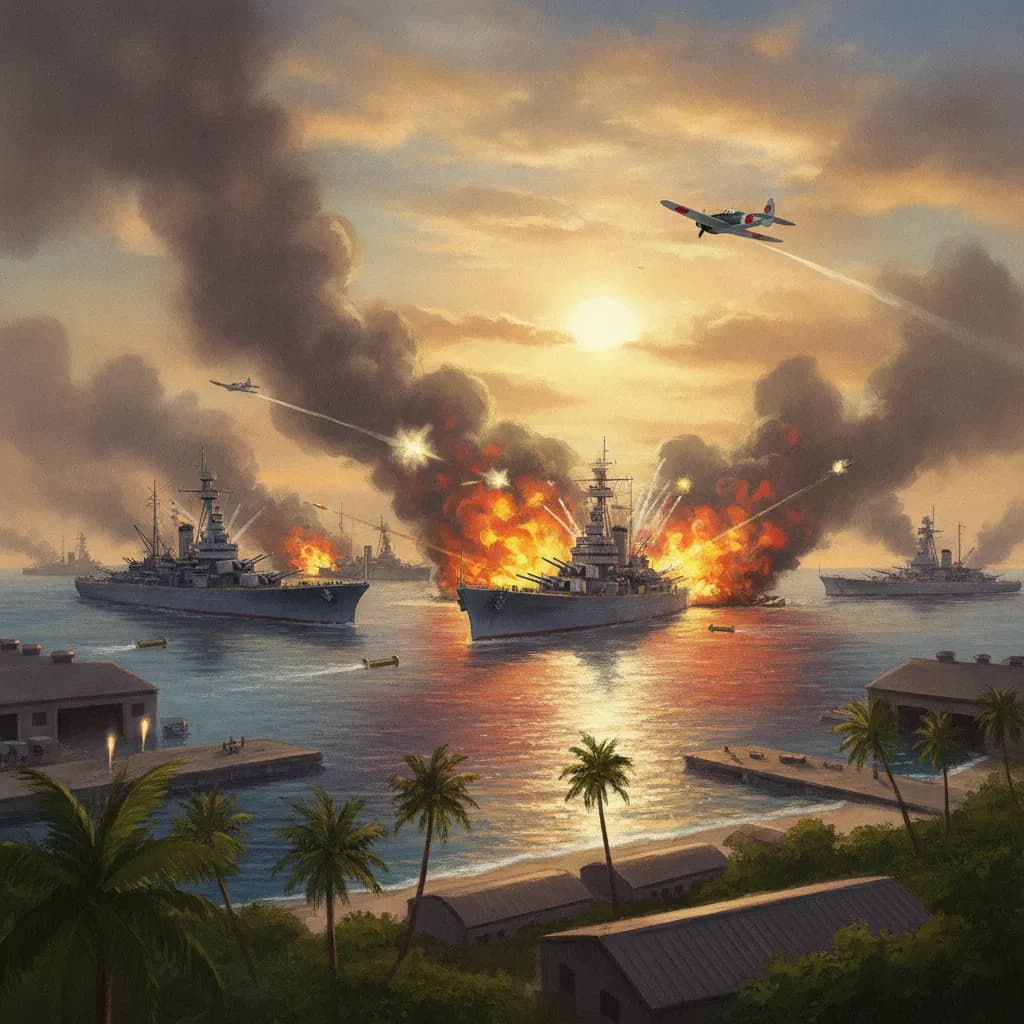
A task force of six carriers sailed in radio silence across the northern Pacific and launched its first wave about 230 miles north of Oahu. At 7:55 a.m., torpedo bombers, dive bombers, and fighters hit the battleships moored along Ford Island and the airfields around the island. A second wave followed an hour later. By about 9:45 a.m. it was over. Eight battleships were damaged or sunk, along with cruisers, destroyers, and other vessels. The USS Arizona blew up when a bomb detonated its forward ammunition magazine, killing 1,177 of its crew. Hundreds of aircraft on the ground were destroyed, largely because they were parked wingtip to wingtip as a precaution against sabotage. The Japanese lost 29 aircraft and all five midget submarines.
What the Raid Missed
Despite the devastation, the attack failed to achieve its aim. The aircraft carriers Enterprise and Lexington were delivering aircraft to other islands, and Saratoga was on the West Coast. Japan also did not strike the huge oil storage tanks, the submarine base, or the repair yards, which meant damaged ships could be salvaged quickly. All but three of the battleships were eventually returned to service. Six months later, American carriers won the Battle of Midway, a turning point that would have been far harder without those surviving ships and facilities.
America Responds
On December 8, President Franklin D. Roosevelt addressed Congress, calling December 7 "a date which will live in infamy." The Senate voted unanimously for war and the House with a single dissenting vote, from Representative Jeannette Rankin. Isolationist sentiment, which had been strong, collapsed almost overnight. On December 11, Germany and Italy declared war on the United States, and Congress reciprocated. Industry shifted rapidly to war production, and millions enlisted in the months that followed.
Hard Questions and Long Memory
Pearl Harbor also left more troubling legacies. In February 1942, fears of disloyalty led to Executive Order 9066 and the forced incarceration of about 120,000 people of Japanese ancestry, most of them American citizens, a policy the US government formally apologized for in 1988. Historians have also debated for decades whether American leaders had enough warning to prevent the surprise; investigations found failures of communication and imagination rather than a conspiracy. Today the USS Arizona Memorial, built over the sunken battleship, is among the most visited sites in Hawaii.
Why People Care
Pearl Harbor is a hinge of the 20th century, the moment the United States moved from the sidelines to the center of World War II. It also remains a lasting case study in intelligence failure, in how sanctions and strategy can escalate toward war, and in how fear in wartime can lead democracies to violate the rights of their own citizens.
Glossary
- Battleship Row
- The line of moored US battleships along Ford Island that took the heaviest hits.
- Isoroku Yamamoto
- The Japanese admiral who planned the attack, who had reportedly warned that Japan could not win a long war against the US.
- Oil embargo
- The 1941 US freeze on Japanese assets and halt on oil exports, which pushed Japan toward seizing resources in Southeast Asia.
- Executive Order 9066
- The February 1942 order that led to the forced removal and incarceration of about 120,000 people of Japanese ancestry on the West Coast.
- Midget submarine
- A small two-man submarine; Japan sent five on the raid, and none achieved lasting results.
Go Deeper
More to Explore
- The Battle of Britain
A few thousand pilots, a new technology called radar, and one very well-organized control system kept Britain in the war.
- The Treaty of Versailles
The treaty meant to prevent another world war is often blamed for helping cause the next one.
- The Battle of Stalingrad
A city named for Stalin became the place where Hitler's advance in the East finally broke.
- The Marshall Plan
One 1947 Harvard commencement speech set in motion roughly $13 billion in aid to rebuild war-wrecked Western Europe.
- The Manhattan Project
Over 130,000 people worked on the Manhattan Project at its peak, and most had no idea what they were building.