The Battle of Stalingrad
A city named for Stalin became the place where Hitler's advance in the East finally broke.
By Greg Goodwin · Published October 16, 2026 · Updated October 24, 2026
Cheat Sheet
- Dates: August 23, 1942 to February 2, 1943, in the city of Stalingrad (now Volgograd) on the Volga River.
- Scale: total casualties on both sides are estimated at roughly 1.5 to 2 million, making it one of the deadliest battles in history.
- Encirclement: Operation Uranus began November 19, 1942, and closed the ring around the German Sixth Army in four days.
- Trapped: roughly 250,000 to 300,000 Axis troops were caught in the pocket.
- Prisoners: about 91,000 were taken at the end, and only a small fraction ever returned home.
- Command: Soviet General Vasily Chuikov defended the city; German General Friedrich Paulus commanded the Sixth Army.
The 60-Second Version
In summer 1942, Germany launched a new offensive in southern Russia aimed at the oil fields of the Caucasus. Part of that drive pushed toward Stalingrad, an industrial city on the Volga with Stalin's name on it. German bombers reduced much of it to rubble, and the fighting turned into months of savage combat in factories, streets, and basements, with the Soviets clinging to a thin strip along the riverbank. In November, the Red Army struck the weakly held flanks of the German line and surrounded the Sixth Army. Hitler refused to allow a breakout, the air supply effort failed, and the trapped troops starved and froze. Paulus surrendered at the end of January 1943, and the last pockets gave up by February 2. It was a catastrophic defeat for Germany and a turning point of the war.
The Long Version
Why Stalingrad
Germany's 1942 plan, Case Blue, aimed to capture the oil fields of Baku and cut off Soviet supplies. Stalingrad was originally a flank objective: its location on the Volga mattered for river traffic. But as the battle grew, symbolism took over. For Hitler, capturing a city bearing Stalin's name was a prize. For Stalin, losing it was unthinkable. Both sides poured in resources far beyond the city's strategic value, turning it into a contest of will.
Fighting Street by Street
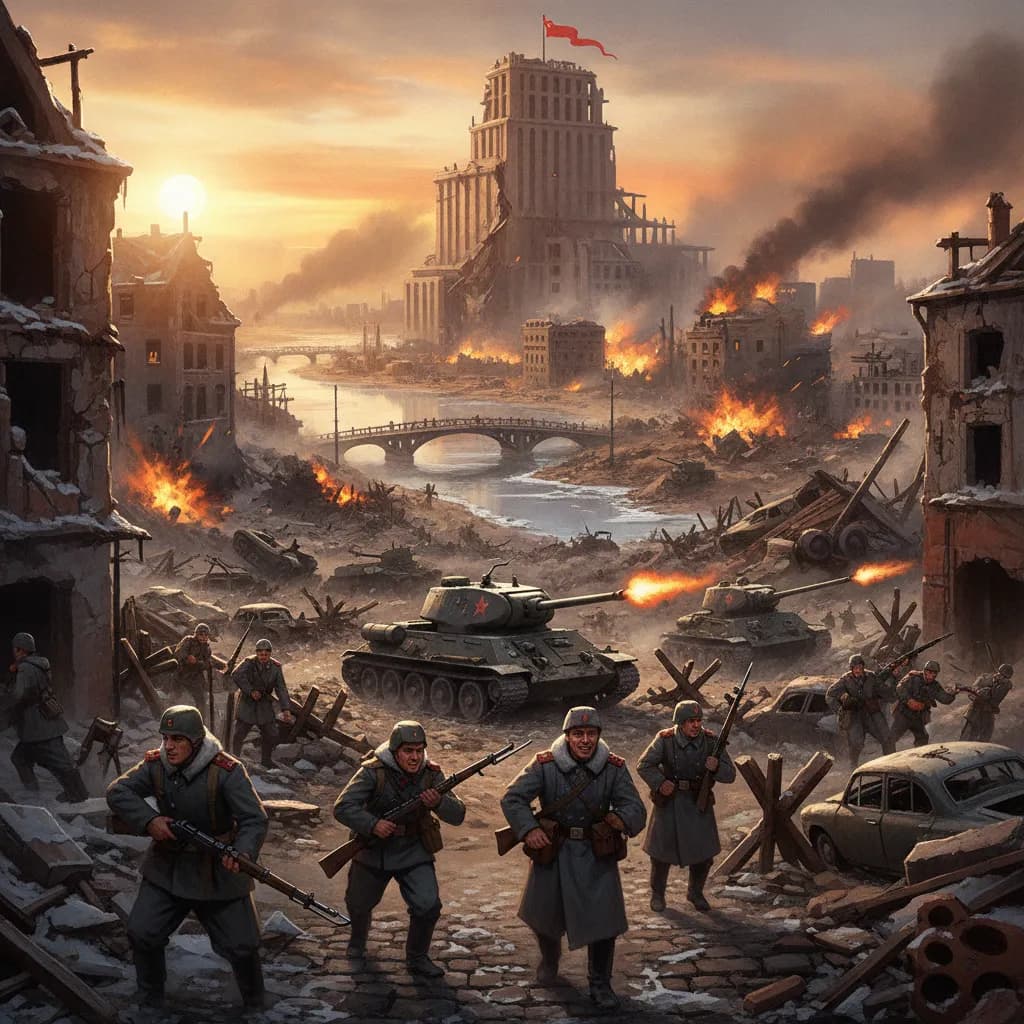
German forces reached the Volga in late August after heavy bombing killed thousands of civilians. Then came the grinding fight. Soviet General Vasily Chuikov ordered his troops to stay as close as possible to the Germans, so that the Luftwaffe and artillery could not hit one side without hitting the other. Battles raged over single buildings, the grain elevator, the Red October factory, and Mamayev Kurgan, a hill overlooking the city. Reinforcements were ferried across the river at night under fire. Snipers such as Vasily Zaytsev became famous. Average life expectancy for new Soviet soldiers was said to be very short.
The Trap
While the Germans bled in the city, Soviet planners gathered reserves to the north and south. On November 19, Operation Uranus hit Romanian armies guarding the flanks, which lacked heavy anti-tank weapons. Soviet pincers met at Kalach on November 23, sealing in about a quarter of a million Axis troops. Hitler ordered the Sixth Army to stay, and Luftwaffe chief Hermann Göring promised to supply it by air. The aircraft could deliver only a fraction of the required tonnage, and Soviet fighters took a toll.
Collapse
A relief attempt by Field Marshal Erich von Manstein in December came within about 30 miles but was stopped, and Paulus did not attempt to break out to meet it. Rations dwindled, frostbite and disease spread, and the airfields were overrun. Hitler promoted Paulus to field marshal on January 30, expecting him to fight to the death, since no German field marshal had been captured; Paulus surrendered the next day. Around 91,000 men went into captivity, and only a small share survived the camps to return.
Aftermath
The defeat shocked Germany, and the Soviets gained confidence and the initiative on the Eastern Front. Germany would later launch offensives such as Kursk, but it was increasingly on the defensive. The cost for the Soviet Union was staggering, with hundreds of thousands of soldiers and civilians killed. In 1961 the city was renamed Volgograd, and a huge memorial now stands on Mamayev Kurgan.
Why People Care
Stalingrad is often called the turning point of the war in Europe. It shows how overreach, rigid leadership, and logistics failures can turn an army into a trap, and it remains among the most studied battles in military history.
Glossary
- Operation Uranus
- The Soviet offensive that surrounded the German Sixth Army by attacking weaker allied units on the flanks.
- Rattenkrieg
- 'Rat war,' the German soldiers' name for the brutal close-quarters fighting in the ruins.
- Sixth Army
- The largest German field army, which was destroyed at Stalingrad.
- Order No. 227
- Stalin's July 1942 'Not one step back' order, aimed at halting retreats.
- Eastern Front
- The theater of fighting between Germany and the Soviet Union, the largest land war in history.
Go Deeper
- Encyclopaedia Britannica — Battle of Stalingrad
- Stalingrad, by Antony Beevor
More to Explore
- Pearl Harbor
One Sunday-morning raid lasting under two hours pulled a reluctant United States into the largest war in history.
- The Battle of Britain
A few thousand pilots, a new technology called radar, and one very well-organized control system kept Britain in the war.
- The Treaty of Versailles
The treaty meant to prevent another world war is often blamed for helping cause the next one.
- The Marshall Plan
One 1947 Harvard commencement speech set in motion roughly $13 billion in aid to rebuild war-wrecked Western Europe.
- The Manhattan Project
Over 130,000 people worked on the Manhattan Project at its peak, and most had no idea what they were building.