The Battle of Britain
A few thousand pilots, a new technology called radar, and one very well-organized control system kept Britain in the war.
By Greg Goodwin · Published October 16, 2026 · Updated October 24, 2026
Cheat Sheet
- Dates: conventionally July 10 to October 31, 1940, with the peak in August and September.
- Opponents: Germany's Luftwaffe versus the Royal Air Force, mainly RAF Fighter Command under Air Chief Marshal Hugh Dowding.
- Aircraft: Hawker Hurricanes (which scored the most kills) and Spitfires against Messerschmitt Bf 109 fighters and Bf 110, Heinkel, Dornier, and Junkers bombers.
- Losses: roughly 1,000 RAF aircraft and nearly 1,900 German aircraft; about 544 Fighter Command aircrew died.
- Turning points: September 7, when Germany switched to bombing London, and September 15, 'Battle of Britain Day.'
- Result: Germany postponed Operation Sea Lion, its planned invasion, on September 17, and it was never launched.
The 60-Second Version
In June 1940, France fell, and Britain stood alone against Nazi Germany. Hitler hoped Britain would negotiate, but when it refused, he ordered preparations for an invasion across the English Channel. That plan depended on first defeating the Royal Air Force, so the Luftwaffe began attacking Channel shipping, then ports, airfields, and radar stations. The RAF, with Hurricanes and Spitfires directed by radar and a centralized command network, fought back in the skies over southern England. After a German raid accidentally bombed London and Britain retaliated against Berlin, Hitler shifted to bombing cities, which gave the RAF crucial breathing room. By mid-September, Germany had failed to gain air superiority, and the invasion was postponed indefinitely. It was Germany's first major defeat.
The Long Version
Britain Alone
After the evacuation at Dunkirk and the fall of France, Britain had a small army, a large navy, and a modest air force. Prime Minister Winston Churchill rejected any peace terms, declaring in June that "this was their finest hour." Germany planned Operation Sea Lion, but German naval commanders knew the Royal Navy could sink a crossing force unless the Luftwaffe controlled the air. That made the RAF the decisive target. Germany had more aircraft, but the RAF had advantages: it was fighting over its own territory, its pilots who bailed out could fly again, and its fighters had a short distance to reach the battle.
Radar and the Dowding System
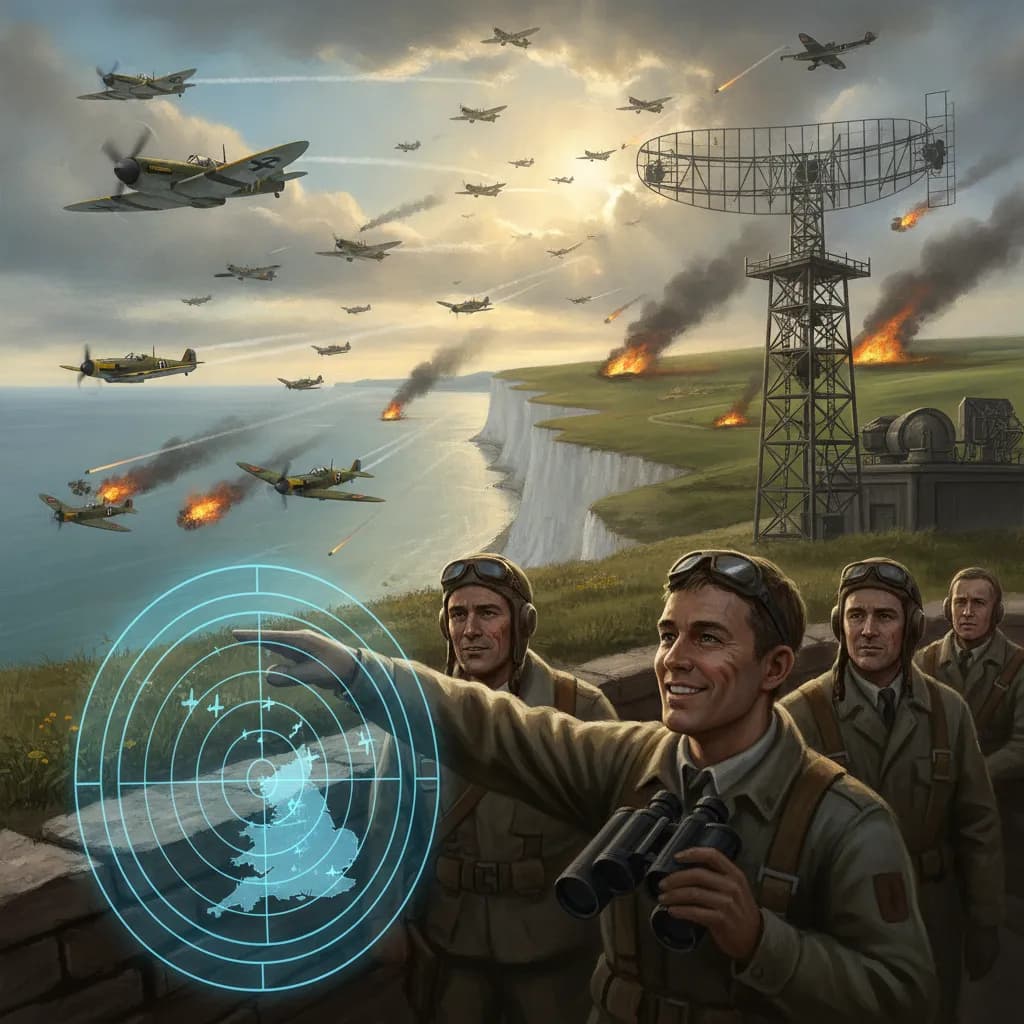
The real secret weapon was information. Britain had built a line of radar stations, Chain Home, along its coast, which could detect aircraft forming up over France. Reports flowed to a control center at Fighter Command headquarters and then to regional group and sector stations, where controllers vectored squadrons to meet raiders. Dowding and his group commander Keith Park used this system to commit fighters only where needed, preserving strength. Without it, the RAF would have needed to keep patrols constantly in the air, which it could not afford.
The Fight Over Southern England
The big German effort began in August, with "Eagle Day" on August 13. For weeks the Luftwaffe hit airfields and sector stations, and the RAF was strained, particularly by pilot shortages rather than aircraft production. Pilots flew several sorties a day. They came from Britain, the Commonwealth, and occupied Europe, including Polish and Czechoslovak airmen; No. 303 Polish Squadron became the highest-scoring squadron in the battle. Around 2,900 Allied airmen took part, and more than 500 from Fighter Command were killed.
The Shift to London
On the night of August 24, German bombers off course hit London. Britain retaliated by bombing Berlin, which enraged Hitler, and on September 7 he ordered massive daylight raids on London. This relieved pressure on the airfields. On September 15, large formations attacked and met strong resistance, and German losses were heavy. Two days later, Hitler postponed Sea Lion. The Luftwaffe turned to night bombing, the Blitz, which killed tens of thousands of civilians but did not break British morale or its war industry.
Why It Mattered
Britain's survival kept a base for later operations, including the bombing campaign and the eventual D-Day invasion. It also showed that Germany could be stopped. Churchill's August 20 speech gave the airmen the nickname "the Few." Historians continue to debate whether the invasion was ever truly feasible, but the battle remains a symbol of resistance.
Why People Care
The Battle of Britain is often described as the first great battle fought entirely in the air. It illustrates how technology, organization, and logistics can matter as much as raw numbers, and it remains one of the defining national stories of Britain.
Glossary
- Chain Home
- The chain of coastal radar stations that gave the RAF early warning of incoming raids.
- Dowding System
- The integrated network of radar, observers, and sector control rooms that guided fighters to intercept attackers efficiently.
- Operation Sea Lion
- Germany's code name for the planned amphibious invasion of southern England.
- The Few
- Churchill's term for the Allied airmen of the battle, from his August 20, 1940 speech.
- The Blitz
- The sustained German night bombing of British cities from September 1940 to May 1941.
Go Deeper
More to Explore
- Pearl Harbor
One Sunday-morning raid lasting under two hours pulled a reluctant United States into the largest war in history.
- The Treaty of Versailles
The treaty meant to prevent another world war is often blamed for helping cause the next one.
- The Battle of Stalingrad
A city named for Stalin became the place where Hitler's advance in the East finally broke.
- The Marshall Plan
One 1947 Harvard commencement speech set in motion roughly $13 billion in aid to rebuild war-wrecked Western Europe.
- The Manhattan Project
Over 130,000 people worked on the Manhattan Project at its peak, and most had no idea what they were building.