The Crusades
Two centuries of popes, kings, and detours, plus a numbering system that historians treat as more of a suggestion.
By Greg Goodwin · Published November 4, 2026
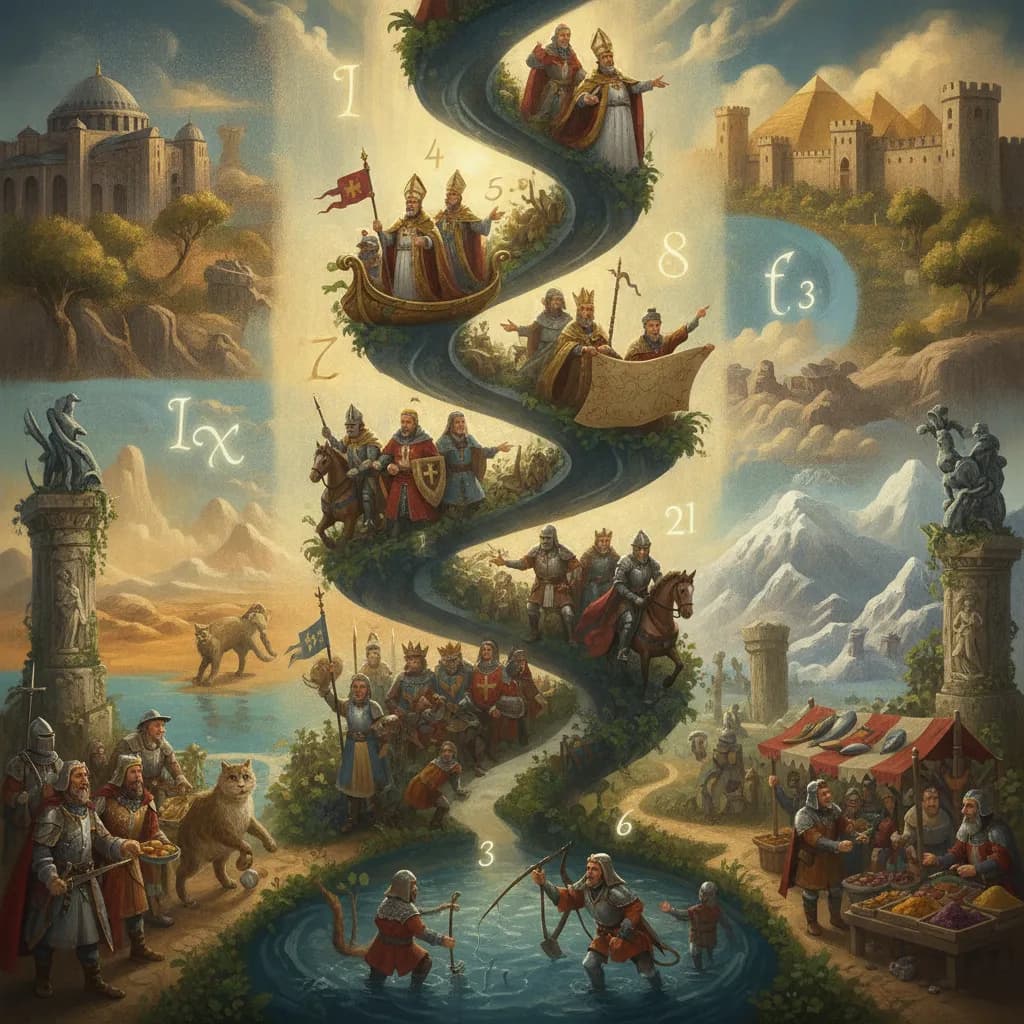
Cheat Sheet
- Launch: Pope Urban II called for the First Crusade at the Council of Clermont, convened on November 18, 1095.
- Jerusalem: the First Crusade's army took the city on July 15, 1099 after a siege that began June 7.
- Numbering: the traditional count of nine Crusades to the Holy Land is usually credited to Charles Mills in 1820, and historians call it a convenience.
- Third Crusade: 1189 to 1192, a response to Saladin's victory at Hattin in 1187; it recovered Acre and Jaffa but not Jerusalem.
- Fourth Crusade: 1202 to 1204, diverted to Zara and then Constantinople, which was sacked in April 1204.
- End date: 1291, when Acre fell and the Latin Christians were expelled from Syria; crusading continued in other forms for centuries.
The 60-Second Version
The Crusades were a series of religious-military expeditions, called by the papacy and carried out largely by western European Christians from the late eleventh century onward. The best-known aimed at the Holy Land, especially Jerusalem, but crusading also reached Spain, the Baltic, and other targets, and it lasted centuries. Participants took vows, wore the cross, and were promised spiritual rewards. Behind the religious language were politics, trade, family ambition, and an appeal from the Byzantine emperor for help against the Seljuq Turks. The campaigns founded Christian-ruled states along the eastern Mediterranean coast, brought Europe into lasting contact with the Islamic world and Byzantium, and left a contested legacy that shapes how they are remembered today. Even the basic scorekeeping is debated, and historians disagree about what counts as a crusade and when the story ends.
The Long Version
The Call at Clermont
By the late eleventh century the Seljuq Turks had taken most of Asia Minor from the Byzantine Empire, and Emperor Alexius Comnenus sought aid from the West. Pope Urban II convened the Council of Clermont on November 18, 1095. According to Britannica, he addressed a large crowd and urged action for Eastern Christians and the holy places, though his exact words are unknown because the surviving accounts were written years later. The council also granted a plenary indulgence to those who aided Christians in the East. The response was immediate and larger than Urban had probably anticipated, with cries of "Deus le volt," meaning "God wills it," and volunteers took the cross.
The First Crusade
Popular bands under Peter the Hermit, often called the People's Crusade, set out ahead of the main army and were largely destroyed in Anatolia. In 1096 crusading bands also attacked Jewish communities in Rhineland towns including Speyer, Worms, Mainz, and Cologne. The main force left in August 1096 in four major contingents; Britannica notes that no king took part. After capturing Antioch on June 3, 1098, the army reached Jerusalem, then held by the Fatimids, in June 1099. Crusaders entered on July 15, 1099, and Britannica describes a general slaughter of Muslim and Jewish residents. Founders then established the Crusader states: Edessa, Antioch, Jerusalem, and Tripoli.
Saladin, Richard, and the Third Crusade
The Crusader states proved difficult to hold. Edessa fell to Zangi in 1144, and in 1187 Saladin's victory at the Battle of Hattin led to the loss of the kingdom of Jerusalem. The Third Crusade, from 1189 to 1192, was led by Richard I of England and Philip II of France, with Frederick I of the Holy Roman Empire also involved. It recaptured Acre and Jaffa and reversed much of Saladin's conquests, but did not retake Jerusalem. It ended with a truce, the Treaty of Jaffa, usually dated to September 2, 1192, which left Muslim control of Jerusalem in place while allowing unarmed Christian pilgrims and merchants to visit.
Detours and Disputes
Not every crusade went where it was aimed. The Fourth Crusade, from 1202 to 1204, was meant for Egypt or Jerusalem but was redirected, first to the Dalmatian city of Zara in 1202 and then to Constantinople, which the crusaders sacked in April 1204. The Latin Empire of Constantinople that followed lasted until 1261. The label also stretched beyond the Holy Land. The Albigensian Crusade, launched in 1209, was aimed at the Cathars of southern France, and papally organized Baltic campaigns ran from the twelfth to the fifteenth century. The Children's Crusade of 1212 is contested; recent research suggests the participants were not necessarily children, and its details are debated.
Counting and Ending the Crusades
The standard scheme of nine Crusades to the Holy Land, from the First Crusade of 1095 to 1099 to the Ninth of 1271 to 1272, is usually credited to Charles Mills's 1820 history. Scholars treat it as a convenience: some historians count only five large expeditions, others note the numbers are inconsistent, and there is no consensus about numbering after the Fourth Crusade. Historians also disagree on what counts as a crusade. Jonathan Riley-Smith defined it as an expedition under papal authority, which excludes the Spanish Reconquista; others use a wider definition. The traditional end date is 1291, when Acre fell and the Latin Christians were expelled from Syria. Britannica notes that crusading continued for centuries and declined rapidly in the sixteenth century.
Why People Care
The Crusades are invoked in politics, religion, and popular culture far more often than they are understood. Knowing the dates, the actors, and the scholarly debates helps you tell what the history shows from what later speakers have borrowed from it.
Glossary
- Crusade
- A military expedition sanctioned by the papacy; historians debate how broadly to define the word.
- Plenary indulgence
- A remission of all penance for sin, granted at Clermont to those who aided Christians in the East.
- Crusader states
- The territories founded after the First Crusade, including Edessa, Antioch, Jerusalem, and Tripoli.
- Franks
- The name Muslims used for the largely French-speaking participants in the Crusades.
- Seljuq Turks
- A Turkic dynasty that expanded into Anatolia and the Middle East in the 11th century.
Go Deeper
More to Explore
- The Black Death
The worst pandemic in European history arrived by ship, stayed for four years, and rearranged the continent's economy on its way out.
- The Vikings
They sailed to Newfoundland nearly five centuries before Columbus, and still the internet insists on putting horns on their helmets.
- The Middle Ages
A thousand years of European history that gets remembered as knights, castles, and plague, and was a lot more than that.
- Watergate
A taped-open door at a Washington office complex ended with a president resigning, and a suffix that now follows every scandal.
- The Hittites
They ran a Bronze Age superpower, fought Egypt to a draw, and then helped write history's oldest surviving peace treaty.