The Black Death
The worst pandemic in European history arrived by ship, stayed for four years, and rearranged the continent's economy on its way out.
By Greg Goodwin · Published October 24, 2026
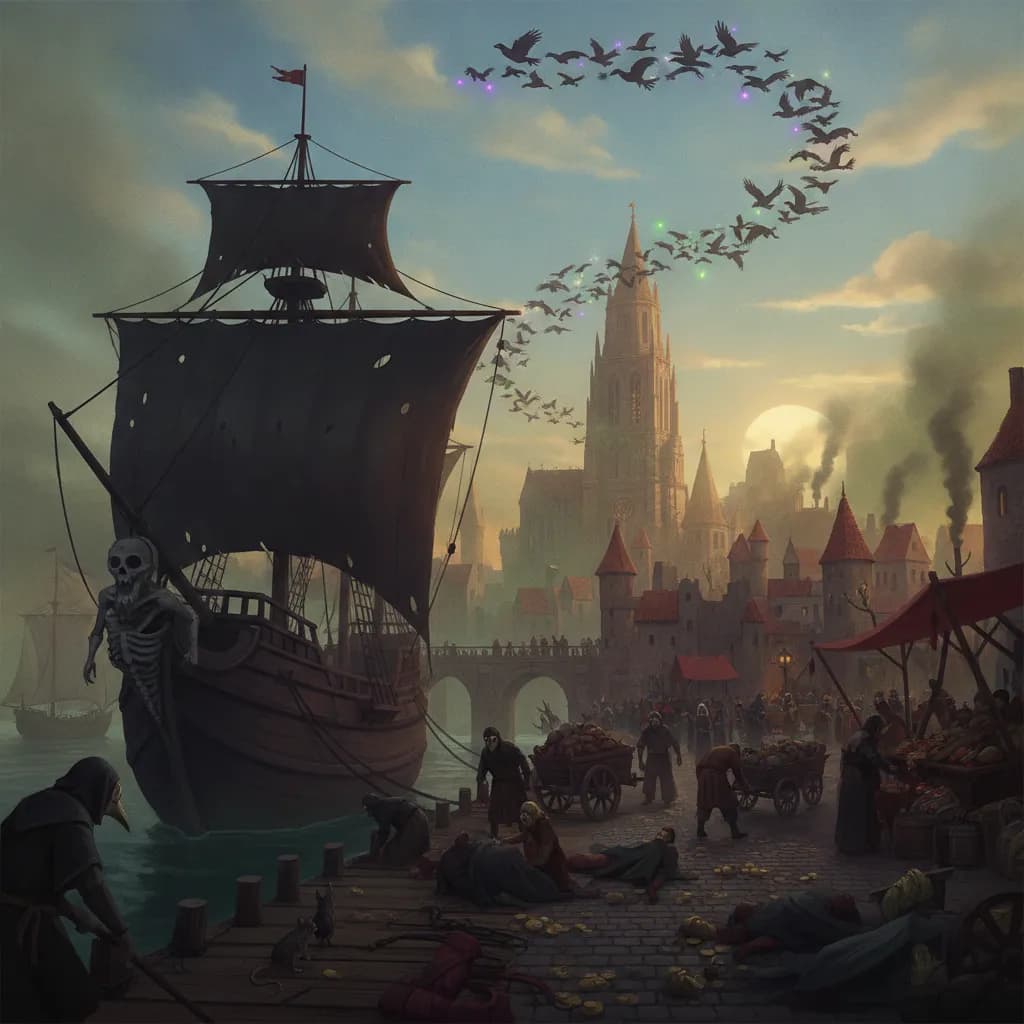
Cheat Sheet
- Dates: the main wave swept Europe from 1347 to 1351, with plague returning in later outbreaks for centuries.
- Death toll: scholars' estimates run from about one third to one half of Europe's population, and some argue higher. Estimates vary by a factor of two.
- Pathogen: the bacterium Yersinia pestis, confirmed in victims' remains from mass graves across northern, central and southern Europe.
- Genome: a Y. pestis genome reconstructed from London victims of 1348 to 1350 was published in Nature in 2011.
- Entry point: the plague reached the Sicilian port of Messina on trade ships from the Black Sea in 1347.
- Aftermath: England's Statute of Labourers (1351) tried to freeze wages, and the Peasants' Revolt followed in 1381.
The 60-Second Version
The Black Death was a plague pandemic that tore through Europe, North Africa and the Middle East in the middle of the fourteenth century. It reached Europe in 1347 aboard trade ships from the Black Sea and burned through the continent by 1351. The cause was Yersinia pestis, a bacterium that lives in rodents and spreads through flea bites, though it could also pass directly from person to person. Victims typically developed painful swellings, fever and chills, and many died within days. Nobody knows the exact toll. Estimates range from roughly a third of Europe's people to half or more, and some regions were hit far harder than others. Entire villages emptied, graveyards overflowed, and labor became scarce. That scarcity changed wages, landholding and even religion, which is why historians treat the plague as a hinge moment between the medieval and early modern worlds.
The Long Version
Where It Came From
The plague arrived in Europe in 1347, when trade ships from the Black Sea reached the Sicilian port of Messina. From there it followed the same shipping lanes that carried grain, cloth and spices, hopping from port to port around the Mediterranean and then inland along roads and rivers. A study in Nature traced the genetic roots of the pathogen to graves near Lake Issyk Kul in what is now Kyrgyzstan, which challenged older theories of a Chinese origin. The exact route eastward is still debated, but the central point is simple: a thriving trade network gave a fast-moving disease an excellent highway.
The Disease Itself
For years some scholars doubted that plague was the culprit. Ancient DNA settled much of the argument. A 2010 study found Yersinia pestis signatures in skeletons from mass graves in northern, central and southern Europe, and a 2011 Nature paper reconstructed a genome from London victims who died between 1348 and 1350. The paper's authors concluded that the Black Death was the major event that spread the ancestor of the plague strains now infecting humans. The classic image is the bubonic form, with swollen lymph nodes called buboes, but the bacterium can also infect the lungs, which spreads through coughing.
How Many Died
Nobody knows precisely, because medieval record keeping was patchy and estimates come from extrapolating tax rolls, wills and clergy replacement lists. Philip Ziegler's influential 1969 account put the loss at about one European in three. John Aberth argues for about half. Ole Benedictow's 2021 work proposes a figure of 60 percent or more, a claim that remains contested. Regions varied sharply: some towns lost most of their people, while a few places seem to have been spared. Because estimates differ by a factor of two, careful writers give a range rather than a single number.
Fear, Faith, and Early Public Health
People grasped for explanations. Some blamed bad air, planetary alignments or divine punishment, and the persecution of minority groups, especially Jewish communities, broke out in a number of towns. Others turned to flagellant processions or fled the cities altogether. In Florence, Giovanni Boccaccio set his Decameron among a group of young people sheltering from the plague in 1348. Gradually, cities in Italy began experimenting with isolating ships and the sick, an approach that evolved into formal quarantine. It worked imperfectly, but it planted the idea that governments could act against disease.
What Changed Afterward
With so many workers gone, survivors found that their labor was suddenly worth more. Landowners in England responded with the Statute of Labourers in 1351, an attempt to freeze wages at pre-plague levels. It failed to stop wages from rising and fed resentment that helped fuel the Peasants' Revolt of 1381. Historians also link the plague to shifts in religious practice, art, and the decline of strict feudal obligations in parts of Western Europe. Plague did not vanish after 1351; it returned in waves for centuries, shaping the second pandemic that lasted well into the early modern period.
Why People Care
The Black Death is the standard example of how one disease can reshape economies, politics and belief within a single generation. It also keeps showing up in conversations about pandemics, quarantine, and what ancient DNA can reveal about the past.
Glossary
- Yersinia pestis
- The bacterium that causes plague, normally carried by rodents and spread to people by flea bites.
- Bubonic plague
- The form of plague marked by swollen, painful lymph nodes called buboes, usually in the groin, armpit or neck.
- Pneumonic plague
- A form that infects the lungs and can spread directly between people through coughing.
- Quarantine
- Enforced isolation of ships, people or goods suspected of carrying disease, from the Italian for forty days.
- Second pandemic
- The long run of plague outbreaks that began with the Black Death and recurred in Europe for centuries.
Go Deeper
More to Explore
- The Vikings
They sailed to Newfoundland nearly five centuries before Columbus, and still the internet insists on putting horns on their helmets.
- The Middle Ages
A thousand years of European history that gets remembered as knights, castles, and plague, and was a lot more than that.
- The Sumerians
They invented a way to press ideas into clay, and in doing so gave history its first draft.
- The Great Depression
A stock market crash was only the opening act of a decade in which a quarter of American workers had no job to go to.
- Marie Curie
She won two Nobel Prizes in two different sciences, drove X-ray machines to the front lines, and did it all in an era that barely let women into the lab.