Watergate
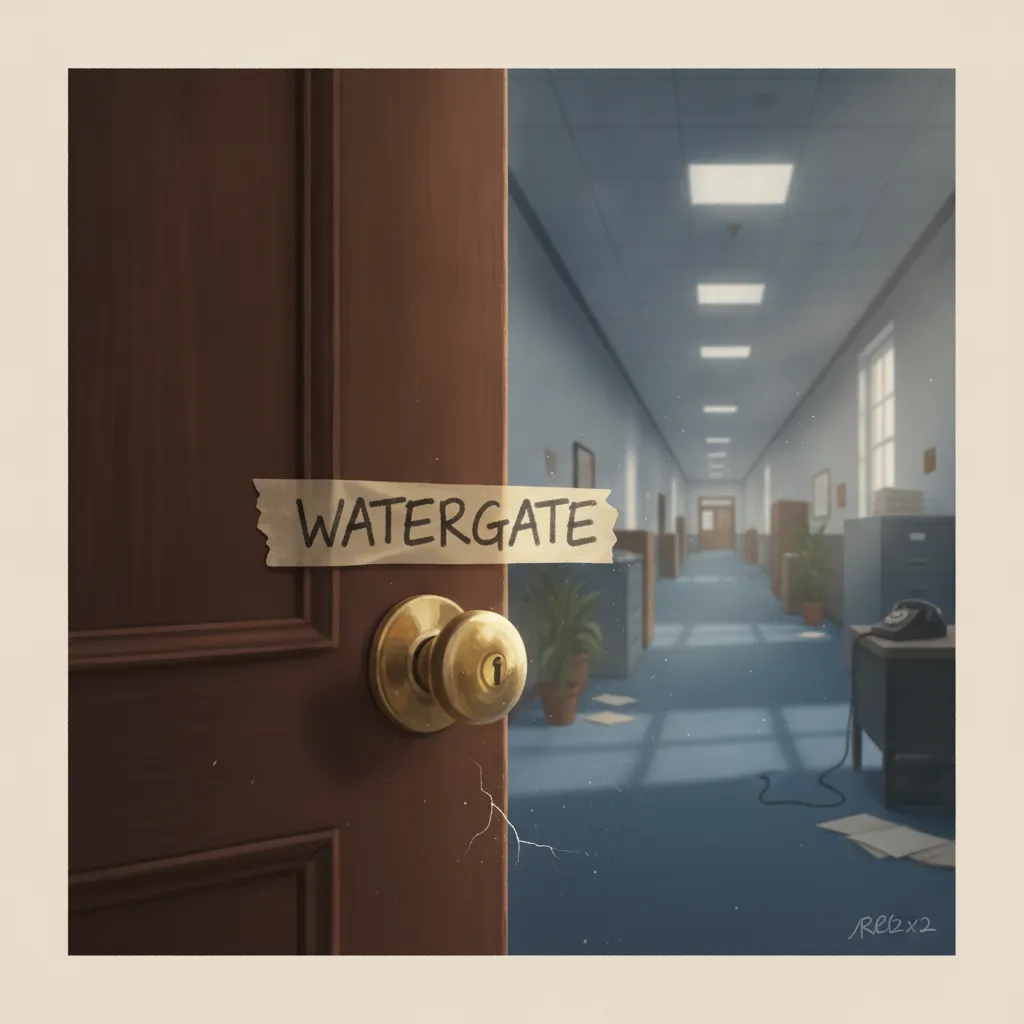
A taped-open door at a Washington office complex ended with a president resigning, and a suffix that now follows every scandal.
By Greg Goodwin · Published November 4, 2026
Cheat Sheet
- Break-in: five burglars were arrested at the Democratic National Committee offices in the Watergate complex on June 17, 1972.
- Police call: security guard Frank Wills's log shows he called police at 1:47 a.m.
- Senate vote: the Senate created the Watergate Committee unanimously on February 7, 1973; Sam Ervin chaired it at age 76.
- Tapes ruling: United States v. Nixon, decided unanimously on July 24, 1974, required the president to hand over the tapes.
- Resignation: Nixon's letter became effective at 11:35 a.m. on August 9, 1974, when Henry Kissinger initialed it.
- Legacy: Watergate gave the world the habit of adding -gate to a word to signal a scandal.
The 60-Second Version
Watergate was a political scandal that grew out of a burglary. In the early hours of June 17, 1972, five men were arrested inside the Democratic National Committee headquarters at the Watergate office complex in Washington, D.C. Investigators found links to President Richard Nixon's re-election campaign. Nixon won re-election in a landslide in November 1972, but the story kept growing as the FBI, the courts, Congress, and the press dug further. Senate hearings in 1973 revealed that the White House had a secret taping system, and a long fight over those recordings ended in the Supreme Court. Facing likely impeachment for his role in covering up the scandal, Nixon resigned on August 9, 1974, the only U.S. president to do so. Watergate reshaped American law on campaign finance, ethics, and government transparency.
The Long Version
The Break-In
According to the National Archives, five burglars broke into the offices of the Democratic National Committee in the Watergate complex during the night of June 17, 1972. A security log shows that guard Frank Wills called police at 1:47 a.m., and the five were arrested inside. The Senate Historical Office says they carried more than $3,500 in cash and high-end surveillance equipment. One of the five, James McCord, was the security chief of the Committee to Re-elect the President, and the FBI quickly found itself in what its own history page calls the most politically sensitive investigation in its history. Britannica adds that the other arrested men had earlier been involved in CIA activities related to Cuba.
Cover-Up and Trial
The story did not end with the arrests. Reporters Bob Woodward and Carl Bernstein of The Washington Post kept publishing articles linking the break-in to the president's campaign, aided by an anonymous source called Deep Throat, later identified as FBI deputy director Mark Felt, who revealed himself in 2005. The White House denied any connection to the break-in, and Nixon was re-elected in November 1972 in a landslide, winning every state but Massachusetts, plus the District of Columbia going the other way. The burglars' trial began on January 10, 1973. Five men pleaded guilty and two were convicted by a jury. Judge John Sirica said he doubted all the facts had come out, and urged defendants awaiting sentencing to cooperate with Congress.
The Senate Hearings and the Tapes
On February 7, 1973, the Senate voted unanimously to create the Select Committee on Presidential Campaign Activities, chaired by Sam Ervin with Howard Baker as vice chairman. Television carried the hearings live for two weeks in May 1973, and the Senate says that within a month 97 percent of Americans had heard of Watergate. Former White House counsel John Dean testified that the president had approved plans to cover up the White House connection, which Nixon denied. Another aide, Alexander Butterfield, revealed that Nixon had a voice-activated taping system. The committee subpoenaed the tapes on July 16, 1973, Nixon refused citing executive privilege, and the committee took the unprecedented step of suing the president on August 9, 1973. The court dismissed that suit for lack of jurisdiction.
The Supreme Court and the Resignation
Special Prosecutor Leon Jaworski pursued the tapes in a separate case. On July 24, 1974, the Supreme Court ruled unanimously in United States v. Nixon that the president must surrender the recordings to the special prosecutor. Nixon complied, and the Senate Historical Office says the tapes showed he had participated in devising a plan to cover up the White House connection to the burglary. The House Judiciary Committee adopted three articles of impeachment. Before the full House could vote, Nixon announced his resignation in a televised speech on August 8 and signed his letter on August 9, 1974. President Gerald Ford pardoned him on September 8, 1974.
What Changed
Watergate prompted a wave of reforms. Congress amended the Federal Election Campaign Act in 1974, imposing limits on spending and contributions and requiring regular reporting. It strengthened the Freedom of Information Act in 1974, overriding a presidential veto, and passed the Government in the Sunshine Act in 1976. The Ethics in Government Act of 1978 required financial disclosure by executive and judicial branch officials and created the Office of Government Ethics. The National Archives still preserves the Watergate Special Prosecution Force records, about 1,362 feet of them, and the FBI notes the word Watergate has become so ingrained that adding -gate to any word signals a scandal.
Why People Care
Watergate is the standard case study in how the press, courts, and Congress can check presidential power. It also explains why we have campaign finance rules, ethics disclosures, and a suspicion of cover-ups that outlasted the original crime.
Glossary
- Committee to Re-Elect the President
- Nixon's 1972 campaign organization, often shortened to CRP or, by critics, CREEP.
- Special prosecutor
- A prosecutor appointed to investigate government officials, with some independence from the officials being investigated.
- Executive privilege
- The president's claimed power to withhold certain communications from Congress and the courts.
- Articles of impeachment
- The formal charges the House of Representatives can adopt against an official; the House Judiciary Committee adopted three against Nixon.
- Pardon
- An official act that forgives a crime; President Ford pardoned Nixon on September 8, 1974.
Go Deeper
More to Explore
- The Great Depression
A stock market crash was only the opening act of a decade in which a quarter of American workers had no job to go to.
- The US Constitution
A few thousand words, drafted in a hot Philadelphia summer, that still decide who gets to run the country and how.
- The Hittites
They ran a Bronze Age superpower, fought Egypt to a draw, and then helped write history's oldest surviving peace treaty.
- The Crusades
Two centuries of popes, kings, and detours, plus a numbering system that historians treat as more of a suggestion.
- Florence Nightingale
She carried a lamp into a war hospital, then carried a very persuasive chart into the halls of government.