Marie Curie
She won two Nobel Prizes in two different sciences, drove X-ray machines to the front lines, and did it all in an era that barely let women into the lab.
By Greg Goodwin · Published October 24, 2026
Cheat Sheet
- Born: Maria Sklodowska in Warsaw, Poland, in 1867.
- Elements: she announced polonium and radium in 1898, naming polonium for her native Poland.
- 1903 Nobel Prize in Physics: shared with Pierre Curie and Henri Becquerel for work on radiation phenomena; she was the first woman awarded a Nobel Prize.
- 1911 Nobel Prize in Chemistry: awarded for isolating radium, making her the only person to win Nobel Prizes in two different sciences.
- Sorbonne: after Pierre's death in 1906, she took over his chair and became the university's first female professor.
- Death: she died on 4 July 1934, aged 66, of aplastic anemia.
The 60-Second Version
Marie Curie was a Polish-born physicist and chemist who did her most famous work in Paris. Working with her husband Pierre, she investigated the mysterious rays given off by uranium, work that helped establish the field of radioactivity. In 1898 the couple announced two new elements, polonium and radium, after laboriously processing tons of ore. In 1903 she shared the Nobel Prize in Physics with Pierre and Henri Becquerel, becoming the first woman to receive a Nobel Prize. After Pierre died in a street accident in 1906, she carried on alone, took over his Sorbonne chair, and won the 1911 Nobel Prize in Chemistry. During the First World War she helped equip mobile X-ray units to diagnose wounded soldiers. Years of exposure to radiation took a toll, and she died in 1934.
The Long Version
From Warsaw to Paris
Maria Sklodowska was born in Warsaw in 1867, at a time when Poland was under foreign rule and higher education for women was restricted. She moved to Paris to study science, and there she met Pierre Curie, a physicist, whom she married. They formed a partnership in which both were researchers rather than one assisting the other. The couple shared a modest, cramped workspace and an obsession with a puzzle: why were certain uranium ores more radioactive than the uranium in them could explain? That question would define her career.
Naming a Phenomenon, Finding Two Elements
Building on Henri Becquerel's discovery of uranium's rays, Marie measured the radiation from uranium compounds and ores. She found that pitchblende emitted far more radiation than expected, which implied a new and powerful source. In 1898 the Curies announced polonium, named for her native Poland, and shortly afterward radium. Announcing an element and producing it are different things, though. Over the next few years, Marie did the heavy work of purifying radium from tons of ore, eventually isolating it as a salt. The effort was physically exhausting and conducted with little protection from the radiation she was handling.
Two Nobel Prizes
The 1903 Nobel Prize in Physics honored research on radiation phenomena and was shared among Marie, Pierre and Henri Becquerel. It made Marie the first woman to win a Nobel Prize. Pierre was killed in a street accident in 1906, a loss that left her a widowed mother of two. She was appointed to his Sorbonne professorship, becoming the first woman to hold a professorship there. In 1911 the Nobel committee awarded her the Prize in Chemistry for isolating radium, and she remains the only person to win Nobel Prizes in two different scientific fields.
Science in a War
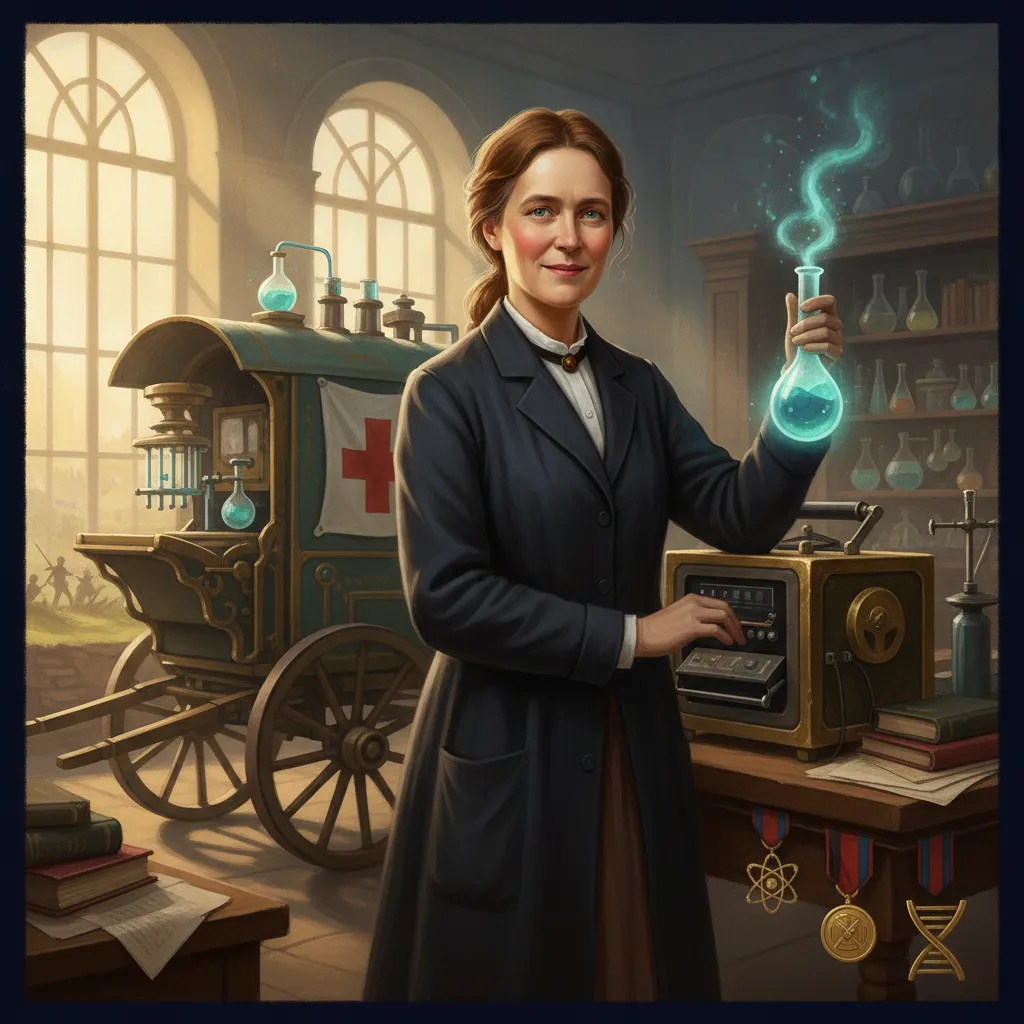
When the First World War began, Curie recognized that X-rays could help surgeons locate bullets and shrapnel. She promoted mobile radiography units that came to be called Little Curies, and she learned to drive so she could take the equipment to hospitals near the front herself. The work shows a practical streak: she moved from laboratory theory to saving lives in the field. It also underlines how little was understood about radiation hazards at the time. Researchers handled radioactive materials without the shielding or monitoring that is routine today.
Legacy and Cost
Marie Curie died on 4 July 1934 at a sanatorium in Passy, France, of aplastic anemia, a blood disorder likely linked to radiation exposure. Accounts differ on whether radium or her wartime X-ray work was the larger factor. Her legacy is enormous: she helped found modern atomic physics, laid groundwork for radiation therapy in medicine, and became a symbol of what determined women could accomplish in science. Her legacy is a reminder that scientific courage and scientific caution have to travel together.
Why People Care
Curie's work launched the study of radioactivity, which underpins modern medicine, from cancer treatment to imaging, and nuclear physics. Her story also remains a touchstone for questions of who gets to do science, and what that work can cost.
Glossary
- Radioactivity
- The spontaneous emission of radiation from unstable atoms, a phenomenon Curie's work helped establish.
- Polonium
- A radioactive element she and Pierre announced in 1898, named after Poland.
- Radium
- A highly radioactive element announced by the Curies in 1898 and later isolated by Marie.
- Pitchblende
- A uranium-rich ore that proved far more radioactive than its uranium content could explain.
- Little Curies
- The nickname for the mobile X-ray vehicles she promoted during the First World War.
Go Deeper
More to Explore
- Alexander Fleming and Penicillin
A messy lab, a summer vacation and a stray mold spore gave medicine its first mass-produced antibiotic, though it took other people to make it work.
- Hippocrates
The most famous doctor in history may be as much a symbol as a person, and the oath with his name on it probably is not his.
- The Sumerians
They invented a way to press ideas into clay, and in doing so gave history its first draft.
- The Great Depression
A stock market crash was only the opening act of a decade in which a quarter of American workers had no job to go to.
- The Black Death
The worst pandemic in European history arrived by ship, stayed for four years, and rearranged the continent's economy on its way out.