The Great Depression
A stock market crash was only the opening act of a decade in which a quarter of American workers had no job to go to.
By Greg Goodwin · Published October 24, 2026
Cheat Sheet
- Market peak and trough: the Dow closed at 381.17 on September 3, 1929, and bottomed at 41.22 on July 8, 1932.
- Black Monday: on October 28, 1929, the Dow fell nearly 13 percent in a single day.
- Unemployment: about 3.2 percent before the crash, peaking around 25 percent in early 1933 depending on the data series.
- Output: real GDP fell roughly 26 to 30 percent from 1929 to 1933, depending on the estimate.
- Deposit insurance: the FDIC came out of the Banking Act of 1933, and coverage began in 1934 at $2,500 per depositor.
- Social Security: Roosevelt signed the Social Security Act on August 14, 1935.
The 60-Second Version
The Great Depression was the longest and deepest economic downturn in modern US history, running from 1929 until the end of the 1930s. It is usually dated from the stock market crash of October 1929, though economists point to deeper causes: fragile banks, unequal incomes, falling prices and a tight money supply. Over the next several years industrial output collapsed, thousands of banks failed, and unemployment climbed to roughly one worker in four by early 1933. Farmers, already struggling, suffered further when drought struck the Plains. President Herbert Hoover's efforts proved too limited for the scale of the crisis, and voters elected Franklin D. Roosevelt in 1932. His New Deal brought bank reforms, public works and, in 1935, Social Security. Recovery was real but uneven, with a sharp relapse in 1937 and 1938. Mobilization for the Second World War finally brought unemployment down to low levels.
The Long Version
The Crash and What Came After
The stock market peaked on September 3, 1929, when the Dow closed at 381.17, according to the Federal Reserve History essay. Then the sell-off began. On Black Monday, October 28, the Dow dropped nearly 13 percent, and the following day, Black Tuesday, brought panic trading. But the crash alone did not create the Depression: the index kept sliding until July 8, 1932, when it closed at 41.22, a fall of close to 90 percent from its peak. The market was a symptom as much as a cause, reflecting a broader collapse in confidence and spending.
The Spiral Downward
Between 1929 and 1933 the economy contracted violently. Estimates of the drop in real GDP range from about 26 percent to nearly 30 percent, depending on the source and the method. Unemployment rose from about 3.2 percent to roughly 25 percent in early 1933, with the figure depending on the series: one common annual estimate is 24.9 percent, while a monthly series peaks at 25.6 percent in May 1933. Banks that had lent heavily failed, taking customers' savings with them, and the failures fed further panic. The 1930 Smoot-Hawley Tariff, which raised duties on imports, drew retaliation from other nations and further cut international trade.
Hoover, Roosevelt, and the New Deal
Hoover believed in voluntary cooperation and limited federal action, and as conditions worsened his approach lost public support. Roosevelt won the 1932 election promising relief, recovery and reform. His first moves in March 1933 included an Emergency Banking Act and a national bank holiday to stop runs on banks. The Banking Act of 1933 created the Federal Deposit Insurance Corporation, which began insuring deposits in 1934 at $2,500 per depositor and raised the limit to $5,000 the next year. Other programs, such as the Civilian Conservation Corps, put unemployed men to work on public projects.
Life During the Depression
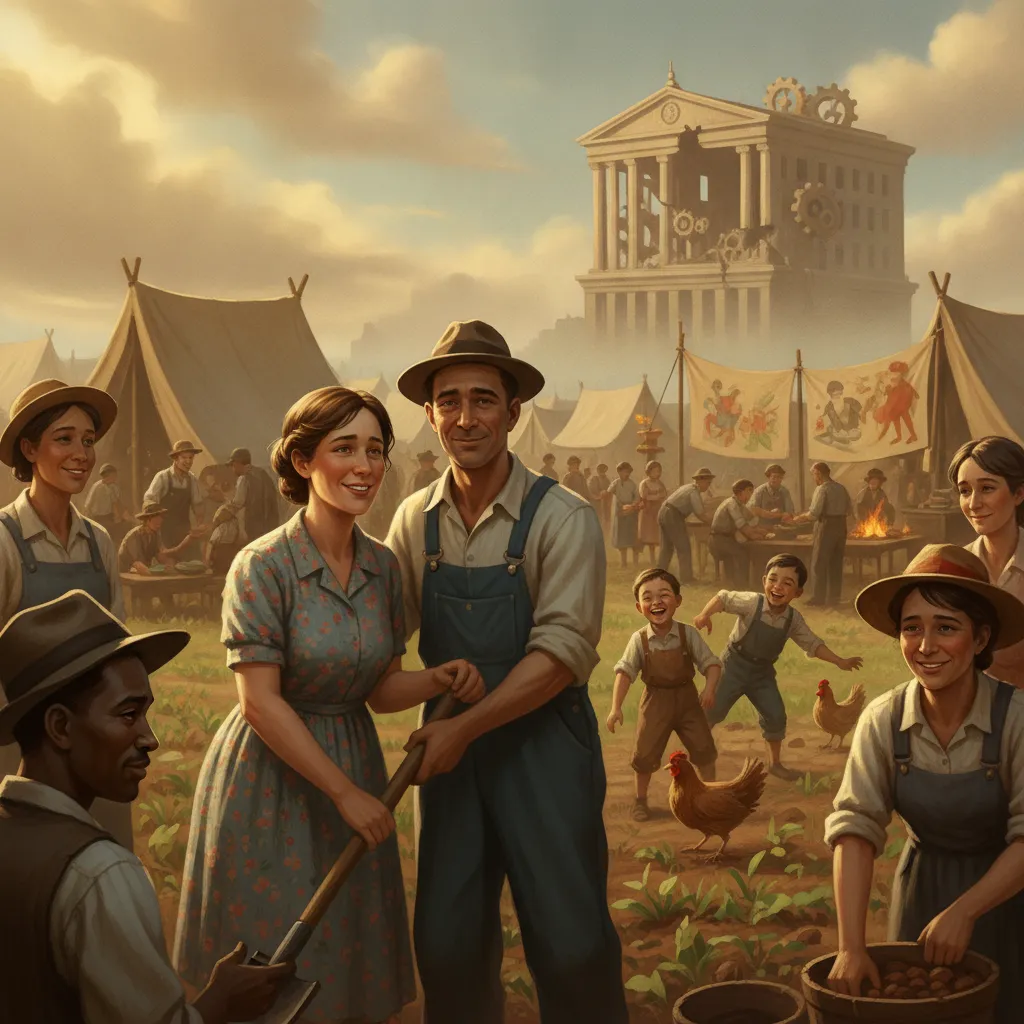
For ordinary families the numbers meant lost homes, shuttered farms and long lines for relief. Some people built camps of scrap lumber on the edge of cities, which they bitterly called Hoovervilles. On the Plains, drought and dust storms in the 1930s drove many farm families to leave their land. Many families doubled up in shared housing, young people delayed starting careers, and the experience left lasting habits of thrift in the generation that lived through it. The decade is remembered above all for hardship, and for the sense that ordinary people were suddenly at the mercy of forces far larger than themselves.
A Slow, Uneven Recovery
The economy improved after 1933, but the recovery was incomplete. According to a Northern Trust analysis, the monthly unemployment rate fell from its May 1933 high of 25.6 percent to 11.0 percent in July 1937, only for the economy to slip into a second recession that lasted through June 1938. On August 14, 1935, Roosevelt signed the Social Security Act, creating a lasting national system of retirement and unemployment protections. The return to full employment came with war production in the early 1940s. Economists still argue about which policies helped most, and that debate shapes how governments respond to crises today.
Why People Care
The Great Depression is the benchmark every later downturn gets compared to, and it created institutions Americans still rely on, from deposit insurance to Social Security. Understanding it helps make sense of arguments about banks, tariffs, and the proper role of government in a crisis.
Glossary
- Black Tuesday
- October 29, 1929, the day of the heaviest trading in the stock market crash, often used as shorthand for the crash itself.
- New Deal
- The package of relief, recovery and reform programs launched by Franklin D. Roosevelt's administration beginning in 1933.
- Smoot-Hawley Tariff
- A 1930 law that raised US import duties sharply and prompted retaliation from trading partners.
- Bank holiday
- A temporary closure of banks, declared nationally in March 1933, to stop panic withdrawals and allow inspection.
- Hooverville
- A shantytown of homeless people, sarcastically named for President Herbert Hoover.
Go Deeper
More to Explore
- The US Constitution
A few thousand words, drafted in a hot Philadelphia summer, that still decide who gets to run the country and how.
- The Sumerians
They invented a way to press ideas into clay, and in doing so gave history its first draft.
- The Black Death
The worst pandemic in European history arrived by ship, stayed for four years, and rearranged the continent's economy on its way out.
- Marie Curie
She won two Nobel Prizes in two different sciences, drove X-ray machines to the front lines, and did it all in an era that barely let women into the lab.
- Alexander Fleming and Penicillin
A messy lab, a summer vacation and a stray mold spore gave medicine its first mass-produced antibiotic, though it took other people to make it work.