Alexander Fleming and Penicillin
A messy lab, a summer vacation and a stray mold spore gave medicine its first mass-produced antibiotic, though it took other people to make it work.
By Greg Goodwin · Published October 24, 2026
Cheat Sheet
- Discovery: Fleming noticed the mold effect in a Petri dish at St Mary's Hospital, London, after a vacation in the late summer of 1928.
- Mold: the contaminant was a Penicillium mold, and the active substance it released was named penicillin.
- Nobel Prize: the 1945 Prize in Physiology or Medicine was split in three equal shares among Fleming, Ernst Chain and Howard Florey.
- Oxford team: Florey and Chain showed in 1940 that penicillin worked as a therapeutic agent against many bacterial diseases.
- Left out: Norman Heatley, who helped develop the Oxford purification work, was not among the Nobel laureates.
- First civilian: Anne Miller, treated at New Haven Hospital in 1942, is widely cited as the first American civilian patient cured by penicillin.
The 60-Second Version
In late summer 1928, the Scottish bacteriologist Alexander Fleming returned to his notoriously untidy laboratory at St Mary's Hospital in London and found a Petri dish where bacteria had been cleared away around a patch of mold. The mold was a Penicillium, and whatever it released was killing the bacteria nearby. Fleming named the substance penicillin and published his observations, but he could not isolate it in a stable, usable form. For roughly a decade it stayed mostly a curiosity, mainly considered for its use as a topical antiseptic. In Oxford, Howard Florey, Ernst Chain and their colleagues took up the problem and showed in 1940 that penicillin could treat bacterial infections. Wartime production followed, and the three men shared the 1945 Nobel Prize. The story is often told as a single lucky accident, but it was really a relay race.
The Long Version
A Lab Left to Its Own Devices
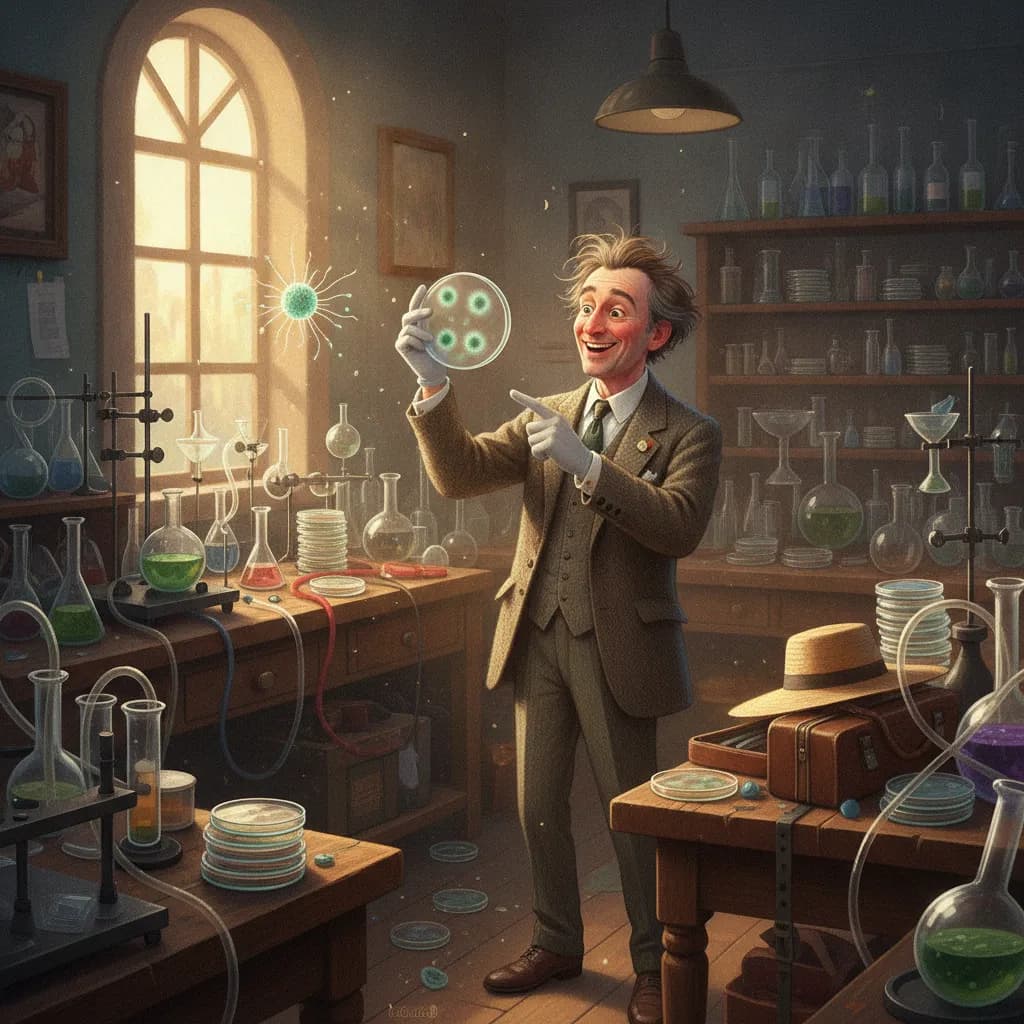
Fleming had been working with Staphylococcus bacteria when he left for vacation in August 1928. Sources describing the episode note that his workspace was famously disordered, and that one plate had not been touched by the disinfectant. When he returned, he noticed an unusual clearing around a mold colony: the bacteria near it had stopped growing or dissolved. Fleming recognized that something was wrong in the best possible way and did what a careful scientist should. He cultured the mold, identified it as a Penicillium, and began testing what its broth could do against other bacteria.
Why Fleming Stalled
Fleming published his findings, and he saw that penicillin could stop the growth of bacteria. But PBS NewsHour notes he had neither the laboratory resources at St Mary's nor the chemistry background to take the next steps of isolating the active ingredient. The substance was also unstable and hard to purify. Fleming underrated its therapeutic potential for about a decade and thought of it mostly as a surface antiseptic for wounds. That was not a failure of insight so much as a limit of tools, and it explains why the discovery sat on the shelf instead of reaching patients.
The Oxford Relay
The turning point came at Oxford, where Howard Florey led a team that included the biochemist Ernst Chain and the technician Norman Heatley. By 1940 they showed that penicillin could serve as a therapeutic agent against a wide range of bacterial diseases. Producing enough of it was the hard part: the mold yielded very little, and the group had to improvise its extraction methods. Chain's Nobel profile describes the early 1940s as the period when they obtained a pure form, with later work making larger-scale manufacture possible. This is the stage that turned a laboratory observation into a drug.
From Lab Bench to Battlefield
Patients came next. Anne Miller, seriously ill at New Haven Hospital in Connecticut in 1942, is widely cited as the first American civilian successfully treated with penicillin. Wartime governments then poured resources into manufacturing, because infected wounds were killing and disabling soldiers. Penicillin stopped being a rarity and became a mass-produced medicine, opening the era of antibiotics. Sources differ in how they phrase Miller's distinction, with some calling her the first civilian and others the first person in the United States, so it is safest to say she was among the earliest.
Credit and Legacy
The Nobel Committee awarded the 1945 Prize in Physiology or Medicine in three equal shares to Fleming, Chain and Florey. The nomination records show Fleming was recognized for the discovery of penicillin, while Chain and Florey were recognized for its curative effects. Heatley, a key contributor, was left off the list. Today penicillin and its descendants are under pressure from antibiotic resistance, which makes the story feel less like a closed chapter and more like an ongoing contest between medicine and microbes.
Why People Care
Penicillin opened the antibiotic era, turning many once-deadly infections into treatable ones. The story also shows how science actually works: an observation, years of delay, and a team effort to make it useful. It remains relevant as resistance threatens the drugs that followed.
Glossary
- Antibiotic
- A substance that kills bacteria or stops them from growing, used to treat bacterial infections.
- Penicillium
- The genus of mold that includes the strain whose chemical output Fleming observed.
- Petri dish
- A shallow, lidded glass or plastic dish used to grow microbes on a nutrient surface.
- Staphylococcus
- A genus of bacteria, including strains that cause skin infections and serious wound infections, which Fleming was culturing.
- Antibiotic resistance
- The ability of bacteria to survive drugs that once killed them, which makes some infections harder to treat.
Go Deeper
More to Explore
- Marie Curie
She won two Nobel Prizes in two different sciences, drove X-ray machines to the front lines, and did it all in an era that barely let women into the lab.
- Hippocrates
The most famous doctor in history may be as much a symbol as a person, and the oath with his name on it probably is not his.
- The Sumerians
They invented a way to press ideas into clay, and in doing so gave history its first draft.
- The Great Depression
A stock market crash was only the opening act of a decade in which a quarter of American workers had no job to go to.
- The Black Death
The worst pandemic in European history arrived by ship, stayed for four years, and rearranged the continent's economy on its way out.