Florence Nightingale
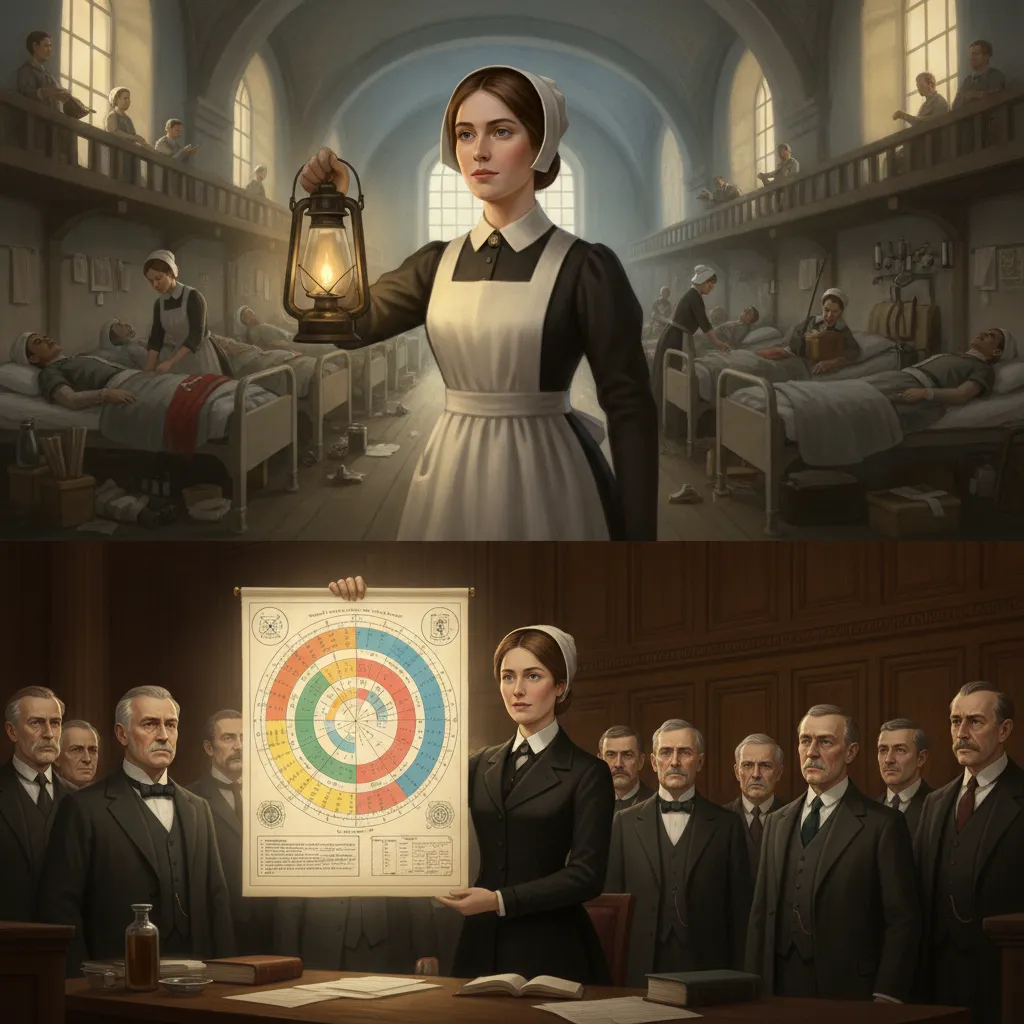
She carried a lamp into a war hospital, then carried a very persuasive chart into the halls of government.
By Greg Goodwin · Published November 4, 2026
Cheat Sheet
- Dates: born May 12, 1820, in Florence, Italy; died August 13, 1910, in London, aged 90.
- Team size: she led an officially sanctioned party of 38 women to Scutari, arriving November 5, 1854.
- Nightingale School of Nursing: opened in 1860 at St. Thomas' Hospital in London.
- Honor: in 1907 she became the first woman awarded the Order of Merit.
- Statistics: elected a Fellow of the Statistical Society of London in 1858, the first woman to be so.
- Birthday tribute: International Nurses Day is observed every year on May 12.
The 60-Second Version
Florence Nightingale was a British nurse, statistician, and social reformer who became the founding philosopher of modern nursing. Born in 1820 to a wealthy family that did not want her to work, she trained briefly in Germany and then ran a small London hospital for women. In 1854, during the Crimean War, she led a group of nurses to the British military hospitals at Scutari, in present-day Turkey. Her nighttime rounds earned her the nickname the Lady with the Lamp. She cleaned wards, bought supplies, and set standards for basic care. Back in Britain she turned data into persuasion, using charts to argue for sanitary reform, and in 1860 she opened a nursing school at St. Thomas' Hospital. She spent decades afterward working on hospital design and army health, often from her bed.
The Long Version
A Calling the Family Did Not Want
Nightingale was born on May 12, 1820, in Florence, Italy, the city she was named after, during her parents' extended European honeymoon. Her father taught her history, philosophy, and literature, and she excelled at mathematics and languages. At age 16 she felt one of several calls from God, which she understood as a calling to reduce human suffering. Nursing seemed the right path, but her family opposed it as unsuitable for a woman of her standing. She eventually trained at the Institution of Protestant Deaconesses at Kaiserswerth in Germany, for two weeks in July 1850 and three months in July 1851. In 1853 she became superintendent of an institution for sick gentlewomen in London, where she improved nursing care, working conditions, and efficiency.
Scutari and the Lady with the Lamp
British newspapers had reported that wounded soldiers in the Crimean War were being treated by an incompetent medical establishment and that basic supplies were missing. Public outrage followed, and Sidney Herbert, the secretary of state at war, asked Nightingale to lead nurses to Scutari. Her party of 38 women left on October 21, 1854, and reached the Barrack Hospital on November 5. She found filthy conditions, inadequate supplies, and severe overcrowding. Nightingale bought equipment, enlisted soldiers' wives to help with laundry, and required bathing, clean clothing and dressings, and adequate food. Her night rounds in the wards earned her the title of the Lady with the Lamp, and the Florence Nightingale Museum in London displays the lamp she carried.
The Statistician
Nightingale was also a pioneer in using numbers as an argument. During the Crimean War she collected data and systematized record keeping, and she plotted the incidence of preventable deaths in the military on a polar-area diagram, a chart in which each wedge's area is proportional to the statistic it shows. The aim was to dramatize needless deaths caused by unsanitary conditions. In 1858 she was elected a Fellow of the Statistical Society of London, the first woman to be so honored, and the society is now the Royal Statistical Society. She also designed a Model Hospital Statistical Form so hospitals could collect consistent data. Her mortality claims need a caveat: Britannica notes she reportedly cut the rate at Barrack Hospital to about 2 percent, but historians later found the real rate was much higher than reported.
Illness, Reform, and the Nursing School
In May 1855 Nightingale fell ill with what was called Crimean fever, most likely brucellosis according to Britannica, and its effects lingered for about 25 years, often confining her to bed with severe chronic pain. The Treaty of Paris ended the war on March 30, 1856, and she returned to her family home in Derbyshire on August 7, 1856, as a reluctant heroine. She kept working. Her book Notes on Nursing appeared in 1859, and in 1860 the Nightingale School of Nursing opened at St. Thomas' Hospital in London, the first scientifically based nursing school according to Britannica. She also helped set up training for midwives and for nurses in workhouse infirmaries.
Legacy
Nightingale received the Order of Merit in 1907, the first woman to be awarded it, and died in London on August 13, 1910, at age 90. International Nurses Day, observed each May 12, commemorates her birth. The Florence Nightingale Museum, located in the grounds of St. Thomas' Hospital, also notes less formal details of her life, including that she owned over 60 cats and a pet owl called Athena. Her real legacy is the combination she insisted on: compassion at the bedside, and evidence in the report on the table.
Why People Care
Modern nursing education, hospital hygiene, and the habit of arguing for health policy with data all trace back to her. She is a reminder that the person with the lamp can also be the person with the spreadsheet, and that both jobs save lives.
Glossary
- Scutari
- The district across the Bosporus from Constantinople (now Istanbul) where the British had their main hospitals during the Crimean War.
- Crimean War
- A war that began in 1853 pitting Russia against the Ottoman Empire and its British and French allies.
- Polar-area diagram
- A circular chart where each wedge's area represents a quantity, used by Nightingale to show deaths by cause month by month.
- Kaiserswerth
- The German institution of Protestant deaconesses where Nightingale trained briefly in 1850 and 1851.
- Sanitary reform
- Improving cleanliness, ventilation, water, and waste handling to prevent disease, which was Nightingale's central cause.
Go Deeper
More to Explore
- Edward Jenner and the First Vaccine
A country doctor, a milkmaid, and an 8-year-old boy changed medicine, and the ethics review board would like a word.
- Charles Darwin
He went on a five-year boat trip as a dinner companion and came back with the idea that rewrote biology.
- Marie Curie
She won two Nobel Prizes in two different sciences, drove X-ray machines to the front lines, and did it all in an era that barely let women into the lab.
- Alexander Fleming and Penicillin
A messy lab, a summer vacation and a stray mold spore gave medicine its first mass-produced antibiotic, though it took other people to make it work.
- Hippocrates
The most famous doctor in history may be as much a symbol as a person, and the oath with his name on it probably is not his.