Charles Darwin
He went on a five-year boat trip as a dinner companion and came back with the idea that rewrote biology.
By Greg Goodwin · Published November 4, 2026
Cheat Sheet
- Dates: born February 12, 1809, in Shrewsbury; died April 19, 1882, in Downe, Kent.
- Voyage clock: HMS Beagle sailed from Plymouth on December 27, 1831, and reached Falmouth on October 2, 1836.
- Galapagos stop: the Beagle dropped anchor there on September 15, 1835, and left in October 1835.
- Print run: the first edition of On the Origin of Species had 1,250 copies; the second edition (January 7, 1860) had 3,000.
- Co-announcement: Darwin and Alfred Russel Wallace's joint paper was read to the Linnean Society on July 1, 1858.
- Barnacle detour: Darwin spent 1846 to 1854 on an exhaustive study of barnacles.
The 60-Second Version
Charles Darwin was an English naturalist whose theory of evolution by natural selection became the foundation of modern evolutionary biology. After leaving medical studies at Edinburgh, he trained for the church at Cambridge, then took a place on HMS Beagle, a Royal Navy survey voyage that sailed in December 1831 and returned in October 1836. He collected fossils, plants, and animals around the world, and after coming home he worked out his theory in private in 1837 to 1839. He then spent about two decades gathering evidence. In 1858 he and Alfred Russel Wallace announced the idea jointly, and in November 1859 he published On the Origin of Species. Darwin argued that species change over time through natural selection and share common ancestors, an idea that unsettled Victorian society and still shapes science today.
The Long Version
From Dissection Rooms to Beetle Collecting
Darwin was born on February 12, 1809, in Shrewsbury, the second son of a society doctor and the grandson of potter Josiah Wedgwood on his mother's side. His father sent him to study medicine at Edinburgh University in 1825, but Darwin loathed anatomy, and surgery without anesthesia sickened him. He did learn plenty there, collecting sea creatures with the radical naturalist Robert Edmond Grant and learning taxidermy from John Edmonstone, a freed slave from South America. His father then moved him to Christ's College, Cambridge, in 1828, planning a career in the church. Darwin spent his time beetle collecting and shooting, and finished tenth in the Bachelor of Arts degree in 1831, guided by professor John Stevens Henslow.
The Voyage of the Beagle
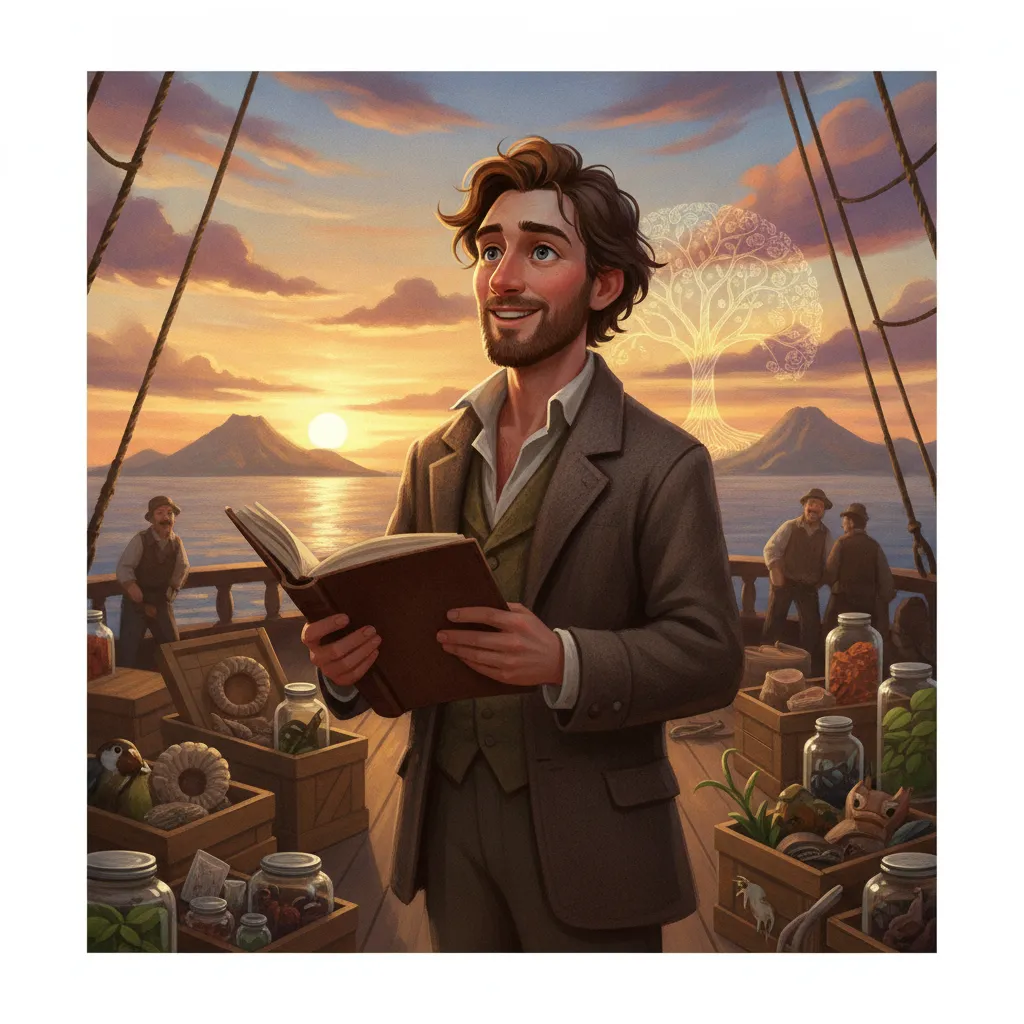
On Henslow's suggestion, Darwin joined HMS Beagle as a self-financed gentleman companion to the 26-year-old captain, Robert FitzRoy, who feared the loneliness of command. The ship's main job was surveying the coast of South America. Darwin carried the first volume of Charles Lyell's Principles of Geology. The Beagle sailed from Plymouth on December 27, 1831, spent years on the South American coast, rounded Cape Horn in 1834, anchored off the Galapagos on September 15, 1835, and reached Falmouth on October 2, 1836. That is four years, nine months, and six days, according to the Cambridge University Library.
Working It Out in Private
Britannica says Darwin formulated his theory in private in 1837 to 1839, after returning from the voyage. He then waited. He published his Journal of Researches in 1839 and Coral Reefs in 1842, the same year he moved to Down House in Kent. From 1846 to 1854 he undertook an exhaustive study of barnacles. This long, careful build-up of evidence helps explain why the final book felt so solid, and why the delay remains one of science's famous slow burns.
Wallace and the Origin
In 1858 Alfred Russel Wallace sent Darwin an essay that outlined a similar idea. Charles Lyell and Joseph Hooker arranged a joint presentation, and papers by Wallace and Darwin were read to the Linnean Society of London on July 1, 1858. Neither man attended: Wallace was in Borneo, and Darwin was at the funeral of his son. The reading pushed Darwin to write a condensed abstract of his larger work, published as On the Origin of Species in November 1859. Sources date publication to November 24, 1859. The first edition ran to 1,250 copies, and a second edition of 3,000 copies followed on January 7, 1860.
Reception and Legacy
Britannica says Darwin at first shocked religious Victorian society by suggesting that animals and humans shared a common ancestry, yet his non-religious biology appealed to the rising class of professional scientists. By the time of his death, evolutionary ideas had spread through science, literature, and politics. Darwin died on April 19, 1882, and, though an agnostic, was buried in Westminster Abbey. Nearly every branch of biology today, from medicine to ecology, builds on the framework he proposed, and the questions he raised about how life diversifies are still active research.
Why People Care
Evolution by natural selection is the organizing idea of biology, and it comes up constantly in debates over science education, medicine, and our place in nature. Knowing Darwin's actual story is a good antidote to myths, including the idea that it was a single eureka moment.
Glossary
- Natural selection
- The process by which inherited traits that help organisms survive and reproduce become more common over generations.
- Evolution
- Change in the inherited characteristics of populations over generations, including the descent of species from common ancestors.
- HMS Beagle
- The Royal Navy survey ship that carried Darwin around the world from 1831 to 1836 under Captain Robert FitzRoy.
- Common ancestry
- The idea that different species descend from shared ancestors, which shocked many Victorians when applied to humans.
- Linnean Society
- The London learned society where the Darwin and Wallace papers were read in 1858.
Go Deeper
More to Explore
- Florence Nightingale
She carried a lamp into a war hospital, then carried a very persuasive chart into the halls of government.
- Edward Jenner and the First Vaccine
A country doctor, a milkmaid, and an 8-year-old boy changed medicine, and the ethics review board would like a word.
- Marie Curie
She won two Nobel Prizes in two different sciences, drove X-ray machines to the front lines, and did it all in an era that barely let women into the lab.
- Alexander Fleming and Penicillin
A messy lab, a summer vacation and a stray mold spore gave medicine its first mass-produced antibiotic, though it took other people to make it work.
- Hippocrates
The most famous doctor in history may be as much a symbol as a person, and the oath with his name on it probably is not his.