Edward Jenner and the First Vaccine
A country doctor, a milkmaid, and an 8-year-old boy changed medicine, and the ethics review board would like a word.
By Greg Goodwin · Published November 4, 2026
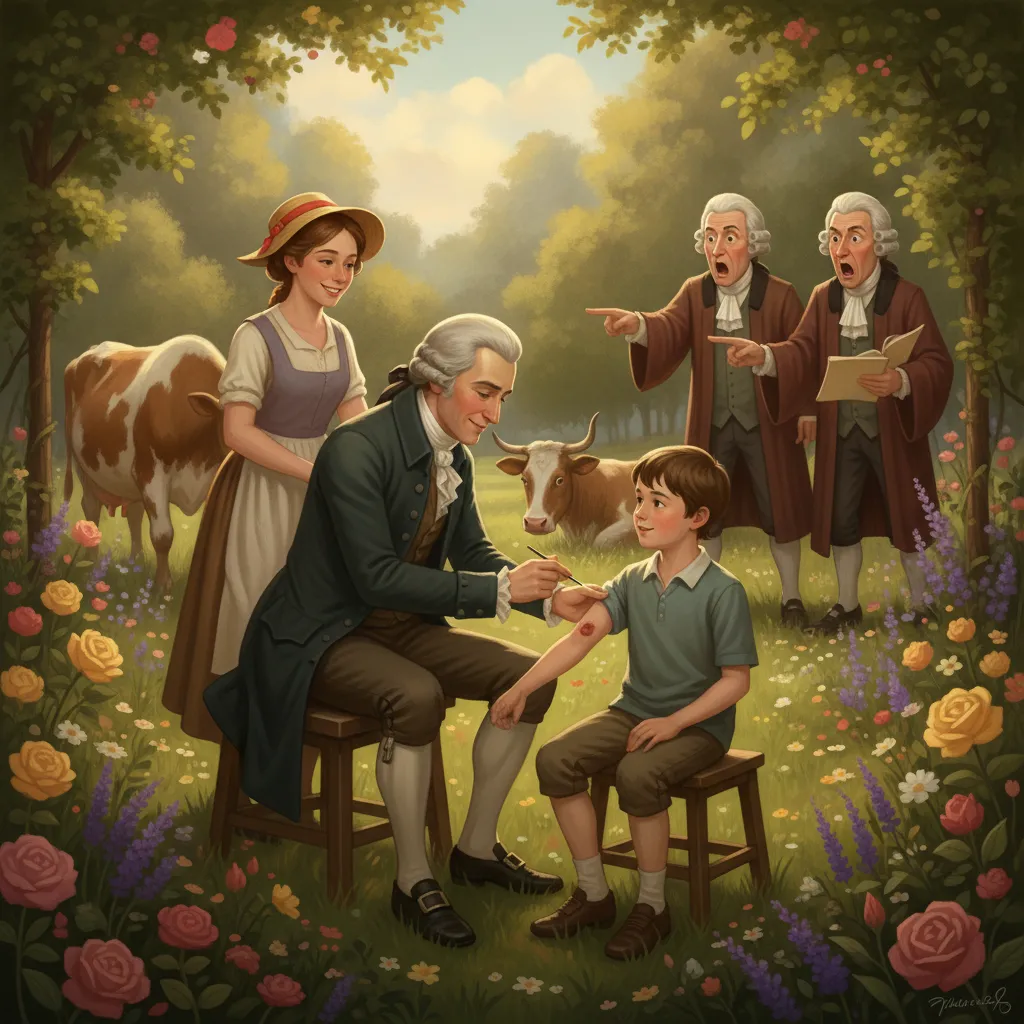
Cheat Sheet
- Dates: Jenner was born May 17, 1749, in Berkeley, Gloucestershire, and died there on January 26, 1823.
- Test subject: James Phipps, age 8, was inoculated with cowpox on May 14, 1796.
- Genetic twist: old smallpox vaccine samples proved closer to horsepox virus than to cowpox virus.
- Word origin: vaccine comes from the Latin vacca, meaning cow.
- Lethality: smallpox killed at least 1 in 3 people it infected, according to the WHO.
- Finish line: smallpox remains the only human disease eradicated so far, declared so by WHO in 1980.
The 60-Second Version
Edward Jenner was an English country surgeon who noticed what many rural people already believed: dairy workers who caught cowpox seemed protected from smallpox, a disease that killed at least one in three of the people it infected. On May 14, 1796, he put the idea to the test by inoculating eight-year-old James Phipps with matter from a cowpox sore on the hand of a milkmaid named Sarah Nelmes. Phipps felt unwell for several days, then recovered. Two months later Jenner exposed him to material from a human smallpox sore, and the boy stayed healthy. That was the first demonstration of a vaccine, a name that traces back to the Latin word for cow. Jenner's method spread across the world, and nearly two centuries later it helped end smallpox for good, the only human disease eradicated so far.
The Long Version
Before Jenner: Living With Smallpox
Smallpox was one of the deadliest diseases in human history. The WHO says it killed hundreds of millions of people over thousands of years, killing at least one in three of those infected, and often more in the most severe forms. Symptoms began with high fever and vomiting, followed by fluid-filled lesions across the body, and survivors could be left blind or infertile. Evidence of the disease has been found in Egyptian mummies from around 1350 BCE. People fought back with variolation, deliberately infecting a healthy person with smallpox material to cause a milder case. It was used in Asia and parts of Africa, and Lady Mary Wortley Montagu helped introduce it in Europe in 1721, after seeing it in the Ottoman Empire.
The Country Doctor of Berkeley
Edward Jenner was born on May 17, 1749, in Berkeley, Gloucestershire, England. At age 14 he began a seven-year apprenticeship with a surgeon named Daniel Ludlow, and in 1770 he went on to study at St. George's Hospital in London. He returned to Berkeley in 1772 and practiced there. Britannica describes him as a country youth, the son of a clergyman, working in an era when the line between university-trained physicians and apprenticeship-trained surgeons was slowly blurring. His great advantage was not a lab or a grant. It was patient observation of the people and animals around him, and a willingness to take rural folk wisdom seriously enough to test it.
May 1796: The Experiment
The History of Vaccines project at the College of Physicians of Philadelphia records the key moment. On May 14, 1796, Jenner inoculated eight-year-old James Phipps with matter from a cowpox sore on the hand of the milkmaid Sarah Nelmes. Phipps suffered a local reaction and felt poorly for several days, then made a full recovery. In July 1796, Jenner inoculated him with matter from a fresh human smallpox sore, the same challenge used in variolation. Phipps remained healthy. Jenner then showed that cowpox matter passed along a chain from person to person still protected against smallpox. By modern standards, using a child as a test subject would never be approved, which is worth remembering when admiring the result.
Spreading the Idea
The method won converts quickly, though not without mockery. The WHO notes that rumors circulated that the vaccine would turn people into cows, but by 1801, extensive testing had shown it protected against smallpox. Vaccine was passed from arm to arm as it traveled to other continents, and mandatory smallpox vaccination arrived in Britain and parts of the United States in the 1840s and 1850s, along with vaccination certificates for travel. There is also a scientific footnote. Jenner suspected cowpox actually came from horsepox, and recent genetic analysis of old smallpox vaccine samples found them more closely related to horsepox virus than to cowpox virus.
From One Boy to Eradication
Vaccination eliminated smallpox from western Europe, North America, and Japan, but the disease persisted elsewhere. The World Health Assembly called for global eradication in 1958, and an intensified campaign began in 1967. The WHO says it cost roughly US$300 million, two thirds of it from the countries where smallpox was endemic. The disease was eliminated from South America in 1971, Asia in 1975, and Africa in 1977, and WHO declared it eradicated in 1980. The WHO adds that eradication was achieved through prevention, as Jenner himself predicted.
Why People Care
Jenner's experiment launched the idea of vaccination, and the same basic principle now protects people from many diseases. Smallpox is the proof of concept: a disease that killed hundreds of millions was ended on purpose, through observation, testing, and global cooperation.
Glossary
- Smallpox
- A deadly, highly infectious viral disease caused by the variola virus, with fever followed by fluid-filled lesions across the body.
- Cowpox
- A usually mild illness in cattle that can pass to people, often as pustules on the hands of dairy workers.
- Variolation
- The older practice of deliberately giving a healthy person material from smallpox sores to cause a milder, protective infection.
- Vaccination
- Giving a person a safer substance, originally cowpox matter, to train the body to resist a more dangerous disease.
- Eradication
- Permanently reducing a disease to zero cases worldwide, with no risk of it returning.
Go Deeper
More to Explore
- Florence Nightingale
She carried a lamp into a war hospital, then carried a very persuasive chart into the halls of government.
- Charles Darwin
He went on a five-year boat trip as a dinner companion and came back with the idea that rewrote biology.
- Marie Curie
She won two Nobel Prizes in two different sciences, drove X-ray machines to the front lines, and did it all in an era that barely let women into the lab.
- Alexander Fleming and Penicillin
A messy lab, a summer vacation and a stray mold spore gave medicine its first mass-produced antibiotic, though it took other people to make it work.
- Hippocrates
The most famous doctor in history may be as much a symbol as a person, and the oath with his name on it probably is not his.