The Byzantine Empire
The people history calls "Byzantines" never used that word for themselves — as far as they were concerned, they were simply Romans, for almost a thousand years after Rome itself had fallen.
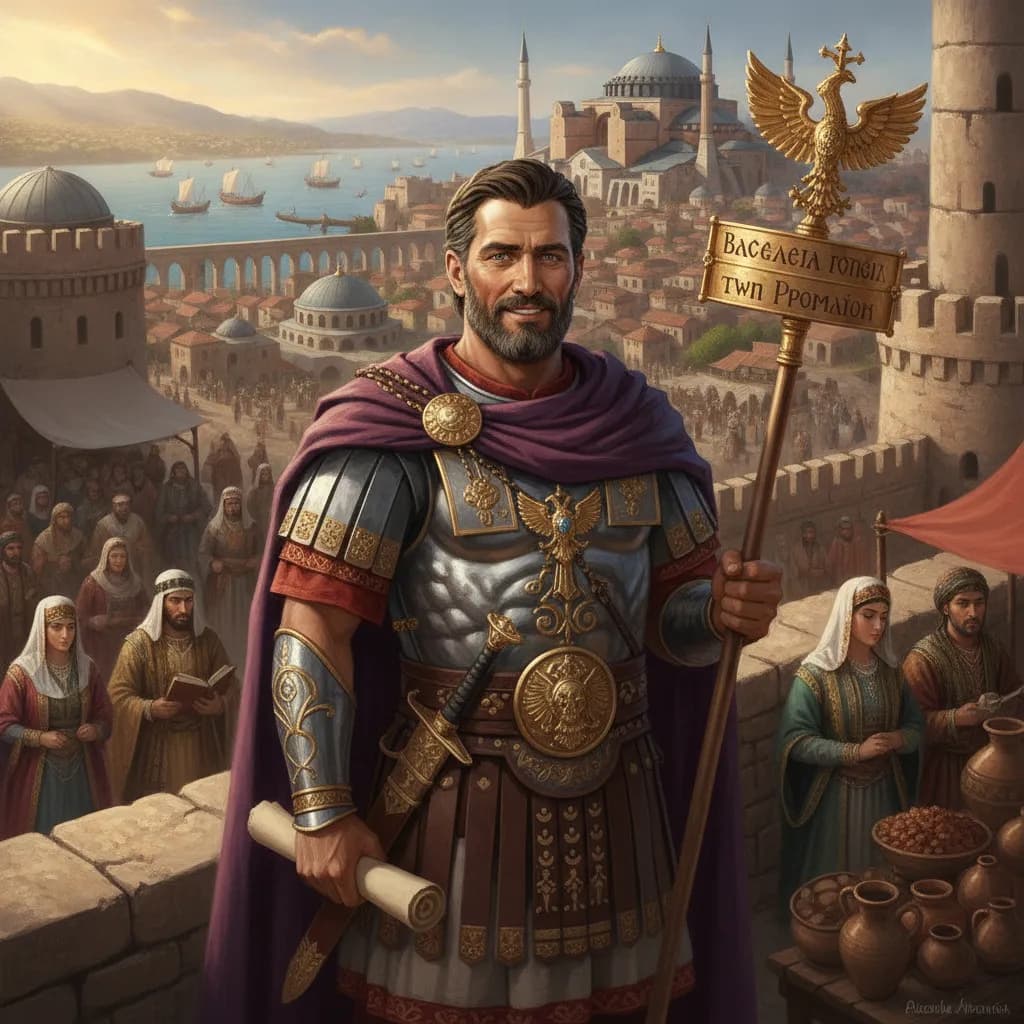
Cheat Sheet
- Continuation of the Eastern Roman Empire after the fall of Rome in 476 CE, lasting until Constantinople fell to the Ottomans in 1453.
- Capital city Constantinople (modern-day Istanbul) sat at the crossroads of Europe and Asia, making it one of history's most strategically valuable cities.
- Emperor Justinian I (r. 527-565) codified Roman law into the Corpus Juris Civilis, a legal foundation still influencing modern civil law systems.
- The Hagia Sophia, completed in 537 CE under Justinian, remained the largest cathedral in the world for nearly a thousand years.
- The empire preserved and transmitted a vast amount of ancient Greek and Roman scholarship that later fueled the European Renaissance.
- The Byzantines never called themselves 'Byzantine' — they identified as Romans; the term was coined by later Western historians.
The 60-Second Version
When Rome fell in 476 CE, its eastern half didn't collapse alongside it — it carried on for nearly another thousand years as what historians later dubbed the Byzantine Empire, centered on the extraordinarily well-positioned capital of Constantinople straddling Europe and Asia. Its residents never adopted that "Byzantine" label at all, continuing to call themselves Romans right up until the empire's final fall, a naming quirk that later Western historians introduced largely to distinguish the medieval Greek-speaking empire from ancient Rome itself. Under Emperor Justinian I, the empire produced one of history's most consequential legal achievements, a sweeping codification of Roman law that still echoes through modern civil law systems today, alongside architectural landmarks like the Hagia Sophia that stood as the largest cathedral on Earth for centuries. Perhaps its quietest but most far-reaching legacy was as a kind of living archive, preserving vast amounts of ancient Greek and Roman scholarship that had been lost or scattered in Western Europe, scholarship that later resurfaced to help fuel the Renaissance. The empire's story finally ended in 1453, when Ottoman forces captured Constantinople, closing out one of history's longest-running continuous political entities.
The Long Version
Rome's Eastern Half Kept Going
When the Western Roman Empire collapsed in 476 CE, its eastern counterpart, centered on Constantinople, continued functioning as a coherent political and cultural entity for nearly another thousand years, a continuity later historians named the "Byzantine Empire" even though its own citizens simply considered themselves Romans throughout.
A Capital Built for Power
Constantinople's location at the literal crossroads of Europe and Asia made it one of the most strategically and commercially valuable cities in world history, a geographic advantage that helped the empire project military and economic power for centuries even as territory elsewhere was gradually lost.
Justinian's Enduring Legal and Architectural Legacy
Emperor Justinian I oversaw two of the empire's most consequential achievements: the Corpus Juris Civilis, a sweeping codification of Roman law whose influence still echoes through modern civil law systems, and the construction of the Hagia Sophia, a cathedral so architecturally ambitious it remained the largest in the world for nearly a thousand years.
Keeper of Ancient Knowledge
Beyond its own political and legal achievements, the empire functioned as a crucial custodian of ancient Greek and Roman scholarship that had been lost or scattered across much of Western Europe, preserving texts and ideas that later resurfaced to help spark the European Renaissance. The empire's long run finally ended in 1453, when Ottoman forces captured Constantinople, closing the book on one of history's longest continuously functioning political states.
Ad slot (placeholder — set NEXT_PUBLIC_ADSENSE_SLOT_ID once an ad unit is created)
Why People Care
The Byzantine Empire's legal, architectural, and scholarly legacy shaped medieval and modern Europe far more than its relative historical obscurity suggests, and understanding it fills in a genuinely crucial thousand-year gap between the fall of ancient Rome and the start of the modern era.
Glossary
- Constantinople
- The capital of the Byzantine Empire, located at the crossroads of Europe and Asia; known today as Istanbul.
- Corpus Juris Civilis
- A comprehensive codification of Roman law compiled under Emperor Justinian I, still influential in modern legal systems.
- Hagia Sophia
- A massive cathedral (later mosque, later museum, later mosque again) built under Justinian I, celebrated for its architectural achievement.
- Eastern Orthodox Church
- The dominant Christian church of the Byzantine Empire, which formally split from the Roman Catholic Church in 1054.
- Fall of Constantinople
- The 1453 conquest of the Byzantine capital by the Ottoman Empire, marking the end of the Byzantine Empire.
Go Deeper
- A History of Byzantium, by Timothy E. Gregory
- Metropolitan Museum of Art — Byzantine Art and Culture
More to Explore
- The Persian Empire
More than two thousand years before "human rights" was a modern political phrase, one ancient Persian king was already documenting a policy of letting conquered peoples keep their own customs and religions.
- The Aztec Empire
When Spanish conquistadors first laid eyes on the Aztec capital in 1519, they were looking at a city larger than Paris or London at the time — built entirely on an island in the middle of a lake.
- The Roman Empire
An empire whose roads and aqueducts were engineered so well that some of them were still functioning well over a thousand years after Rome itself had fallen.
- The Ottoman Empire
An empire that lasted over 600 years — long enough to span from the age of medieval knights all the way to the aftermath of World War I.
- The Mongol Empire
The largest contiguous land empire ever assembled in world history was built, remarkably, by unifying scattered nomadic tribes that had previously spent generations fighting each other.