The Aztec Empire
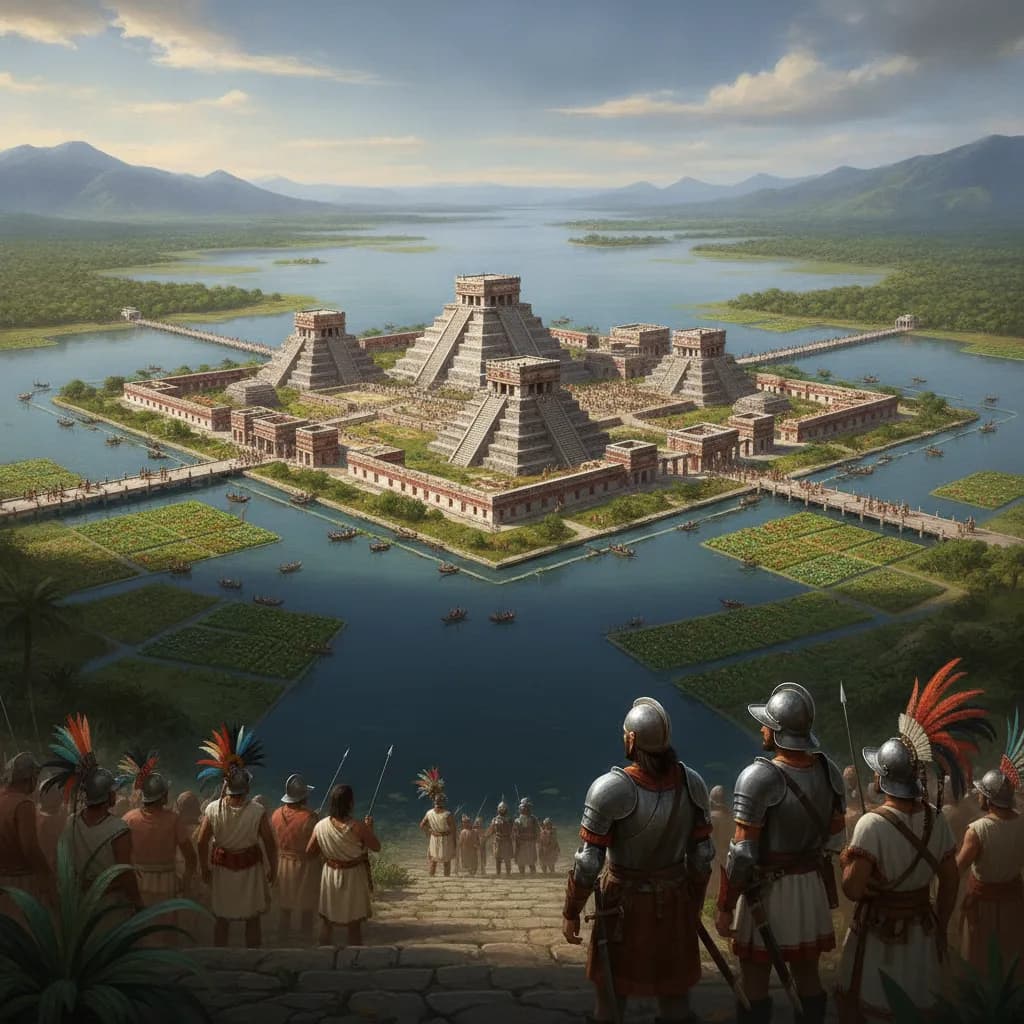
When Spanish conquistadors first laid eyes on the Aztec capital in 1519, they were looking at a city larger than Paris or London at the time — built entirely on an island in the middle of a lake.
Cheat Sheet
- The Aztec Empire was centered on Tenochtitlan, a remarkable city built on an island in Lake Texcoco, founded around 1325 CE.
- At its height, Tenochtitlan is estimated to have housed 200,000-300,000 people, making it larger than most European cities of the same period.
- The empire functioned as a 'Triple Alliance' between three city-states — Tenochtitlan, Texcoco, and Tlacopan — rather than a single centralized monarchy.
- Aztec engineers built extensive chinampas, artificial floating agricultural islands, to farm efficiently despite the lake-based city's limited land.
- Spanish conquistador Hernán Cortés, aided by rival indigenous groups and European diseases, conquered the empire between 1519 and 1521.
- Smallpox and other introduced diseases, to which the Aztec population had no prior immunity, killed a substantial share of the population and severely weakened resistance to Spanish conquest.
The 60-Second Version
The Aztec Empire was centered on Tenochtitlan, an extraordinary capital city founded around 1325 CE and built directly on an island in Lake Texcoco, a location that shaped nearly every aspect of the empire's engineering and daily life. At its height, Tenochtitlan is estimated to have housed somewhere between 200,000 and 300,000 people, making it larger than most European cities of the same period, a scale that stunned the Spanish conquistadors who eventually encountered it. Rather than functioning as a single centralized monarchy, the empire actually operated as a "Triple Alliance" between three allied city-states, Tenochtitlan, Texcoco, and Tlacopan, sharing power and military resources across the broader territory. Solving the practical problem of farming enough food for such a dense island-based population, Aztec engineers built extensive chinampas, artificial floating agricultural islands that dramatically expanded usable farmland well beyond the lake's limited natural shoreline. The empire's fall came swiftly between 1519 and 1521, when Spanish conquistador Hernán Cortés, aided significantly by rival indigenous groups eager to break free of Aztec dominance and by introduced European diseases like smallpox that devastated a population with no prior immunity, brought down an empire that had taken nearly two centuries to build.
The Long Version
A Capital Built on Water
The Aztec Empire was centered on Tenochtitlan, an extraordinary capital city founded around 1325 CE and built directly on an island in Lake Texcoco, a striking and highly unusual location that shaped nearly every aspect of the empire's engineering, agriculture, and daily urban life.
A City Larger Than Most of Europe
At its height, Tenochtitlan is estimated to have housed somewhere between 200,000 and 300,000 people, making it larger than most European cities of the same period, a genuinely staggering scale that stunned the Spanish conquistadors who eventually encountered it in the early 16th century.
Power Shared Among Three Cities
Rather than functioning as a single centralized monarchy, the empire actually operated as a "Triple Alliance" between three allied city-states, Tenochtitlan, Texcoco, and Tlacopan, sharing political power and military resources across the broader imperial territory rather than concentrating authority under one single ruling seat.
Farming a City With No Land to Spare
Solving the practical problem of feeding such a dense island-based population, Aztec engineers built extensive chinampas, artificial floating agricultural islands constructed from layered vegetation and lake sediment, which dramatically expanded usable farmland well beyond the lake's naturally limited shoreline.
A Swift and Devastating Fall
The empire's fall came remarkably swiftly between 1519 and 1521, when Spanish conquistador Hernán Cortés, aided significantly by rival indigenous groups eager to break free of Aztec dominance and by introduced European diseases like smallpox that devastated a population with no prior immunity, brought down an empire that had taken nearly two centuries to build.
Ad slot (placeholder — set NEXT_PUBLIC_ADSENSE_SLOT_ID once an ad unit is created)
Why People Care
The Aztec Empire's engineering ingenuity and genuinely urban sophistication challenge outdated assumptions about pre-colonial civilizations in the Americas, and understanding both its achievements and its rapid collapse provides essential context for the broader, devastating history of European conquest across the continent.
Glossary
- Tenochtitlan
- The Aztec Empire's capital city, built on an island in Lake Texcoco, that once housed an estimated 200,000-300,000 people.
- Triple Alliance
- The political structure of the Aztec Empire, formed by the allied city-states of Tenochtitlan, Texcoco, and Tlacopan.
- Chinampas
- Artificial floating agricultural islands built by Aztec engineers to farm efficiently on the limited land around Lake Texcoco.
- Hernán Cortés
- The Spanish conquistador who led the conquest of the Aztec Empire between 1519 and 1521.
- Columbian Exchange diseases
- Diseases like smallpox introduced by Europeans to which Indigenous American populations had no prior immunity, devastating populations across the Americas.
Go Deeper
- The Metropolitan Museum of Art — The Art of the Aztec Era
- Aztecs: An Interpretation, by Inga Clendinnen
More to Explore
- The Persian Empire
More than two thousand years before "human rights" was a modern political phrase, one ancient Persian king was already documenting a policy of letting conquered peoples keep their own customs and religions.
- The Byzantine Empire
The people history calls "Byzantines" never used that word for themselves — as far as they were concerned, they were simply Romans, for almost a thousand years after Rome itself had fallen.
- The Roman Empire
An empire whose roads and aqueducts were engineered so well that some of them were still functioning well over a thousand years after Rome itself had fallen.
- The Ottoman Empire
An empire that lasted over 600 years — long enough to span from the age of medieval knights all the way to the aftermath of World War I.
- The Mongol Empire
The largest contiguous land empire ever assembled in world history was built, remarkably, by unifying scattered nomadic tribes that had previously spent generations fighting each other.