The Inca Empire
The Inca ran an empire of millions across some of the world's steepest mountains, without writing, money, or wheeled transport.
By Greg Goodwin · Published October 16, 2026 · Updated October 24, 2026
Cheat Sheet
- Extent: the largest empire in the pre-Columbian Americas, stretching about 2,500 miles along the Andes from Ecuador to central Chile.
- Rise: rapid expansion began under Pachacuti around 1438; the capital was Cusco, in modern Peru.
- Name: the Inca called their realm Tawantinsuyu, 'the four parts together.'
- Records: no writing system; accounting and records used knotted cords called quipu.
- Roads: the Qhapaq Ñan system covered roughly 40,000 kilometers, with relay runners and storehouses.
- Fall: Francisco Pizarro's small force captured Emperor Atahualpa at Cajamarca in November 1532.
The 60-Second Version
The Inca began as a small group around Cusco in the Andes. In the 15th century, under the ruler Pachacuti and his successors, they expanded in a few generations into the largest empire in the Americas, with perhaps 10 million subjects. They governed through a mix of conquest and diplomacy, moving populations, imposing a common language (Quechua), and demanding labor service rather than coins. A road network connected the empire, and storehouses held food and textiles. Records were kept on quipu. In the 1520s, a civil war between two sons of the emperor Huayna Capac, along with epidemic disease, weakened the empire just before Francisco Pizarro arrived. In 1532, the Spanish ambushed and captured the emperor Atahualpa, and the empire soon fell.
The Long Version
From Valley to Empire
Inca tradition places their origins in the Cusco valley, but archaeology suggests they were just one of many Andean groups until around 1438, when they repelled an attack by the neighboring Chanka. Pachacuti, a military and administrative reformer, then began expansion. His son Topa Inca and grandson Huayna Capac extended the empire north into Ecuador and south into Chile. The Inca used a mixture of force and incentives, offering conquered local elites status and gifts in return for loyalty, and sometimes relocating whole communities (mitma) to secure frontiers or fill farmland.
Government Without Money
The Inca had no markets or coinage in the Western sense. Instead, the state collected labor through the mit'a. People worked on roads, terraces, fields, or in the army for a period each year, and in return the state provided food, drink, and festivals. Goods were stored in thousands of warehouses (qollqa) and redistributed. The emperor, the Sapa Inca, was considered semi-divine, and mummified rulers were kept and consulted. Officials tracked population and production with quipu, whose full meaning researchers are still trying to understand.
Roads, Runners, and Engineering
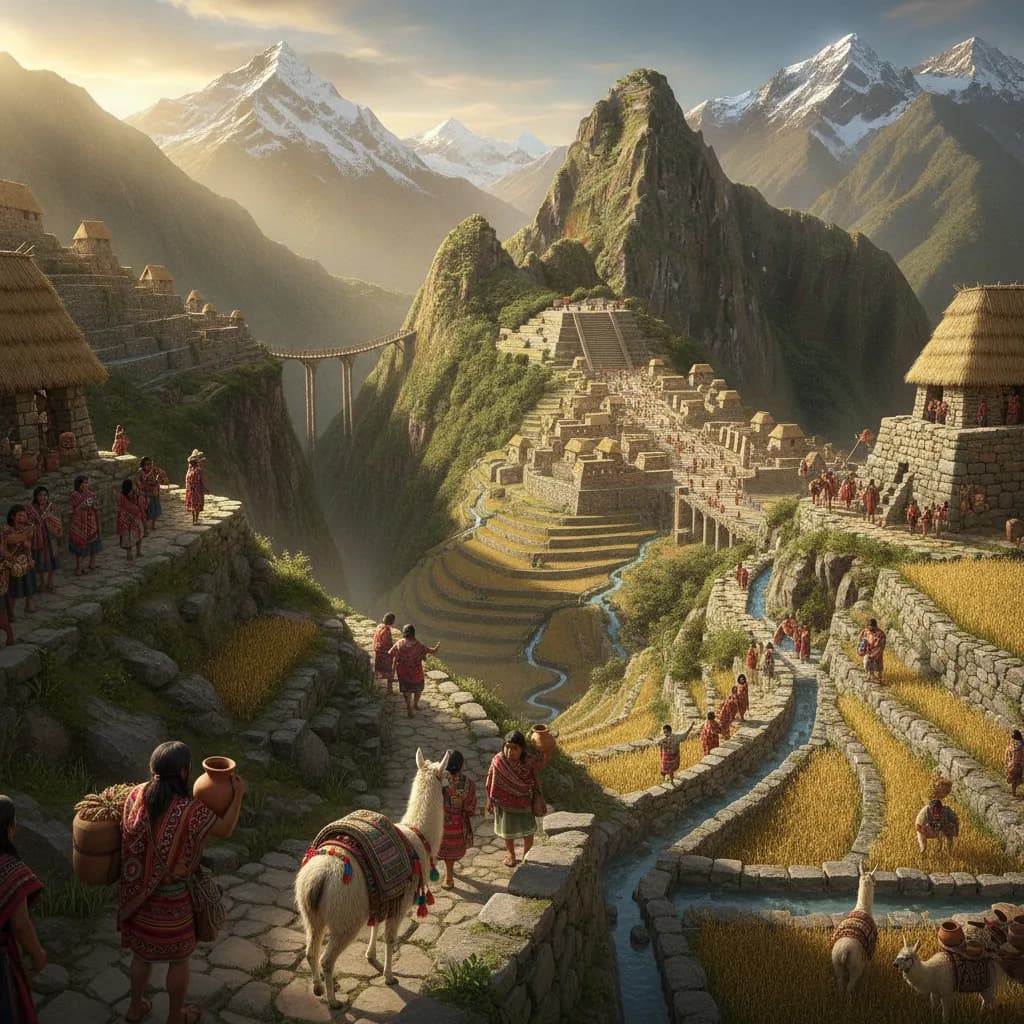
The Qhapaq Ñan, a network of about 40,000 kilometers of roads, included stone paving, suspension bridges made of woven grass, and tunnels. Chasqui runners stationed at relay posts could carry messages across hundreds of miles in a few days. Inca builders fitted massive stones so tightly that mortar was unnecessary, a technique visible in Cusco and at Machu Picchu, a royal estate built around 1450. Terraces and irrigation channels enabled farming on steep slopes, and freeze-dried potatoes (chuño) allowed food to be stored for years.
Civil War and Conquest
Huayna Capac died around 1527, possibly of smallpox that had spread ahead of the Spanish from earlier contacts. His sons Huáscar and Atahualpa fought over succession. Atahualpa had just won when Pizarro arrived with roughly 168 men, horses, and steel weapons. At Cajamarca in November 1532, the Spanish seized Atahualpa after a sudden attack. He offered a room full of gold and silver as ransom, which was paid, but he was executed in 1533. The Spanish exploited divisions among Andean peoples, many of whom resented Inca rule, and took Cusco soon after.
Afterward
Inca resistance continued from Vilcabamba until 1572, when the last ruler, Túpac Amaru, was captured and executed. Spanish rule brought forced labor in silver mines, disease, and cultural disruption, but Quechua remains widely spoken, with millions of speakers today, and Andean traditions persist.
Why People Care
The Inca built one of history's most impressive states with very different tools than Old World empires, showing there is more than one way to run a complex society. Their roads, farming methods, and monuments continue to draw scholars and visitors.
Glossary
- Sapa Inca
- The emperor, regarded as a descendant of the sun god Inti.
- Mit'a
- A labor-tax system in which communities supplied workers for state projects like roads, farming, and mining.
- Quipu
- A set of knotted, colored cords used to store numerical and possibly narrative information.
- Chasqui
- Relay runners who carried messages and goods along the road network.
- Terrace farming
- Building stepped fields on slopes to grow crops like potatoes and maize at altitude.
Go Deeper
More to Explore
- The Qing Dynasty
China's last dynasty was founded by outsiders who conquered the country, then governed it in a distinctly Chinese way for nearly 270 years.
- The Persian Empire
Cyrus the Great conquered a huge swath of the ancient world, then mostly let his new subjects keep their own customs and religions.
- The Aztec Empire
Tenochtitlan, the Aztec capital, sat on an island in a lake and was bigger than most European cities of its day.
- The Byzantine Empire
The Byzantines never called themselves Byzantine; they were simply Romans, for nearly a thousand years after Rome fell.
- The Roman Empire
Rome's roads and aqueducts were built so well that some kept working for over a thousand years afterward.