The Roman Empire
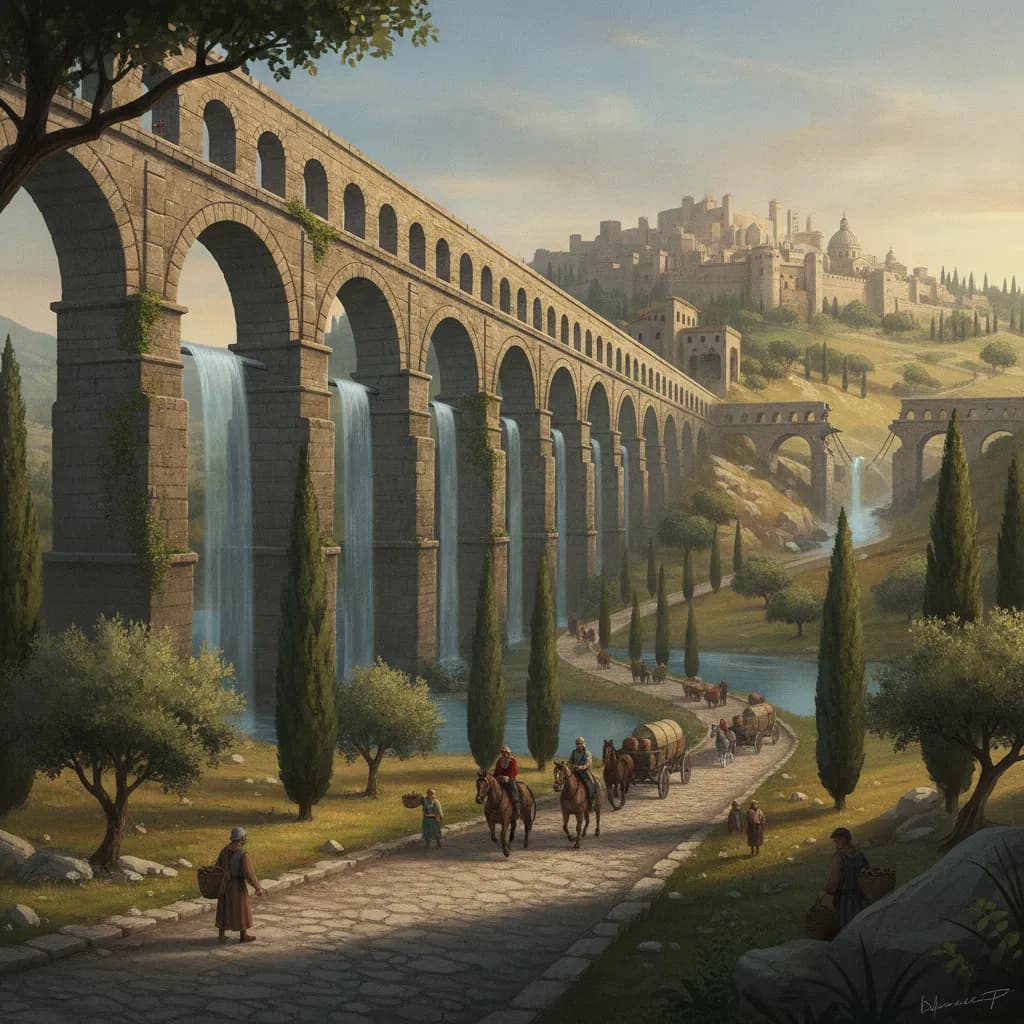
An empire whose roads and aqueducts were engineered so well that some of them were still functioning well over a thousand years after Rome itself had fallen.
Cheat Sheet
- The Roman Empire, at its height, controlled territory spanning from Britain to the Middle East and North Africa, one of the largest and most influential empires in Western history.
- Rome transitioned from a republic to an empire in 27 BCE, when Augustus became its first emperor, ending centuries of republican governance.
- Roman engineering achievements — including roads, aqueducts, and concrete architecture — were so effective that some Roman-built infrastructure remained in use for well over a thousand years afterward.
- Latin, the Roman Empire's official language, forms the direct linguistic ancestor of French, Spanish, Italian, Portuguese, and Romanian, and heavily influenced English vocabulary as well.
- The Western Roman Empire fell in 476 CE, generally attributed to a combination of internal political instability, economic troubles, and repeated invasions by external groups.
- The Eastern half of the empire, later known as the Byzantine Empire, continued for nearly another thousand years after Rome's western half collapsed, until finally falling in 1453.
The 60-Second Version
The Roman Empire, at its height, controlled territory spanning from Britain to the Middle East and North Africa, one of the largest and most influential empires in Western history. Rome transitioned from a republic to an empire in 27 BCE, when Augustus became its first emperor, ending centuries of republican governance. Roman engineering achievements, including roads, aqueducts, and concrete architecture, were so effective that some Roman-built infrastructure remained in use for well over a thousand years afterward. Latin, the Roman Empire's official language, forms the direct linguistic ancestor of French, Spanish, Italian, Portuguese, and Romanian, and heavily influenced English vocabulary as well. The Western Roman Empire fell in 476 CE, generally attributed to a combination of internal political instability, economic troubles, and repeated invasions by external groups. The Eastern half of the empire, later known as the Byzantine Empire, continued for nearly another thousand years after Rome's western half collapsed, until finally falling in 1453.
The Long Version
From Republic to Empire
For centuries, Rome operated as a republic governed by elected officials and a powerful senate, but escalating political instability and civil conflict eventually led to Augustus's rise as Rome's first emperor in 27 BCE, marking a permanent transition from republican governance to centralized imperial rule that would define Rome for the following several centuries.
An Empire of Enormous Scale
At its greatest territorial extent, the Roman Empire spanned an extraordinary range of geography and culture, stretching from Britain in the northwest to the Middle East in the east and across North Africa in the south, unified under a shared system of law, administration, and, at least initially, Roman citizenship, an empire of a scale rarely matched in Western history.
Engineering That Outlasted the Empire Itself
Roman engineers built an extensive network of roads, aqueducts, and durable concrete structures so well-constructed that a number of them remained functional for well over a thousand years after the empire's political collapse, a lasting practical testament to Roman engineering skill that considerably outlived Roman political power itself.
Fall in the West, Survival in the East
The Western Roman Empire ultimately collapsed in 476 CE, a decline generally attributed to a combination of chronic internal political instability, economic strain, and repeated invasions by external groups pressing on Rome's borders. Notably, however, the empire's eastern half, which would come to be known as the Byzantine Empire, survived for nearly another thousand years beyond the west's collapse, finally falling only in 1453.
Ad slot (placeholder — set NEXT_PUBLIC_ADSENSE_SLOT_ID once an ad unit is created)
Glossary
- Augustus
- The first Roman emperor, whose rise to power in 27 BCE marked the transition from republic to empire.
- Aqueduct
- A Roman engineering structure used to transport water over long distances, some of which remained functional for centuries.
- Pax Romana
- A roughly 200-year period of relative peace and stability across the Roman Empire, beginning with Augustus's reign.
- Byzantine Empire
- The Eastern continuation of the Roman Empire, which survived nearly a thousand years after Rome's western half fell.
- Latin
- The Roman Empire's official language, the direct linguistic ancestor of French, Spanish, Italian, Portuguese, and Romanian.