Sculpture Basics
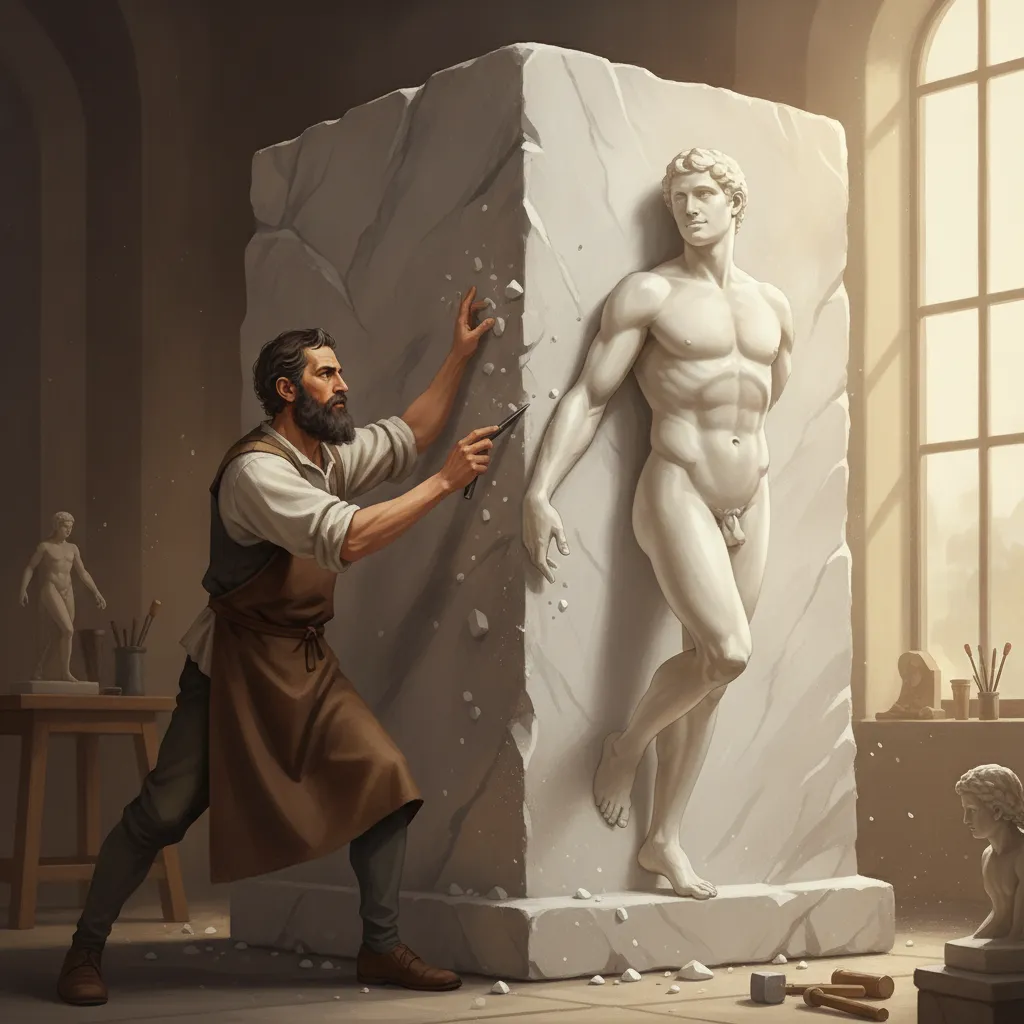
Michelangelo called carving a way of freeing a figure already inside the stone, a view that only fits sculpture made by taking material away.
By Greg Goodwin · Published October 3, 2026 · Updated October 24, 2026
Cheat Sheet
- Sculpture is broadly created through two opposite processes: subtractive (carving away material, as with stone or wood) and additive (building up material, as with clay or welded metal).
- Casting, often using the 'lost-wax' method dating back thousands of years, allows a sculpture to be reproduced in materials like bronze from an original model.
- 'In the round' describes a freestanding sculpture viewable from all sides, distinct from 'relief' sculpture, which projects from a flat background and is viewed primarily from one angle.
- Michelangelo famously described carving as 'freeing' a figure already present within the stone, a philosophy specific to subtractive sculpture rather than additive methods.
- Contemporary sculpture has expanded well beyond traditional materials to include found objects, industrial materials, light, and even digital or kinetic (moving) elements.
- Public monumental sculpture carries distinct technical and logistical demands — scale, structural engineering, and weather durability — beyond those of gallery-scale work.
The 60-Second Version
Sculpture is broadly created through two essentially opposite processes: subtractive methods, which carve away material from a solid block as with stone or wood, and additive methods, which build up a form from material as with clay modeling or welded metalwork. A third major approach, casting, often relies on the ancient lost-wax method, dating back thousands of years, which allows a sculpture to be reproduced in a durable material like bronze starting from an original wax or clay model. Sculptors and art historians also distinguish works by how they're meant to be viewed: "in the round" describes a freestanding sculpture viewable from every side, while "relief" sculpture projects from a flat background and is primarily viewed from one angle, functioning almost like three-dimensional painting. Michelangelo's famous description of carving as "freeing" a figure already present within the stone speaks specifically to the subtractive process, a philosophy that doesn't carry over to additive methods, where the form is built up from nothing rather than revealed from within existing material. Contemporary sculpture has expanded well beyond these traditional materials and methods to include found objects, industrial materials, light installations, and even digital or kinetic elements that move or respond to their environment. Public monumental sculpture, meanwhile, carries distinct technical and logistical demands that gallery-scale work simply doesn't face, including structural engineering for scale and genuine weather durability over decades of outdoor exposure.
The Long Version
Two Opposite Ways to Make a Form
Sculpture is broadly created through two essentially opposite processes: subtractive methods, which carve away material from a solid block as with stone or wood, removing everything that isn't the final form, and additive methods, which build up a form from material as with clay modeling or welded metalwork, constructing the final shape piece by piece from nothing.
Reproducing a Sculpture Through Casting
A third major approach, casting, often relies on the ancient lost-wax method, a technique dating back thousands of years that allows a sculpture to be reproduced in a durable material like bronze starting from an original wax or clay model, a process that's made it possible to create multiple authorized copies of a single sculptural work.
How a Sculpture Is Meant to Be Seen
Sculptors and art historians also distinguish works by how they're meant to be viewed: "in the round" describes a freestanding sculpture viewable from every side, requiring a sculptor to consider the composition from every angle, while "relief" sculpture projects from a flat background and is primarily viewed from one angle, functioning almost like three-dimensional painting rather than a fully freestanding object.
Freeing the Figure Within
Michelangelo's famous description of carving as "freeing" a figure already present within the stone speaks specifically to the subtractive process, a philosophy that doesn't carry over to additive methods, where the sculptor builds the final form up from nothing rather than revealing it from within existing raw material.
Beyond Stone and Bronze
Contemporary sculpture has expanded well beyond these traditional materials and methods to include found objects, industrial materials, light installations, and even digital or kinetic elements that move or respond to their environment. Public monumental sculpture, meanwhile, carries distinct technical and logistical demands that gallery-scale work simply doesn't face, including structural engineering for scale and genuine weather durability over decades of continuous outdoor exposure.
Why People Care
Understanding the fundamental processes behind sculpture, subtractive, additive, and cast, changes how a viewer looks at a finished work, revealing the very different physical and conceptual journey each piece took on its way from raw material to finished form.
Glossary
- Subtractive sculpture
- A sculptural process that removes material from a solid block, as in stone or wood carving.
- Additive sculpture
- A sculptural process that builds up a form from material, as in clay modeling or welded metalwork.
- Lost-wax casting
- An ancient casting technique used to reproduce a sculpture, often in bronze, from an original wax or clay model.
- In the round
- A freestanding sculpture designed to be viewed from all sides, as opposed to relief sculpture viewed from one angle.
- Relief sculpture
- A sculpture that projects from a flat background surface and is primarily viewed from one angle, rather than a freestanding form.
Go Deeper
- The Metropolitan Museum of Art — Sculpture
- Sculpture: Process and Principles, by Rudolf Wittkower
More to Explore
- Cubism
Cubism reportedly got its name from a critic's sneer that the paintings looked like "little cubes," and the insult stuck.
- Surrealism
Surrealists switched off conscious control on purpose, just to see what the unconscious would come up with.
- Street Art
An art form that began explicitly as illegal vandalism and has since had individual pieces sell for millions at major auction houses.
- Photography Basics
Aperture, shutter speed, and ISO trade off against each other, and that exposure triangle explains why photos come out bright, dark, or blurry.
- Impressionism
A style so disliked by critics at launch that its name started as an insult.