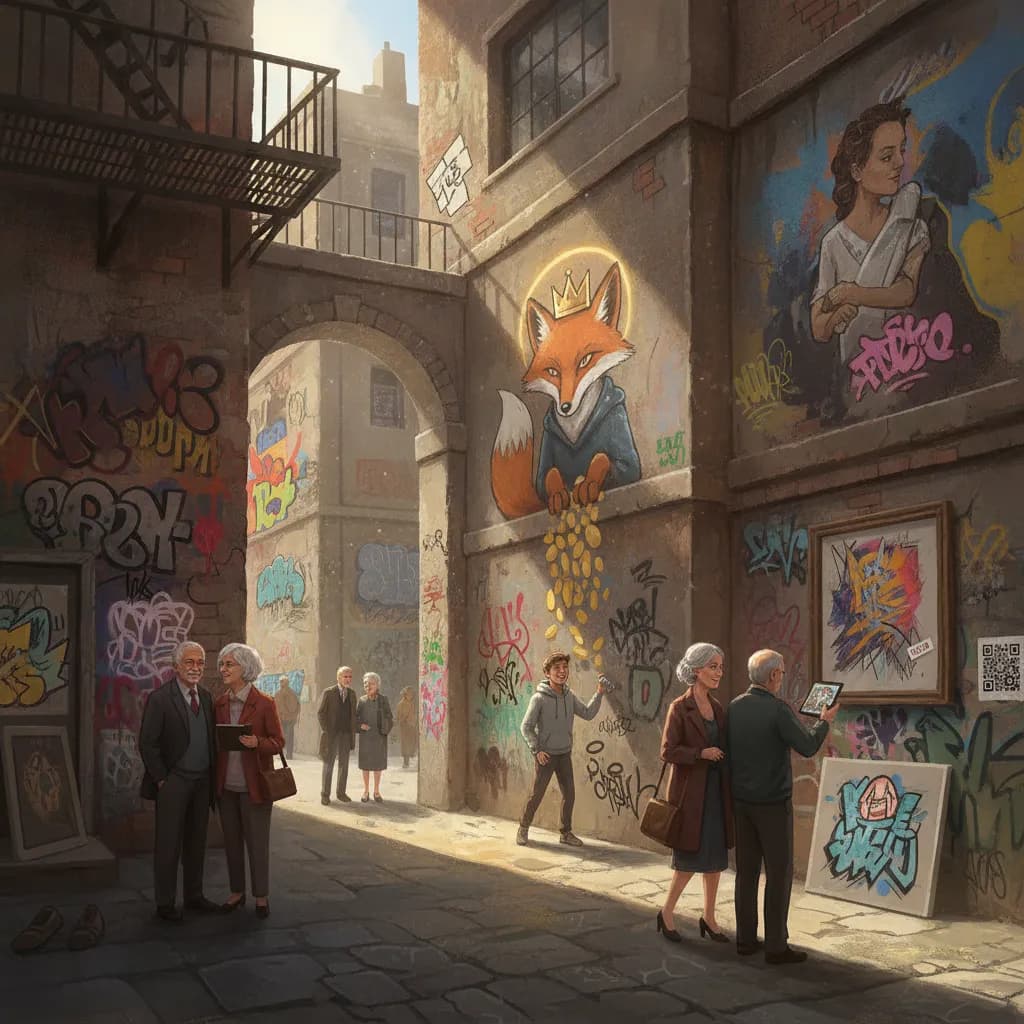
Street Art
An art form that began explicitly as illegal vandalism and has since had individual pieces sell for millions at major auction houses.
Cheat Sheet
- Street art refers to visual art created in public spaces, often without official permission, ranging from simple tags to elaborate murals and large-scale installations.
- Graffiti, one of street art's earliest and most foundational forms, traces its modern roots to 1970s New York City subway culture, closely intertwined with early hip-hop.
- Banksy, an anonymous English street artist, became one of the movement's most internationally famous figures, known for politically charged stencil work and elaborate public stunts.
- Street art occupies a genuinely contested legal and cultural space — often illegal as vandalism, yet increasingly embraced and even commissioned by cities and institutions as legitimate public art.
- Some cities have designated legal walls or organized mural festivals specifically to give street artists a sanctioned outlet, blurring the line between underground and institutional art.
- Street art pieces by famous artists have sold at major auction houses for millions of dollars, a striking shift for an art form that began explicitly outside the traditional gallery system.
The 60-Second Version
Street art refers to visual art created in public spaces, often without official permission, ranging from simple tags to elaborate murals and large-scale installations. Graffiti, one of street art's earliest and most foundational forms, traces its modern roots to 1970s New York City subway culture, closely intertwined with early hip-hop. Banksy, an anonymous English street artist, became one of the movement's most internationally famous figures, known for politically charged stencil work and elaborate public stunts. Street art occupies a genuinely contested legal and cultural space, often illegal as vandalism, yet increasingly embraced and even commissioned by cities and institutions as legitimate public art. Some cities have designated legal walls or organized mural festivals specifically to give street artists a sanctioned outlet, blurring the line between underground and institutional art. Street art pieces by famous artists have sold at major auction houses for millions of dollars, a striking shift for an art form that began explicitly outside the traditional gallery system.
The Long Version
From Subway Tags to Public Art
Modern street art's roots trace back to 1970s New York City, where young artists began "tagging," writing their stylized signatures, on subway cars and public surfaces throughout the city, developing increasingly elaborate lettering and imagery over time. This early graffiti culture developed alongside and closely intertwined with early hip-hop, sharing much of the same youth culture and creative energy before eventually spreading into a global movement encompassing far more than simple tagging.
Banksy and the Politics of Anonymity
Banksy, an anonymous English street artist whose real identity remains publicly unconfirmed, became one of the movement's most internationally recognized figures, known for satirical, politically charged stencil pieces and elaborate public art stunts, including a famous incident where a Banksy piece partially shredded itself immediately after selling at auction, a stunt that only increased the work's fame and value.
Legal Gray Areas and Sanctioned Murals
Street art has always occupied a genuinely contested legal space: creating unauthorized work on someone else's property is typically classified as vandalism and can carry real legal consequences, even as the same style of work is increasingly commissioned by cities, businesses, and cultural institutions as legitimate public art. Many cities now designate specific "legal walls" or host organized mural festivals specifically to give street artists a sanctioned creative outlet, softening, without fully resolving, the tension between the form's rebellious origins and its growing institutional acceptance.
From Vandalism to the Auction House
Perhaps the clearest sign of street art's dramatic cultural repositioning is its growing presence at major fine art auction houses, where pieces by artists like Banksy have sold for millions of dollars, a remarkable outcome for an art form whose earliest practitioners were, by definition, working entirely outside, and often in direct legal conflict with, the traditional gallery and museum system.
Ad slot (placeholder — set NEXT_PUBLIC_ADSENSE_SLOT_ID once an ad unit is created)
Glossary
- Graffiti
- Text or images applied to public surfaces, often illegally, considered one of street art's foundational forms.
- Tag
- A stylized signature or moniker, one of the simplest and most common forms of graffiti.
- Stencil art
- A street art technique using a cut template to quickly and repeatedly apply a consistent image, closely associated with Banksy.
- Mural
- A large-scale artwork painted directly onto a wall or other permanent public surface.
- Legal wall
- A public wall officially designated for street art, allowing artists to work without risk of vandalism charges.
Go Deeper
- Museum of Graffiti
- "Wall and Piece" by Banksy